|

GBP/USD analysis: May's Brexit strategy keeps capping the upside

GBP/USD Current price: 1.3266

  • UK data disappointed big, adding to concerns of the local economy.
  • UK politicians' resignations continue in protest against PM May´s softer Brexit strategy.
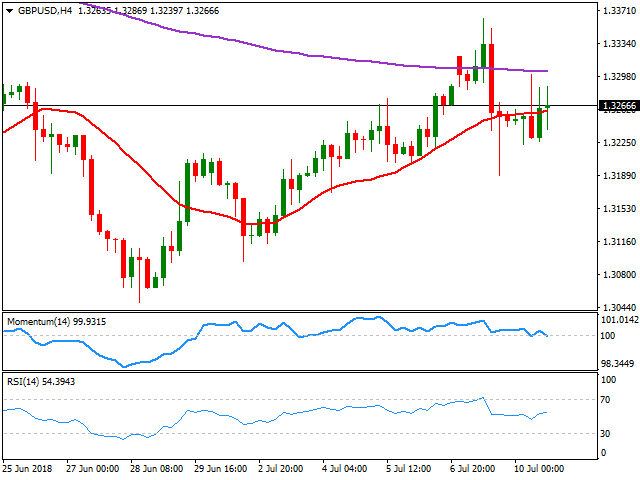
The GBP/USD pair extended its relief rally at the beginning of the day but was unable to hold on to gains, as UK data disappointed, while more politicians resigned in protest at PM May's softer-Brexit plan. UK Industrial Production fell 0.4% in May, against an expected 0.5%, while Manufacturing Production rose by just 0.4% vs. the 0.9% forecasted. The annual figures posted modest advances that fell short from market's expectations.  The Goods Trade Balance posted a wider-than-expected deficit of £12.36B in the same month, while the GBP growth estimate, a new figure that will be released monthly basis from now on, showed that the economy grew by 0.3% in the three-month to May. During the US session, two vice chairs of the Conservative Party, Maria Caulfield, and Ben Bradley, quitted, in protest to PM May's plan.

On Wednesday, the kingdom will release the NIESR GDP estimate for the three months to Jun, while BOE's Governor Carney is scheduled to speak about the global financial crisis at the National Bureau of Economic Research conference, in Boston.

The 4 hours chart for the pair presents a neutral to negative stance, as it met selling interest at around 1.3300, where the pair also has the 200 EMA, and now trades around a flat 20 SMA. In the same chart, technical indicators turned lower, but now lacking directional strength and within neutral levels. The pair has an immediate support around 1.3220, where it bottomed several times during the last few hours, with a break below it, increasing chances for a bearish extension this Wednesday.

Support levels: 1.3220 1.3190 1.3155

Resistance levels: 1.3285 1.3320 1.3365

View Live Chart for the GBP/USD

Author

Valeria Bednarik

Valeria Bednarik was born and lives in Buenos Aires, Argentina. Her passion for math and numbers pushed her into studying economics in her younger years.


More from Valeria Bednarik
Share:

Editor's Picks

AUD/USD stays bid above 0.7100 on Australian trade data, Mideast optimism

AUD/USD clings to minor recovery gains above 0.7100 in the Asian session on Thursday as a new Israel-Lebanon ceasefire keeps a lid on the safe-haven US Dollar. Meanwhile, strong AustralianTrade Balane data also help the Aussie pair sustain the bounce from weekly lows.

USD/JPY trades below 160.00 intervention threshold; bullish bias intact

The USD/JPY pair attracts some sellers during the Asian session amid fears that authorities will step in again to prop up the Japanese Yen. Furthermore, the Israel-Lebanon truce prompts some profit-taking around the US Dollar and exerts downward pressure on the currency pair.

Gold rebounds from one-week low as Israel-Lebanon truce pressures safe-haven USD

Gold gains some positive traction on Thursday and climbs to the $4,475 area during the Asian session, reversing a major part of the previous day's slide to a one-week low. The Israel-Lebanon truce prompts some profit-taking around the US Dollar and supports the commodity. 


Hyperliquid: ETF demand, capital rotation fuel HYPE rally as Bitcoin melts

Hyperliquid price sustains an upward trend near its all-time high of $75.76 on Thursday after posting 80% gains in May, while Bitcoin (BTC) retraces below $65,000, triggering a market-wide panic.

Kevin Warsh takes the Fed helm: What it means for the US Dollar
The Federal Reserve moves away from the highly predictable "forward guidance" model of the Jerome Powell era to a new “Kevin Warsh environment”, characterized by less communication, more policy surprises, and an increased focus on the Fed's complex balance sheet.
Recession on paper: What really moves the Canadian Loonie now?

Statistics Canada handed the headline writers a gift and the analysts a headache. Real GDP shrank 0.1% on an annualized basis in the first quarter, and with the fourth quarter of 2025 revised down to a 1.0% contraction, that is two negative quarters in a row, the textbook definition of a technical recession and Canada's first since the pandemic.