|

GBP/USD analysis: giving back gains at a fast pace

GBP/USD Current price: 1.2592

  • Sterling collapse on risk aversion and in spite of solid manufacturing growth in the UK.
  • Brexit uncertainty is still the highest risk factor for the Pound.
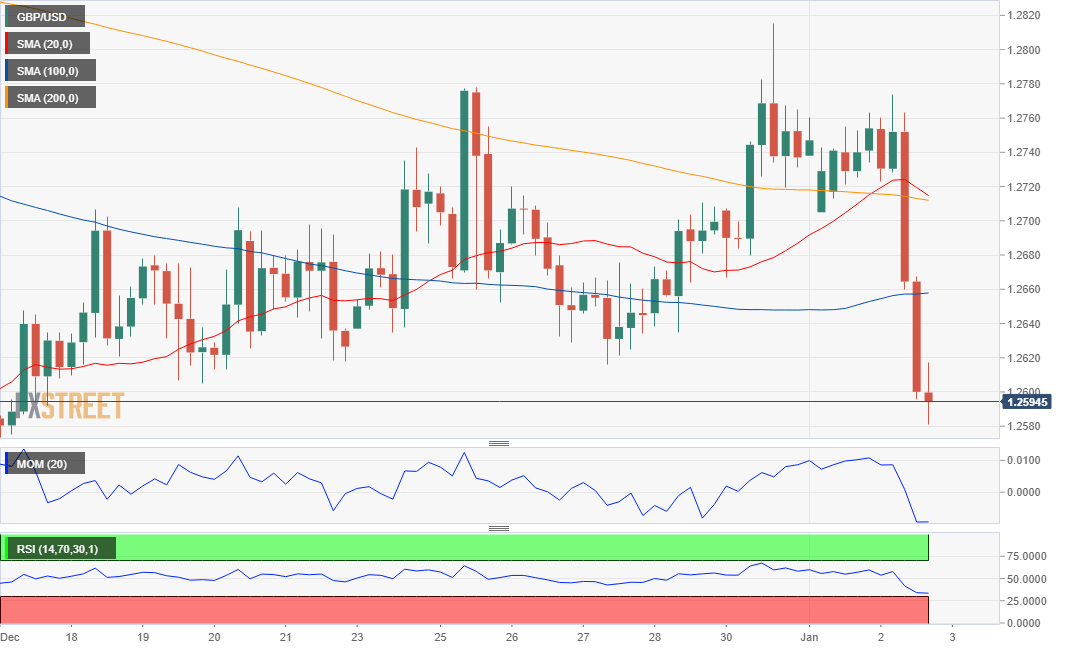
The Sterling was among the worst performers this Wednesday, losing the 1.2600 mark against its American rival. Despite a solid UK Markit Manufacturing PMI, which came in at 54.2 for December, surpassing the previous reading and beating expectations, the pair collapsed on prevalent risk aversion, coupled with Brexit uncertainty. The pair traded as low as 1.2580, settling around the 1.2600 figure late US session. In the Brexit form, opposition Labour wants its leader, Jeremy Corbyn to back a second Brexit referendum, although PM May's had clearly stated that there won't be another people's vote. Corbyn is reluctant to call for another referendum but rather prefers to call for a general election in the hopes he will replace Mrs. May. The Brexit deal will go into the Parliament for approval later this month. This Thursday, the IHS Markit will publish the UK Construction PMI  foreseen at 52.9 vs. the previous 53.4.

Technically, the pair is at its lowest in over two weeks, bearish short-term, given that, in the 4 hours chart, it's back below its moving averages, with the 200 EMA turning lower at 1.2730 and the 20 SMA doing the same near 1.2680. The Momentum indicator in the mentioned chart heads lower in negative territory and at its lowest in over three weeks, while the RSI is trying to stabilize around 36, all of which keeps the risk leaned to the downside. The pair has given back the ground added in the previous two weeks, reflecting how concerned investors are on Brexit and how willing are to resume selling Pound at the slightest sign against it.

Support levels: 1.2580 1.2540 1.2510

Resistance levels: 1.2610 1.2650 1.2685

View Live Chart for the GBP/USD

Author

Valeria Bednarik

Valeria Bednarik was born and lives in Buenos Aires, Argentina. Her passion for math and numbers pushed her into studying economics in her younger years.


More from Valeria Bednarik
Share:

Markets move fast. We move first.

Orange Juice Newsletter brings you expert driven insights - not headlines. Every day on your inbox.

By subscribing you agree to our Terms and conditions.

Editor's Picks

EUR/USD bounces toward 1.1750 as US Dollar loses strength

EUR/USD returned to the 1.1750 price zone in the American session on Friday, despite falling Wall Street, which indicates risk aversion. Trading conditions remain thin following the New Year holiday and ahead of the weekend, with the focus shifting to US employment and European data scheduled for next week.

GBP/USD nears 1.3500, holds within familiar levels

After testing 1.3400 on the last day of 2025, GBP/USD managed to stage a rebound. Nevertheless, the pair finds it difficult to gather momentum and trades with modest intraday gains at around 1.3490 as market participants remain in holiday mood.

Gold trims intraday gains, approaches $4,300

Gold retreated sharply from the $4,400  area and trades flat for the day in the $4,320 price zone. Choppy trading conditions exacerbated the intraday decline, although XAU/USD bearish case is out of the picture, considering growing expectations for a dovish Fed and persistent geopolitical tensions.

Cardano gains early New Year momentum, bulls target falling wedge breakout

Cardano kicks off the New Year on a positive note and is extending gains, trading above $0.36 at the time of writing on Friday. Improving on-chain and derivatives data point to growing bullish interest, while the technical outlook keeps an upside breakout in focus.

Economic outlook 2026-2027 in advanced countries: Solidity test

After a year marked by global economic resilience and ending on a note of optimism, 2026 looks promising and could be a year of solid economic performance. In our baseline scenario, we expect most of the supportive factors at work in 2025 to continue to play a role in 2026.

Crypto market outlook for 2026

Year 2025 was volatile, as crypto often is.  Among positive catalysts were favourable regulatory changes in the U.S., rise of Digital Asset Treasuries (DAT), adoption of AI and tokenization of Real-World-Assets (RWA).