|

GBP/USD analysis: dollar's sell-off saved Pound, for now

GBP/USD Current price: 1.3130

  • Brexit woes and poor data that dent chances of an August hike undermined the Sterling.
  • Pound still among the weakest currencies, little room for advances on self-strength.
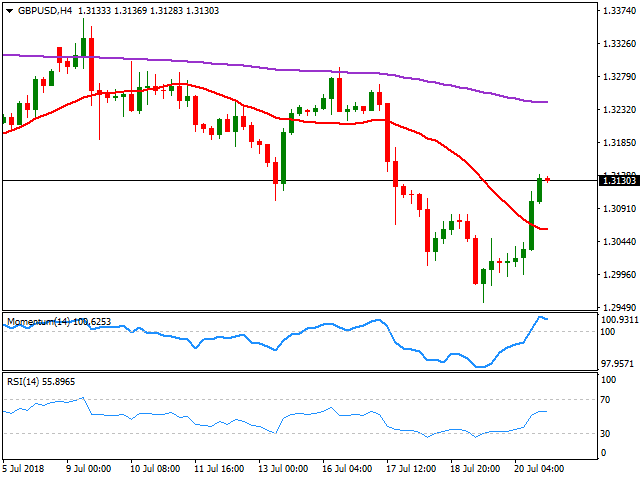
Dollar's weakness rescued the Pound, as the GBP/USD pair continued recovering ground from the yearly low of 1.2957 achieved last week. The pair settled at 1.3130, ending the week anyway in the red, as easing inflation and poor retail sales dented chances of an August rate hike in the UK. The Sterling was already under pressure amid Brexit woes, as the so-long awaited government plan was a major disappointment for Brexiteers, and resulted in several of May's ministers quitting. Despite the recovery, the GBP remains among the weakest currencies, lacking strength of its own, and any future advance will depend mostly on dollar's weakness, while negative headlines from the UK will likely exacerbate shorts. The daily chart indicates that bears are still in control of the pair, as the latest recovery stalled below its 20 DMA, while technical indicators have managed to recover some ground, but remain in negative territory. In the 4 hours chart, the pair settled above a sharply bearish 20 SMA, still some 150 pips below the 200 EMA, while technical indicators stand well above their midlines, but lost their upward strength. The pair could continue advancing on a break above 1.3155, the immediate resistance, although the first line of sellers should appear around the 1.3200 figure. Renewed selling pressure below the 1.3100 level, on the other hand, will likely favor additional declines for this Monday, toward the key 1.3000 psychological threshold.

Support levels: 1.3100 1.3065 1.3030

Resistance levels: 1.3155  1.3195 1.3240

View Live Chart for the GBP/USD

Author

Valeria Bednarik

Valeria Bednarik was born and lives in Buenos Aires, Argentina. Her passion for math and numbers pushed her into studying economics in her younger years.


More from Valeria Bednarik
Share:

Editor's Picks

AUD/USD falls to near 0.7100 after slipping below 50-day EMA

AUD/USD depreciates after registering minor gains in the previous day, trading around 0.7120 during the Asian hours. The technical analysis of the daily chart shows the pair consolidating sideways within a rectangle pattern, as neither bulls nor bears gain control. The AUD/USD pair is holding a slight bearish tone however as it sits beneath both the nine-day and 50-day EMAs.

Japanese Yen edges up but remains close to the 160.00 intervention threshold

The Japanese Yen edges up against the US Dollar on Friday, but the USD/JPY pair remains above 159.90 at the time of writing, unable to put a significant distance from the 160.00 level, considered the limit of tolerable JPY weakness for Japanese authorities.

Gold returns to the red, awaits US NFP

Gold price is looking to test the weekly lows, while in the red near $4,450 in the early European session on Friday. The precious metal remains vulnerable amid ongoing geopolitical turmoil. Traders will closely monitor the developments surrounding the US-Iran peace deal and the US May employment report later on Friday.


Indian Rupee jumps as RBI holds, but unveils measures to boost foreign inflows

The Reserve Bank of India held the Repo Rate at 5.25%, as widely expected, on Friday. But the central bank unveiled various measures to boost foreign inflows into the economy, lifting the Indian Rupee against the US Dollar.

Top 3 Price Prediction: Bitcoin eyes $60,000, Ethereum risks $1,750, XRP could test $1

Bitcoin, Ethereum, and Ripple prices edge lower on Friday, extending a steady decline of roughly 15% so far this week. Institutional outflows weigh on Bitcoin and Ethereum while XRP largely follows the broader market trend.

Recession on paper: What really moves the Canadian Loonie now?

Statistics Canada handed the headline writers a gift and the analysts a headache. Real GDP shrank 0.1% on an annualized basis in the first quarter, and with the fourth quarter of 2025 revised down to a 1.0% contraction, that is two negative quarters in a row, the textbook definition of a technical recession and Canada's first since the pandemic.















