|

GBP/USD analysis: Brexit headlines keep denting bulls' interest

GBP/USD Current price: 1.3101

  • Pound eases on mounting concerns about a no-deal Brexit.
  • USD recovery tepid, as investors fear escalating trade war, political tensions in the US.
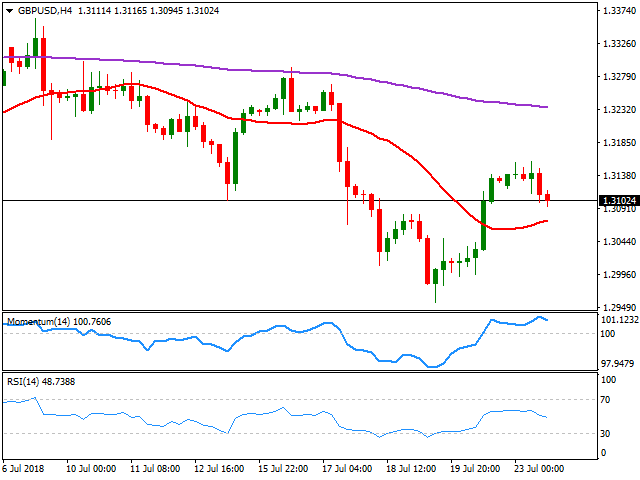
Following a modest uptick in early Asian opening, the GBP/USD pair stabilized in the 1.3140/50 region, to lose ground during US trading hours, amid a broad dollar's recovery, which helped it finish the day with gains against most of its major rivals, and another round of negative Brexit headlines. After ruling out a second Brexit referendum, PM May said that the government is stepping up preparations for a no-deal Brexit, although they are also working hard to avoid it. Jeremy Hunt the new Brexit Secretary said that the EU is to blame if the UK leaves the bloc with no deal. He said that “there is now a very real threat of a Brexit no deal by accident, and this is because many people in the EU are thinking that they just have to wait long enough and Britain will blink”. German Foreign Minister, Maas, quickly responded to such assertion saying that "when it comes to Brexit, there is now a very real risk of a Brexit no-deal by accident,” and that efforts are focused on achieving an ordered Brexit. The GBP/USD pair settled mid-US afternoon around 1.3100, retreating from a 4-day high of 1.3157 but held at the upper end of Friday's range. Technically, the 4 hours chart shows that it's still holding above a mild bullish 20 SMA, but also that technical indicators retreated after a period of consolidation, with the RSI indicator entering negative territory, supporting additional declines ahead on a break below 1.3080 where the pair topped a couple of times last week and is now the immediate support.

 Support levels: 1.3080 1.3035 1.3000

Resistance levels: 1.3155  1.3195 1.3240

View Live Chart for the GBP/USD

Author

Valeria Bednarik

Valeria Bednarik was born and lives in Buenos Aires, Argentina. Her passion for math and numbers pushed her into studying economics in her younger years.


More from Valeria Bednarik
Share:

Editor's Picks

AUD/USD falls to near 0.7100 after slipping below 50-day EMA

AUD/USD depreciates after registering minor gains in the previous day, trading around 0.7120 during the Asian hours. The technical analysis of the daily chart shows the pair consolidating sideways within a rectangle pattern, as neither bulls nor bears gain control. The AUD/USD pair is holding a slight bearish tone however as it sits beneath both the nine-day and 50-day EMAs.

Japanese Yen edges up but remains close to the 160.00 intervention threshold

The Japanese Yen edges up against the US Dollar on Friday, but the USD/JPY pair remains above 159.90 at the time of writing, unable to put a significant distance from the 160.00 level, considered the limit of tolerable JPY weakness for Japanese authorities.

Gold returns to the red, awaits US NFP

Gold price is looking to test the weekly lows, while in the red near $4,450 in the early European session on Friday. The precious metal remains vulnerable amid ongoing geopolitical turmoil. Traders will closely monitor the developments surrounding the US-Iran peace deal and the US May employment report later on Friday.


Arthur Hayes' “Holy Trinity” is dead: Exits Zcash after Orchard Pool exploit

Arthur Hayes has entirely dumped his “Holy Trinity” holdings by offloading his Zcash holdings on Friday. The privacy coin is down 13% so far on Friday, extending Thursday’s 26% decline after an Orchard Shielded Pool audit revealed a critical vulnerability that allowed the undetectable minting of fake coins. Hayes continues to hold Worldcoin ahead of the upcoming SpaceX Initial Public Offering, on the chance of a “high-beta proxy” rally.

Nonfarm Payrolls set to show stable labor market in May as markets digest Fed hawkish shift

The United States Bureau of Labor Statistics will release the Nonfarm Payrolls data for May on Friday at 12:30 GMT. Investors expect NFP to rise by 85K following the surprisingly strong 185K and 115K increases recorded in March and April, respectively.

The US economy defies the rules: 100 days into the Oil shock and the recession signal is still missing

More than three months after the start of the Iran war and the resulting disruption to global energy markets, the US economy continues to display remarkable resilience. The conflict has triggered a sharp rise in Oil prices, reignited inflationary pressures and fueled widespread concerns about a potential economic slowdown.















