|

GBP/JPY: Bulls and bears battle for control

  • GBP/JPY stabilizes its decline at the bottom of a bullish channel.
  • Short-term signals reveal some improvement in sentiment.
  • A bullish outlook could emerge above 210.70.

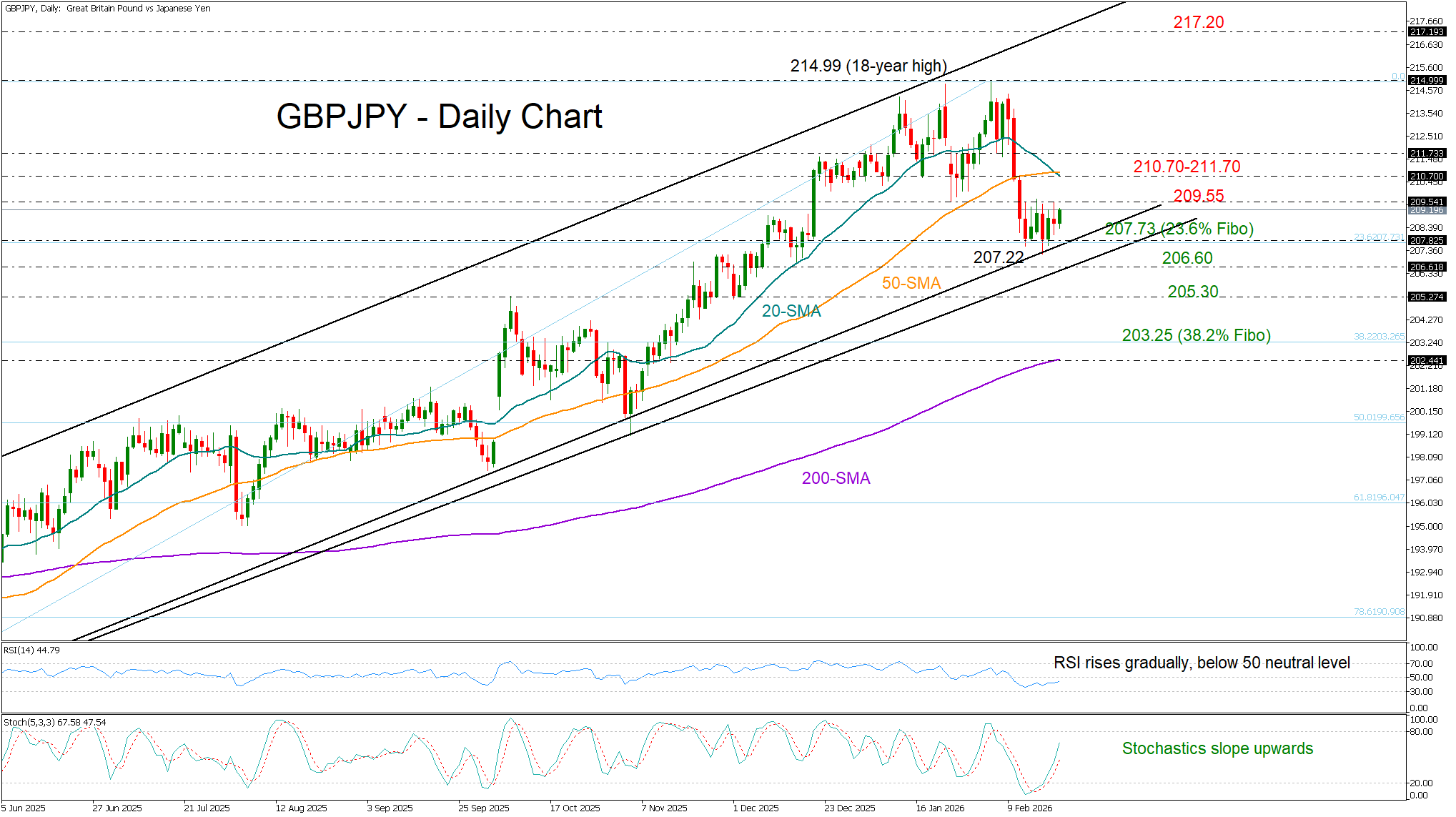
GBP/JPY is set to complete the week on the sidelines, consolidating February’s aggressive decline from 214.99 near a two-month low of 207.22, as Japan’s Prime Minister seeks the right elixir to achieve her pledged stimulative Abenomics-style policy while simultaneously easing the ballooning government debt.

In technical news, the pair appears to be trading near a critical support region, around the 23.6% Fibonacci retracement of the almost one-year-old upleg at 207.73 and at the lower band of a bullish channel. Strikingly, the weekly sideways pattern seems to be taking the shape of an inverse head and shoulders formation on the four-hour chart, with a neckline at 209.55, providing some optimism that the next move in price could be to the upside.

Still, the bar for a positive outlook remains higher, above the 20- and 50-day simple moving averages (SMAs), which are printing a bearish crossover near 210.70. A successful move higher beyond the 211.70 barrier could help the pair reach February’s ceiling around the 18-year high of 214.99.

In the event of a bearish breakout below the trendline zone of 206.60–207.73, selling pressure may accelerate toward the 205.30 constraining zone. Another failure there could trigger a steeper decline toward the 38.2% Fibonacci retracement at 203.25 and closer to the 200-day SMA, currently at 202.45.

Overall, GBP/JPY appears to be standing at a pivot point. While there are some bullish signals in the market, the pair must rebound above 210.70 to attract fresh buying interest.

Author

Christina Parthenidou

Christina joined Trading Point in May 2017. She holds a master degree in Economics and Business from the Erasmus University Rotterdam with a specialization in International economics.


More from Christina Parthenidou
Share:

Editor's Picks

GBP/USD drops to 1.3200 region as UK PM Starmer resigns

GBP/USD has come under renewed selling pressure in the European session on Monday, falling back to the 1.3200 region. UK PM Keir Starmer announced that he will resign and noted that nominations for new contender will open on July 9.

EUR/USD turns south toward 1.1400 amid concerns over Iran deal progress

EUR/USD turns south toward 1.1400 in the European trading hours on Monday. Concerns about progress for the US-Iran peace deal and expectations of higher US interest rates keep the US Dollar supported against the Euro. ECB President Lagarde is set to speak later on Monday.  

Gold lacks bullish conviction near $4,200 as Fed hike bets and Iran risks underpin USD

Gold maintains its bid tone near the $4,200 mark through the first half of the European session, and seems to have snapped a three-day losing streak, to a more than one-week low set the previous day. Crude Oil prices turn lower after mediators – Qatar and Pakistan – announced a formal 60-day roadmap aimed at securing a final US-Iran peace deal.

Breaking: Iran closes the Strait of Hormuz amid ceasefire deal violation
Iran says it is closing the Strait of Hormuz after accusing the United States (US) and Israel of violating the ceasefire. According to Iran, the decision came over the continued Israeli strikes in Lebanon. The Iranian Revolutionary Guard Corps Navy issued a warning to all vessels: "Do not approach the Strait of Hormuz; otherwise, your security will be jeopardized."
Canada CPI Preview: Inflation expected to tick higher in May, pressuring BoC outlook

The publication of Canada’s May Consumer Price Index figures on Monday will be the focus of attention. Indeed, Statistics Canada data will provide markets with an update on price pressures following its June 10 meeting, where policymakers kept the interest rate steady at 2.25%, matching the broad consensus.

Regime change: Inside Kevin Warsh's first move to make the Fed unreadable on purpose

The rate did not move. That was the least interesting thing about Kevin Warsh's first meeting in charge of the Fed. The FOMC held its benchmark at 3.50%-3.75% for the fourth straight meeting, exactly as priced, and then the new chair used his first press conference to dismantle the machinery the market has leaned on for a decade.