Federal Reserve Chairman Powell Testifies before Congress Preview: Pleased but wary
- US economy continues to host a solid expansion
- Manufacturing slowdown from last year appears to be ending
- Labor market providing more jobs than new entrants to workforce

Federal Reserve Chairman Jerome Powell will testify before the House Committee on Financial Services in the Fed’s Semiannual Monetary Policy Report to Congress on Tuesday February 10th at 10:00am EST, 15:00 GMT and before the Senate Banking, Housing and Urban Affairs Committee on Wednesday February 11th at 10:00 EST 15:00 GMT.
The Federal Reserve will present its monetary policy review to Congress this week, observing that some of the risks that prompted three rate cuts last year had declined but that the economic ramifications of the health crisis in China has created new concerns.
“Downside risks to the U.S. outlook seem to have receded in the latter part of the year, as the conflicts over trade policy diminished somewhat, economic growth abroad showed signs of stabilizing, and financial conditions eased. More recently, possible spillovers from the effects of the coronavirus in China have presented a new risk to the outlook,” said the official report which is posted on the Fed website. “The likelihood of a recession occurring over the next year has fallen noticeably in recent months.”
Chairman Powell will deliver the report to Congress, testify and answer questions from legislators as mandated by law.
Federal Reserve governors have reasons to be pleased with the economy and the results of their 0.75% in rate reductions.
The economy grew at a 2.1% annualized rate in the second half and 2.3% for 12 months in the 11th year of expansion which is the longest on record.
American firms added 225,000 jobs in January. Job creation averaged 176,000 new positions per month in 2019, more than enough to provide work to the 125,000 to 150,000 entrants to the labor market and keep moderate upward pressure on wages. Average annual hourly earnings have increases at 3% or more for 18 straight months.
Non-Farm Payrolls
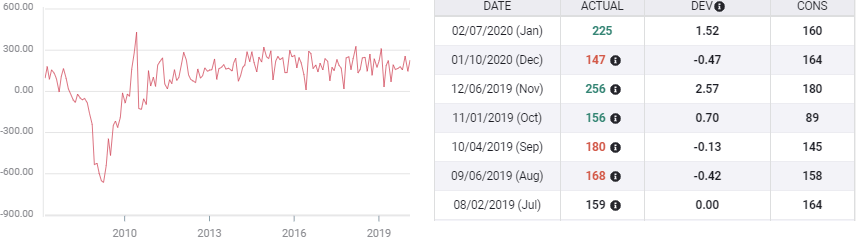
Unemployment rose slightly in January to 3.6% but the 3.5% rate in in September and November was a half-century low and African-American and Hispanic jobless level reached all-time record lows in the last six months. The labor force participation rate rose to 63.4% as more people joined the work force from unemployment.
While inflation continued to run below the Fed’s 2% target at 1.6% in the core PCE in December inflation expectations for businesses and consumers are stable.
Equities are buoyant with the Dow, S&P 500 and the Nasdaq reaching new records this year. Markets are betting that the US-China trade pact will spur growth in the world’s two largest economies and in turn globally.
Even the US manufacturing sector purchasing managers’ index which dropped into contraction in August from trade tensions with China and Boeing's problems with the 737 MAX jet, unexpectedly recovered in January and the new orders index there and for service sector moved higher last month.
ISM Manufacturing PMI
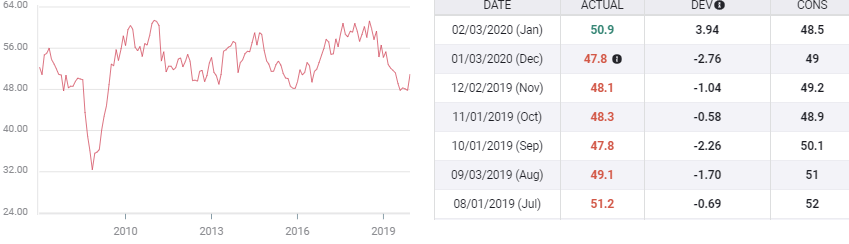
Last year’s decline in manufacturing raised fears that it could herald a general recession, but the Fed disagrees. “In general, a decline in manufacturing similar to that in 2019 would not be large enough to initiate a major downturn for the economy,” commented the policy report.
The policy report repeats the central bank judgement from the January FOMC statement that the level of the fed funds rate between 1.5% and 1.75% was “appropriate to support sustained expansion of economic activity, strong labor market conditions, and inflation returning to the Committee’s symmetric 2 percent objective.”
Items for note in Chairman Powell’s testimony
- The January FOMC statement and the Monetary Policy Report described US economic growth as “moderate.” A stronger characterization by the Chairman will redound to equities and the dollar.
- Mr. Powell will be circumspect on the coronavirus but questioning could excite the safe-haven trade to the dollar.
- Positive comment on the economic potential of the US-China trade pact will play to the US and the dollar
- Legislators will likely question the Chairman on the recent turmoil in the short-term funding markets and the steps the Fed has taken promote calm
The 71-page Monetary Policy Report was posted on the Federal Reserve website on Friday and can be found there.
Author

Joseph Trevisani
FXStreet
Joseph Trevisani began his thirty-year career in the financial markets at Credit Suisse in New York and Singapore where he worked for 12 years as an interbank currency trader and trading desk manager.
















