Fed will lower the capital big banks have to hold against a crisis


Outlook
Today, the data will be overshadowed by the institutional (Fed). We get May goods trade balance, probably a continuation of preemptive buying. We also get durables, okay in headline but ex-aircraft and defense, probably soft. The revision to Q1 GDP is too rear-view mirror now. Jobless claims could start to be interesting. The biggie is tomorrow’s PCE deflator, covered earlier this week.
For today, though: it was always going to happen: as the WSJ and other report, ,, since he can’t fire him and Powell has another 11 months to go. This is dollar-negative, of course. Oh, yes, and the Fed will lower the capital big banks have to hold against a crisis. Weakening firewalls is so confidence-supportive.
Reuters points out that this latest insult has resulted in the dollar down over 10% ytd as the 6-month end approaches next week. It’s the worst 6-month performance since 1991, and the worst first half since the start of the floating exchange rate era 52 years ago.
Trump wanted a weak dollar to boost exports. Well, he got it and will be blamed for the way he got it.
The CME Fed funds probabilities shifted a little on the story. The outlook for the July cut is unchanged at 24.8%. But the probability of a Sept cut rose to 70% from 68.1 the day before and 56.3 a week before.
Even if we get as many as three higher inflation readings by the Sept 17 meeting, as seems likely, the Sept rate cut bet is not off. This is a serious Fed credibility-buster.
Forecast
We worried that the anti-dollar rally had gone so far that a pullback was to be expected and a sideways move was in store. We named 1.1450 as a realistic target for a pullback. We should have known better—tigers and stripes. It was always in the cards that Trump would pull some macho BS stunt to bring down more hail on the dollar’s head.
However, it’s still true that the dollar is oversold and we have Friday coming up plus a US holiday next week, and history tells us that traders retreat from bold speculation under those conditions. Plus the usual month-end, quarter-end and half-year end. Don’t be greedy while holding in your head at the same time that whatever Trump says next is not going to be dollar-friendly.
Tidbit: Foreign direct investment is another casualty of Trump’s “policies.” He claims trillions coming from Middle East countries, and that may end up being true, but in the meanwhile, FDI is already down.
Reuters reports Q1 FDI “actually fell to $52.8 billion, the lowest total since the fourth quarter of 2022. That's well below the quarterly averages of the past 10 and 20 years.”
And consider that Europe, among the hardest hit by Trump, “is by far the largest provider of U.S. FDI, accounting for 45% of the total in 2023, according to Citi. The combination of the continent's German-led fiscal splurge, U.S. tariffs and 'de-dollarization' concerns could easily crimp that flow, perhaps significantly.”
FDI is small compared to flows into stocks and bonds, but the US is always proud of attracting more capital than any other country, even China at its height. The data is always terribly slow, but in 2023, it got 25% of total world FDI. The source is the IMF.
Another way to measure is by FDI per GDP. Here is the World Bank definition: “Foreign direct investment are the net inflows of investment to acquire a lasting management interest (10 percent or more of voting stock) in an enterprise operating in an economy other than that of the investor. It is the sum of equity capital, reinvestment of earnings, other long-term capital, and short-term capital as shown in the balance of payments. This series shows net inflows (new investment inflows less disinvestment) in the reporting economy from foreign investors, and is divided by GDP.”
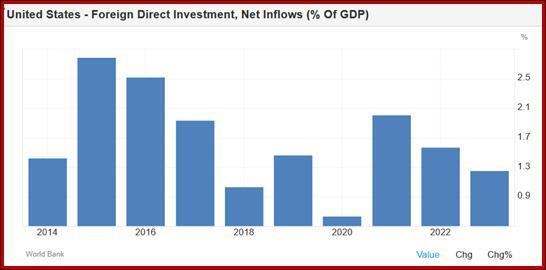
So, a hard to measure inflow divided by a squirrelly measure of total output. Hence, a pretty lousy number. But a measure all the same of the trustworthiness and credibility of a country’s assets and government. Notice the trend is downward over 10 years. If the US imposes a tax on remittance of returns, the downward trend can only accelerate. This is slow-moving and not very good data in the first place, but we should expect a rush to the exit if that tax gets passed.
To see the alphabetical list (so the US comes near the bottom) but with more updated data. The US still has the most by far, $66,726 million as of March ’25 from $77,709 million the quarter before.
The list is intriguing. China has $499 million from $321 million the quarter before. Greece has more. The Czech Republic has a stunningly big number.
The Reuters article is one of a series explaining why the dollar is so weak and therefore useful, but we suspect that when it comes to FDI, the full story is far more complicated.
The US economy is huge. It can take a beating.
This is an excerpt from “The Rockefeller Morning Briefing,” which is far larger (about 10 pages). The Briefing has been published every day for over 25 years and represents experienced analysis and insight. The report offers deep background and is not intended to guide FX trading. Rockefeller produces other reports (in spot and futures) for trading purposes.
To get a two-week trial of the full reports plus traders advice for only $3.95. Click here!
This is an excerpt from “The Rockefeller Morning Briefing,” which is far larger (about 10 pages). The Briefing has been published every day for over 25 years and represents experienced analysis and insight. The report offers deep background and is not intended to guide FX trading. Rockefeller produces other reports (in spot and futures) for trading purposes.
To get a two-week trial of the full reports plus traders advice for only $3.95. Click here!
Author
Barbara Rockefeller
Rockefeller Treasury Services, Inc.
Experience Before founding Rockefeller Treasury, Barbara worked at Citibank and other banks as a risk manager, new product developer (Cititrend), FX trader, advisor and loan officer. Miss Rockefeller is engaged to perform FX-relat