Fed Minutes failed to buttress the Sept rate cut idea


Outlook
The Fed minutes from the July policy meeting failed to buttress the Sept rate cut idea and instead carried the same tone of caution as most other statements. The CME probability of a cut fell to 79.1% this morning from 82.4% yesterday and 92.1% the week before. So, less conviction, but conviction all the same.
Today in the US we get the usual weekly jobless claims, existing home sales, the Philly Fed survey and the biggie, the S&P flash PMI. This one has less muscle than the ISM version, with ISM manufacturing due on Sept 2. Note this is after the PCE report on Aug 29—a week and a day from now.
The Jackson Hole symposium begins today. Powell doesn’t speak until tomorrow. Hope still lives he will say something dovish. Some bond vigilantes are adamant he will do no such thing.
As we await Jackson Hole stories and whispers, it’s interesting to note the prime topic--
Labor Markets in Transition: Demographics, Productivity, and Macroeconomic Policy. As we know, the demographics in nearly all the developed world are dreadful. Labor force participation automatically falls as the oldsters retire, while at the same time, every country is facing a dearth of babies. It’s exceptionally dire in Japan.
In the US, we have a special factor—the giant drop in immigration. Then there is that AI productivity gain that is supposed to cut the demand for labor. Bottom line—nobody knows what is the new normal for job creation, participation, continuing claims and all the rest of it.
If you are having trouble reconciling a Fed rate cut with rising yields, you are not alone. The two things together seems inherently contradictory. But in practice, the Fed deals with the very short-term. It doesn’t get shorter than overnight. The longer yields include “expectations” not included in the Fed funds rate. These days, those expectations are tied to inflation and growth. Since it would be foolish to expect anything other than higher inflation from tariffs, that inflation must be folded into the term premium. The longer the tenor of the note/bond, the bigger the premium.
Then there’s the expected surge in the supply of Treasuries. Here we fall back on basic supply and demand. If we assume demand for US paper is stable, as the auctions seem to suggest, the additional supply needs to give a bigger reward. This is heightened if the rate cut boosts diversification away from bonds into equities. This embodies a risk-on mentality which seems strange when equities are already over-priced, so perhaps bubbly.
The newly expected boost to growth from the rate cut would benefit smaller companies—who are the primary source of jobs. For a while, at least, until that inflation premium gets priced in, the housing market may benefit from improved sentiment and lower mortgage rates. But that window could get shut fast.
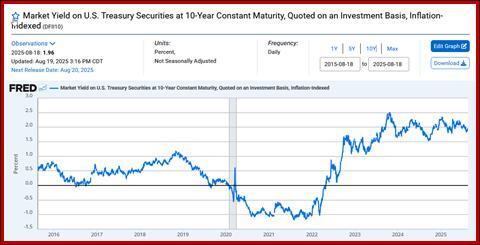
Periodically we try to forecast where the 10-year will go using the Taylor Rule (simple form) and some common sense. If the basic real return is 1.96% (actually already a bit higher than the historical norm) and we add inflation at (say) 3.5-4%, we are looking at a 10-year at 5.46-5.96%, or 5.5-6%. For what it’s worth, this is a far cry from the highest ever, 15.82% in Sept 1981.
Shoppers today don’t care about 1981. And they are all too aware of price increases. Most Americans may not read the WSJ but they watch TV and it’s not possible to turn on the TV and not see some report on rising prices. And even Home Depot, which said in May it won’t be raising prices, has backtracked and now calls for some “modest” prices rises.
Forecast
The market has the collywobbles ahead of Jackson Hole and probably will continue to feel sickish until the Sept FOMC. It seems obvious that despite the worries about US jobs and employment, unemployment is still quite tame at just over 4% and not likely to zoom to higher levels for some time, if at all.
It would be goofy for the Fed to prioritize employment at the Sept meeting when prices are obviously moving up and everyone knows it. It would also be uncharacteristic of the Fed to be so far behind the curve, and besides, it cannot appear to be bowing to White House demands. We can understand the arguments for a rate cut to boost the flagging economy (demand for labor, as Bernstein says), but it’s a weak argument in the face of inflation possibly doubling.
The only problem with this outlook is that the bond vigilantes need to start building in those inflation expectations. Instead, the 10-year is playing tag with the 200-day moving average (see the chart in the Chart Package).
All the same, gird your loins for a dollar surge. With just about every other major country having cut rates and with declining comparable yields—except the UK—it’s hard to see how a dollar rally can’t be in the cards. Soon.
This is an excerpt from “The Rockefeller Morning Briefing,” which is far larger (about 10 pages). The Briefing has been published every day for over 25 years and represents experienced analysis and insight. The report offers deep background and is not intended to guide FX trading. Rockefeller produces other reports (in spot and futures) for trading purposes.
To get a two-week trial of the full reports plus traders advice for only $3.95. Click here!
This is an excerpt from “The Rockefeller Morning Briefing,” which is far larger (about 10 pages). The Briefing has been published every day for over 25 years and represents experienced analysis and insight. The report offers deep background and is not intended to guide FX trading. Rockefeller produces other reports (in spot and futures) for trading purposes.
To get a two-week trial of the full reports plus traders advice for only $3.95. Click here!
Author
Barbara Rockefeller
Rockefeller Treasury Services, Inc.
Experience Before founding Rockefeller Treasury, Barbara worked at Citibank and other banks as a risk manager, new product developer (Cititrend), FX trader, advisor and loan officer. Miss Rockefeller is engaged to perform FX-relat

















