Fed December Preview: Gold stays vulnerable as Fed looks to battle inflation
- Fed is set to accelerate the winddown of the bond-buying program.
- Gold could break out of its two-week-old trading range on Fed's policy announcements.
- Key resistance for XAU/USD seems to have formed around $1,800.

The US Federal Reserve will announce monetary policy decisions and release the updated Summary of Projections at 1900 GMT Wednesday, December 15. FOMC Chairman Jerome Powell will deliver his remarks on the policy outlook and respond to questions from the press in a press conference starting at 1930 GMT.
The Fed is widely expected to leave its policy rate unchanged on Wednesday. Following the decision to reduce the pace of monthly asset purchases by $15 billion starting mid-November, several policymakers voiced their support for a faster asset taper. As it currently stands, the Fed is on track to end its quantitative easing program by June 2022. According to the CME Group’s FedWatch Tool, markets are pricing a 21% chance of the Fed leaving its policy rate unchanged by then.
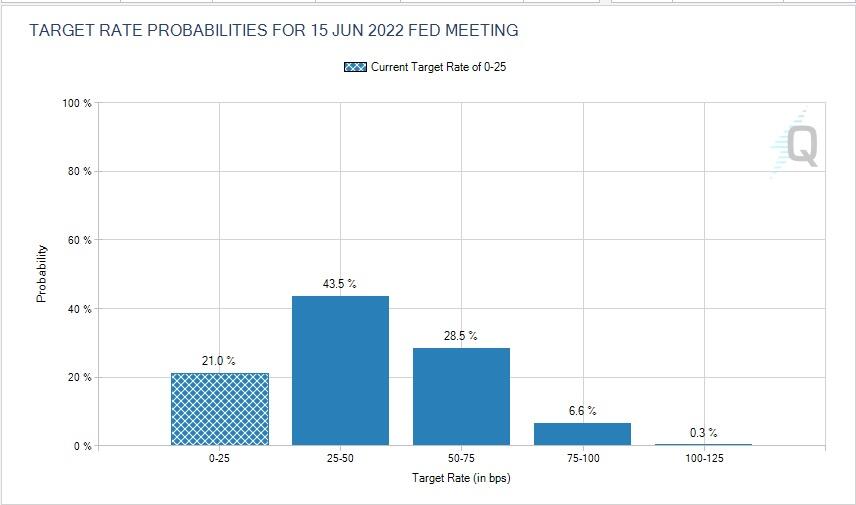
The Fed has a difficult task at hand as it will try to keep the economic recovery alive in the face of the downside risks posed by the coronavirus Omicron variant while battling inflation.
The latest data published by the US Bureau of Labor Statistics revealed that the annual Consumer Price Index (CPI) jumped to its strongest level in nearly four decades at 6.8% in November. While testifying before the US Senate Banking Committee, Powell acknowledged that they need to stop using the term “transitory” when describing inflation in the US. Policymakers are likely to prioritize inflation-control over economic growth in the short term, however. Although markets are concerned over the Omicron variant’s potential negative impact on economic activity, it is also seen as a factor that could feed into price pressures by prolonging the supply chain issues.
San Francisco Fed President Mary Daly said earlier in the month that the Fed could look to end taper by March and have the flexibility to hike the policy rate earlier than planned if needed. Similarly, Atlanta Fed President Raphael Bostic argued that concluding the bond-buying program by the end of the first quarter of 2022 would be in their interest. Following the $15 billion reductions in asset purchases in November and December, the Fed could opt to ramp up the taper to $30 billion per month from January and deplete the remaining $90 billion in the program by three months.
Gold outlook
Gold has been struggling to find direction since the beginning of the month while fluctuating between $1,800 and $1,760. Despite the Fed’s hawkish policy outlook, US Treasury bond yields have been struggling to gain traction amid risk aversion and limiting XAU/USD’s downside.
In case the dot plot shows that the majority of policymakers see the Fed raising the policy rate twice in 2022, the benchmark 10-year US Treasury bond yield could regain its traction and cause XAU/USD to turn south. On the other hand, a dovish policy outlook that points to a single rate hike in the third or the fourth quarter of 2022 is likely to help gold end the year on a firm footing.
Gold technical analysis
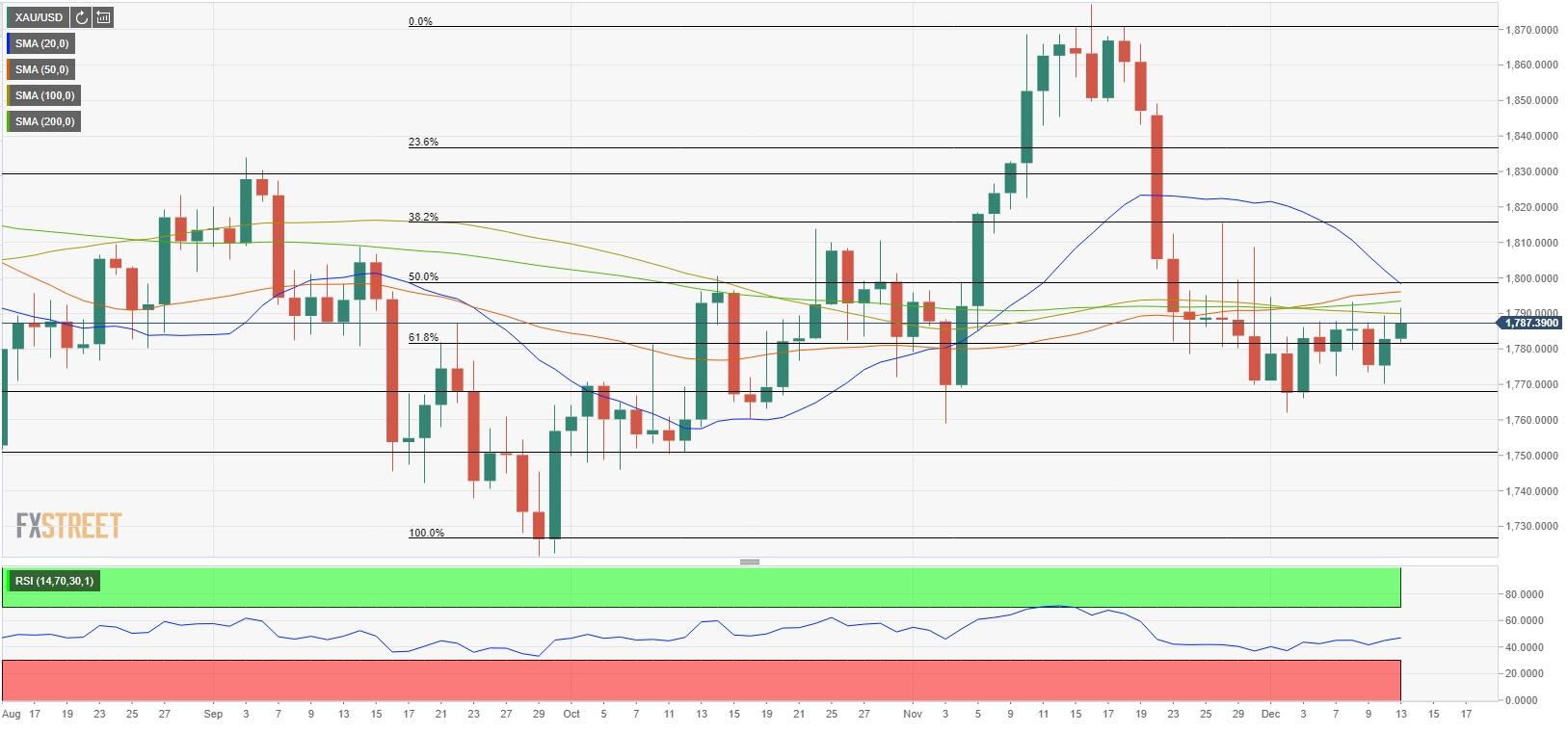
The technical outlook for gold shows that the precious metal is currently in a consolidation phase. The Relative Strength Index (RSI) indicator on the daily chart is staying near 50, confirming XAU/USD’s indecisiveness. Nevertheless, the pair continues to trade below the 100-day and 200-day SMAs, suggesting that buyers have yet to commit to a steady recovery following the sharp decline witnessed in the second half of November.
If US T-bond yields slump on a dovish Fed statement, buyers will look for a break above $1,800, where the Fibonacci 50% retracement of the latest uptrend meets the 100-day and 200-day SMAs. With a daily close above that resistance area, the next target on the upside is located at $1,815 (Fibonacci 38.2% retracement) before $1,830 (static level).
On the flip side, XAU/USD could slide toward $1,770 (static level) if the Fed reassures markets that it will remain on a tightening path to ease the price pressures. Below that support, additional losses to $1,750 (static level) could be witnessed before markets calm down into the Christmas break.
Author

Eren Sengezer
FXStreet
As an economist at heart, Eren Sengezer specializes in the assessment of the short-term and long-term impacts of macroeconomic data, central bank policies and political developments on financial assets.















