Evaluating sentiment for riskiness is a confusing mess


Outlook
Today we get the University of Michigan survey. As you know, we don’t put much faith in surveys but in the absence of government agency data, it will probably get more attention than it deserves. Too much depends on who is called, how many are called, how and in what order questions are posed, etc. Example: the government shutdown is founded on the giant jump in health insurance premia about to hit the average Joe. If that question is asked immediately before questions about growth, inflation, and jobs, would that not change the outcome?
Then we have economists pointing to the loss of growth and rise in inflation from just the shutdown itself. But the Atlanta Fed continues to see Q3 GDPNow at a hefty 4%, the same as earlier this week. We get another try on Nov 14.
To add to mass confusion and general unhappiness, commentators say the Challenger job loss story yesterday and the increasingly louder tech bubble story are behind yesterday multi-asset drop—stocks, bond yields, the dollar.
Bloomberg has a top-of-the-page headline today about the bubble bursting—and then the story is about the S&P, not Nasdaq. “A suddenly turbulent US equity market has traders studying technical charts for clues on where the latest bout of selling might stall out. Doubts around whether the billions of dollars being invested in artificial intelligence will pay off, combined with still-lofty stock valuations sent the S&P 500 Index down to 6,720.32 on Thursday, the lowest level in two weeks. From here, the 50-day moving average of 6,665 looms as a major line of defense, chart watchers say….. Conversely, the gauge’s return to 6,748.10 — its 21-day moving average — would likely reignite risk-on momentum.”
So, we can pick the 50-day for one diagnosis and the 21-day for a different one? This is not technical analysis. It’s cherry picking “data” to back up whatever idea is topmost at the moment. We don’t know whether the bubble is going to burst or even if it is a bubble in the first place, but we do know BS when we see it. It’s also irresponsible reporting. If these guys are really good at forecasting the stock market, show us the audited track records and explain why they are not keeping their technical secrets to themselves to trade for their own accounts.
It’s not clear that risk-off sentiment is wide and deep, though. Evaluating sentiment for riskiness is a confusing mess. One idea is that bitcoin is a leading indicator for risky assets, including the Big Seven and tech names in general. If so, the recent drop in bitcoin can be interpreted as the first step in the stock market bubble headed for a sharp pin.
The wise Authers at Bloomberg had this yesterday: “Beyond its tech correlation, Bitcoin is yet to prove its supposed kinship with gold, which has recently snapped a record rally as the US-China trade truce eased tensions. It’s still up about 50% for the year, far outshining its distant digital cousin.
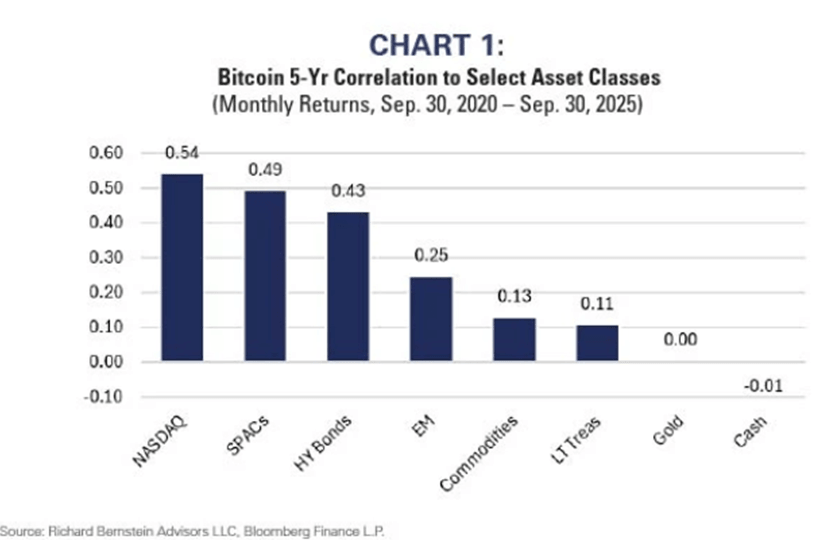
“Strategists at Richard Bernstein Advisors (RBA) argue not only that cryptocurrencies aren’t ‘digital gold,’ but that they play totally dissimilar roles. They point out that if crypto were indeed digital gold, the correlation should be reasonably high. Correlations between Bitcoin and various asset classes using monthly returns show a nonexistent relationship over the last five years — exactly zero.” See the chart.
These advisors “see crypto as speculative investments driven by financial liquidity — also typically the driving factor in asset bubbles. The RBA analysts argue that it’s hard to speculate when financial conditions are tight, lending is constrained, and the economy is contracting. Risk-taking increases as financial conditions ease, lending expands, and overall economic liquidity grows (so Bitcoin might be telling us that conditions are indeed a bit tighter than they appear).”
Meanwhile, gold “thrives in uncertainty.” And “Bitcoin is nowhere close to matching gold as a haven asset.”
Our take: bitcoin and its cousins will do okay as the Fed embraces the Dec rate cut and maybe another in Q1. But it will be gold that takes off when Trump takes away the Fed’s independence. The entire world is watching that.
As for the ever-growing doubt about the AI issues, many of the doubts and questions are probably perfectly true. Vast spending is not backed up by realistic revenue expectations. Some of the deals are spirals of interdependence. And so on. Is it a bubble? Well, maybe not. The indices seems to have broad gains, not just tech, and some analysts are back to (or still on) classic events like sector rotation. As former Fed Greenspan would say, you only know it’s a bubble if it bursts and takes everything else down with it.
Besides, the stock market is not the economy and it’s also not the FX market. The dollar is down on uncertainty over the shut-down and a dozen other mostly Trump issues, plus the sliver of data we are getting about jobs. This last is the core issue for the dollar. What we have so far seems to be a labor market softening fairly dramatically, meaning the Fed will cut for sure in December and maybe into Q1, too.
The rate cut outlook is a driver for the yields and the dollar quite independent of the stock market. This is not to deny that a burst bubble would not affect both bonds and currencies, just to say that this is not what is happening now as the scare-mongers (like Bloomberg) are projecting.
Forecast
We assume the dollar’s corrective downmove is temporary until we get some evidence it has legs. Nimble fingers are called for.
This is an excerpt from “The Rockefeller Morning Briefing,” which is far larger (about 10 pages). The Briefing has been published every day for over 25 years and represents experienced analysis and insight. The report offers deep background and is not intended to guide FX trading. Rockefeller produces other reports (in spot and futures) for trading purposes.
To get a two-week trial of the full reports plus traders advice for only $3.95. Click here!
This is an excerpt from “The Rockefeller Morning Briefing,” which is far larger (about 10 pages). The Briefing has been published every day for over 25 years and represents experienced analysis and insight. The report offers deep background and is not intended to guide FX trading. Rockefeller produces other reports (in spot and futures) for trading purposes.
To get a two-week trial of the full reports plus traders advice for only $3.95. Click here!
Author
Barbara Rockefeller
Rockefeller Treasury Services, Inc.
Experience Before founding Rockefeller Treasury, Barbara worked at Citibank and other banks as a risk manager, new product developer (Cititrend), FX trader, advisor and loan officer. Miss Rockefeller is engaged to perform FX-relat

















