Euro's downturn ahead? Key levels to watch at 1.1467 – Has the bullish momentum vanished?


The coming week for EUR/USD appears modest on the surface, but geopolitical and macro pressures are quietly tightening. While Thursday’s ECB meeting is the main calendar event, no change in rates is expected. Instead, focus shifts to Lagarde’s tone amid weak Eurozone PMIs and the IFO Business Climate Index. Any shift toward dovish guidance could trigger downside repricing, especially if growth risks dominate the narrative.
However, off-calendar risks may drive the real volatility. The U.S. tariff threat resurfaces, with Trump proposing a 15–20% base tariff on EU goods and retaining the 25% auto tariff. If talks fail before the August 1 deadline, risk-off sentiment could dominate, pressuring EUR/USD lower. Conversely, any delay or partial deal may lift the pair toward 1.1700.
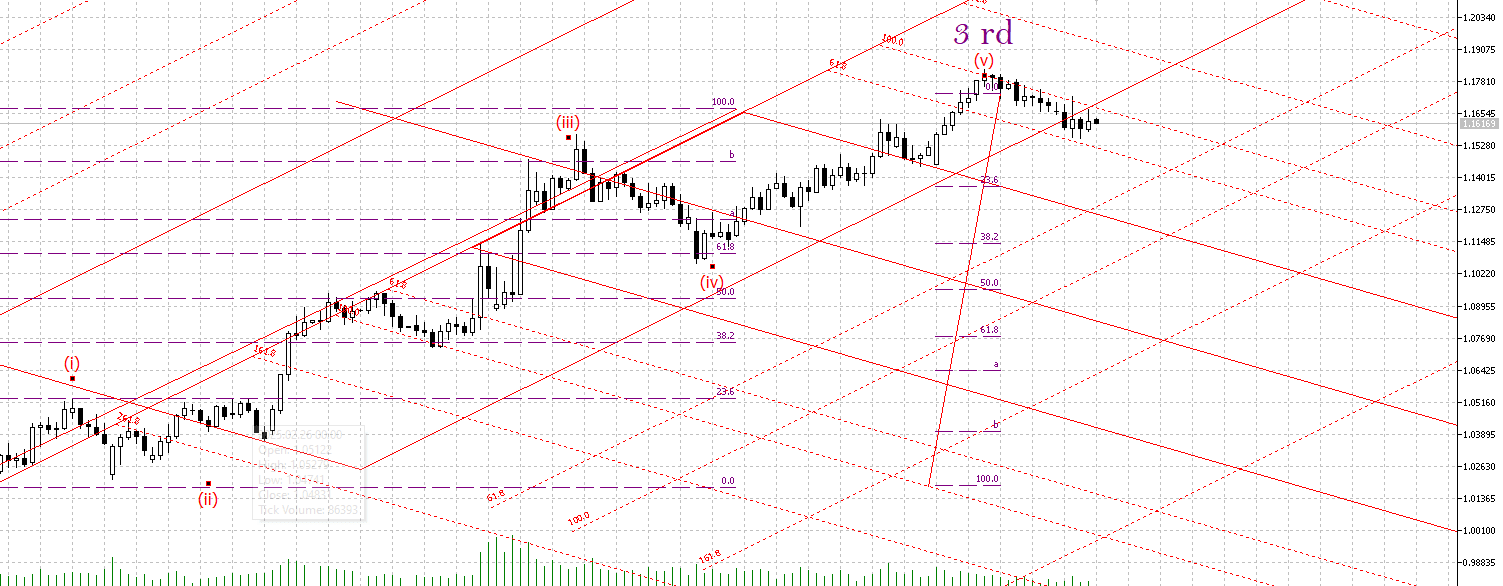
The chart represents a completed five-wave Elliott impulse sequence, ending with Wave (v) marking the top around the 1.1900 area. This labeling confirms that the rally from earlier swing lows formed a classic motive wave, with Wave (iii) being the strongest and most extended in terms of price and volume – a common Elliott characteristic. The labeling also indicates that the move completed a higher-degree Wave 3, suggesting the market is either in a larger Wave 4 correction or potentially forming a topping structure of an even broader degree.
The use of Gann fan angles and pitchfork tools further confirms the underlying structure of this move. The Gann 1x1 and 2x1 angles served as strong support throughout the rally, but recent candles suggest a loss of upward momentum. Price has begun to drift sideways-to-lower, slipping beneath the higher Gann angles. This implies a likely phase of redistribution and possible transition from bullish to corrective behavior. Technically, the immediate downside target rests in the 1.1467 area, where multiple elements converge: this zone represents the 38.2% Fibonacci retracement from the prior rally, intersects with key Gann grid support, and shows signs of prior demand and institutional defense.
ICT framework and smart money interpretation
From an ICT (Inner Circle Trader) standpoint, the market behavior aligns with a classic smart money cycle. The initial accumulation was followed by a displacement phase, leading to a strong impulsive rally. That rally likely engineered a run on buy-side liquidity above previous highs, with the 1.1900 top acting as a liquidity raid point. ICT often describes these moves as engineered to induce retail breakout buying, enabling institutional distribution at premium prices.
Currently, price action is forming what appears to be a shift in market structure. The higher highs have not been sustained, and price is retracing into inefficiencies or "Fair Value Gaps" (FVGs) that remain unfilled from earlier in the trend. A large FVG sits between the 1.1650 and 1.1467 zones, and the market is likely to retrace into this area as part of its rebalancing process. ICT traders would interpret this as a standard phase where price seeks equilibrium after a displacement, often forming either a bullish continuation or setting up for deeper correction.
In addition to the FVG, the 1.1467 level is aligned with a previously formed bullish order block. This zone is where institutions likely initiated long positions before the Wave (v) rally. Price returning to this area may trigger smart money interest again—either to reload longs or to trap liquidity before further downside unfolds.
Projected move and key zones
The immediate expectation is for price to decline toward the 1.1467 region, which serves as a confluence of Fibonacci support, Fair Value Gap, and an institutional order block. If price finds support here and macro conditions turn favorable, there is a possibility of one more bullish rally toward 1.1900. This would likely act as a retest of the previous high or form a lower high, depending on the momentum and volume characteristics.
If price reaches 1.1900 again, it may serve as the final distribution point, particularly if fundamental triggers align. In this scenario, smart money may initiate a broader markdown phase, targeting deeper levels such as the 1.1190 to 1.1140 range. This area corresponds with the 61.8% retracement level and matches the lower boundary of a broader price rebalancing.
Macro and fundamental context
The macroeconomic backdrop plays a critical role in determining whether this projected technical path will play out. On Tuesday, Jerome Powell is scheduled to deliver a speech, which may offer forward guidance on the Federal Reserve's stance regarding interest rates. Given current market positioning and sentiment, the tone of Powell's remarks could be a significant volatility trigger.
If Powell adopts a dovish tone—suggesting future rate cuts or expressing concern about weakening economic indicators—markets could respond with a bullish move in risk assets and a weakening dollar. This scenario could push price back toward 1.1900. However, if Powell reaffirms the Fed’s cautious stance due to sticky inflation or concerns about overheating segments of the economy, the dollar may strengthen, leading to a deeper retracement below 1.1467.
Other key fundamental factors include the slowing of US GDP growth, persistently mixed inflation data (especially Core PCE), rising wage pressure, and continued yield curve inversion. These all point toward a growing divergence between policy expectations and economic reality, which increases the potential for sharp moves when key economic data or speeches are released.
Trading scenarios
- The pair is shifting from a bullish impulse to a corrective phase.
- 1.1467 is a key structural support and potential launchpad for a final move up to 1.1900.
- Break below 1.1440 signals deeper retracement toward 1.1190.
Primary setup – Buy the dip
- Entry Zone: 1.1467–1.1447.
- Stop-Loss: 1.1405 (Below key support and structure break).
- Take-Profit Levels:
- TP1: 1.1625 (minor resistance)
- TP2: 1.1775 (pre-distribution resistance)
- TP3: 1.1900 (distribution top)
Positioning logic
- Buy near structural demand zone.
- Ride final bullish leg (if price confirms stabilization).
- Scale out partial profits as price approaches key resistances.
Bearish breakdown
- Trigger: Clean break below 1.1410 and weekly close below 1.1400.
- New Bias: Bearish.
- Sell Setup:
- Entry on Pullback: 1.1430–1.1450 (post-break retest).
- Stop-Loss: Above 1.1475.
- Target Zone: 1.1205–1.1180.
Rationale
Failure to hold structural support implies deeper correction in line with smart money retracement targets.
- Bullish Interpretation: Dovish tone → weaker USD → supports long positions.
- Bearish Interpretation: Hawkish tone → stronger USD → favors breakdown scenario.
Risk Note: Reduce position size or wait for Powell’s speech if entering close to the event to avoid whipsaws.
Adding to the uncertainty is the brewing controversy around Fed Chair Jerome Powell, with allegations of perjury and misuse of Fed renovation funds. Though unlikely, any move to replace Powell could shake confidence in the Fed’s independence, weakening the dollar.
Structurally, EUR/USD shows signs of distribution. Institutional levels suggest a likely move toward the 1.1467 area — a key Fair Value Gap and order block zone. If that zone holds, a bullish reaction may push toward 1.1900. However, failure to defend 1.1467 would open the door to a deeper move toward 1.1190. The dollar may still dominate as macro risks escalate, making EUR/USD a sell-on-strength setup unless strong support confirms.
Author
Faysal Amin
Mind Vision Traders
Faysal Amin is a seasoned financial analyst and market strategist with over a decade of experience in global markets, including equities, forex, and commodities.