EUR/USD Weekly Forecast: Volatile times ahead
- The Federal Reserve is expected to hike interest rates for the last time, while the latest US data shows still elevated inflation.
- The European Central Bank is expected to continue raising rates beyond May, which could support the Euro.
- The EUR/USD pair has been moving sideways, the upcoming week could bring significant changes.

The EUR/USD pair reached fresh 13-month highs but then pulled back to the levels seen a week ago. Once again, the pair failed to hold above 1.1050, and the run towards 1.1100 faded. However, the retracement has been limited, indicating that the trend is still up. Next week is critical for the markets and could also be for the pair, considering the number of key economic reports and central bank meetings.
Data from the US and Europe showed that their economies are slowing down, and high inflation persists. The Eurozone returned to growth in the first quarter but expanded by just 0.1%. April's preliminary inflation numbers showed an expected rebound in regional Consumer Price Indexes.
In the US, GDP advanced at a 1.1% pace during the first quarter, below expectations. The positive note was strong consumption data. Consumer inflation rebounded moderately, suggesting the battle against inflation is not yet over, and wage inflation rose more than expected in the first quarter.
Analysts and economists continue to warn about an incoming recession. Markets waver between a gloomy global outlook and some upbeat earnings reports. To complicate matters, the First Republic Bank crisis brought back concerns about the banking system.
In times of uncertainty, the Euro performed well recently, even against the US Dollar. Surprisingly, when Wall Street rallied on Thursday, EUR/USD dropped modestly. The Eurozone and Treasury yields spread could be the key, reflecting monetary policy expectations.
With the European Central Bank (ECB) seen raising rates further over the next few months, and the Federal Reserve hiking for the last time, corrections in EUR/USD might be limited.
Central bank’s week
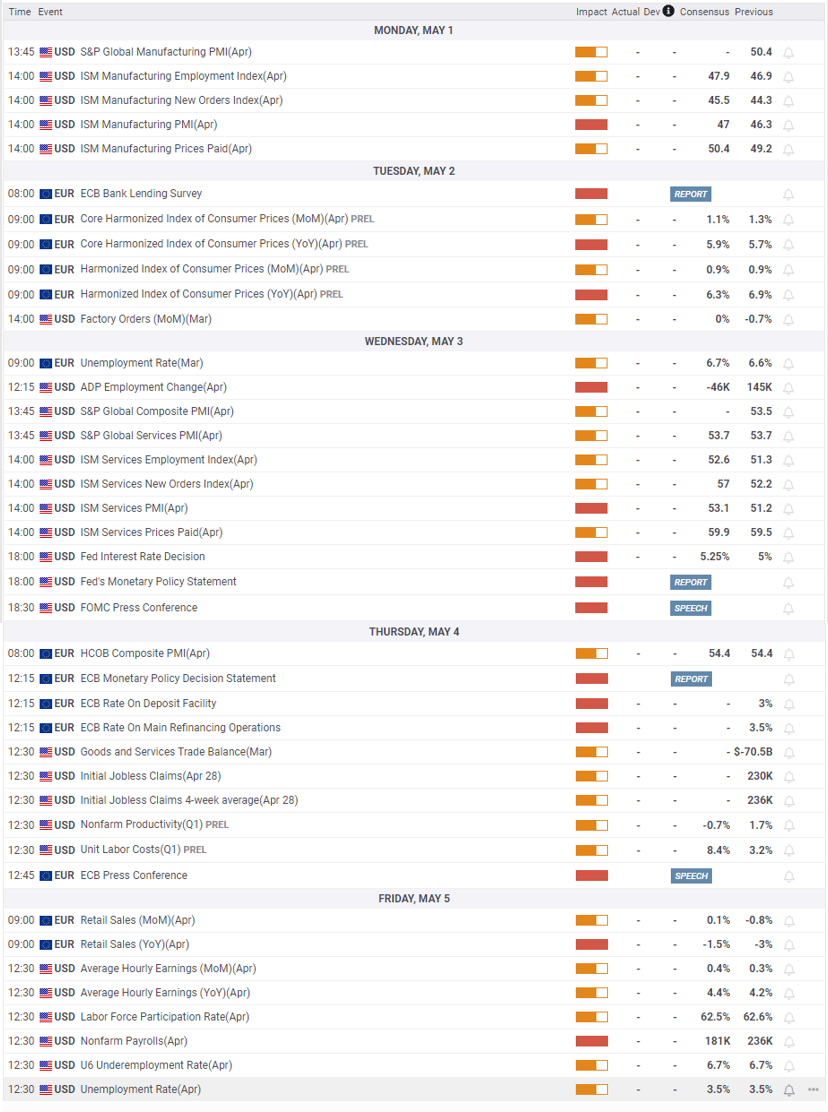
The Federal Reserve (Fed) is set to announce its monetary policy decision on Wednesday, and market participants are predicting a final 25 basis points interest rate hike to 5.00%-5.25%. Despite the tight labor market, evidence of a slowdown is beginning to show. Inflation has also come down from its peak, and banking developments have helped the Fed in tightening conditions. The overall economy is not running hot, and inflation is slowing down.
Traders will be closely watching Fed Chair Powell's comments and the Federal Open Market Committee (FOMC) projections, as they will impact future expectations about interest rates. Powell is expected to confirm that rate cuts are not being discussed, but market attention will shift towards the dot plots. If the projections offer some forecasts for rate cuts later in the year, US yields could drop, potentially leading EUR/USD to climb to fresh cycle highs.
According to the CME Group FedWatch Tool, the odds of a 25 basis points hike stand at 88%, up from 83% of a week ago; and 12% of a pause.

On the day following the Fed's announcement, the European Central Bank (ECB) will hold its meeting, with market participants expecting a rate hike. Odds favor a 25 basis points rate hike, but a 50 bps is not on the table. It is worth noting that the ECB dropped its forward guidance in March amid the banking turmoil, adding to the overall uncertainty surrounding the upcoming meetings.
According to the interest rate market, the peak policy rate is now estimated at 3.75%, down from a week ago when it was near 4%. This suggests a 15% chance of a 50 bps hike next week. Additionally, a 25 bps hike for June, followed by another in September is nearly fully priced in.
The risk for the Euro stems from the doves at the ECB. If their more cautious outlook prevails, markets' expectations for tightening could ease, putting downward pressure on the Euro. However, the latest inflation numbers make this scenario unlikely, at least for the upcoming May meeting.
Economic data still matters
While the central bank's decision will likely make headlines next week, relevant economic data will also be released, and it's important. Equity markets are wavering between positive earnings results from tech companies, banking concerns, and analysts warning about a possible recession in the near future. Meanwhile, the Federal Reserve's tightening cycle is nearing its end, and the European Central Bank (ECB) will continue raising rates. In this context, the economy's performance is relevant.
Eurozone inflation numbers will be released on Tuesday, but they may be old news since regional numbers are already known. Also, on Tuesday, the ECB Bank Lending Survey could provide essential insights into the health of the Eurozone banking system. On Friday, April's Euro area Retail Sales will be released with expectations of a 0.1% monthly increase.
In the US, it will be a busy week, focusing on labor market figures. The ADP report will be released on Wednesday, Jobless Claims on Thursday, and the most important report, the official employment report, will be released on Friday. Nonfarm Payrolls are expected to slow to 181,000, and the unemployment rate is forecast to remain at 3.5%. Average hourly earnings are estimated to rise 0.4% in April and 4.45% from a year ago.
The ISM Manufacturing PMI on Monday and the Services PMI on Wednesday will offer the first insights into how the economy started the second quarter. Both are expected to improve from March.
EUR/USD technical outlook
The EUR/USD shows some signals of exhaustion, but the chances of a sharp reversal are limited. However, a correction appears to be on the horizon. With volatile times ahead, where the pair settles will be important. A correction before resuming the upside seems likely at the moment, but that all changes if the Euro finally breaks firmly to the upside.
If the Euro goes past and posts a close above 1.1060, it could resume the upside, looking for 1.1100 and more. The next resistance above emerges at 1.1120, and then, not much until 1.1200.
The 20-day Simple Moving Average at 1.0960 is the immediate crucial support. A drop below would clear the way for a deeper correction initially to 1.0900, which is another critical support level. If breached, it could weaken the outlook for the Euro. Even with a decline to sub-1.09 levels, the underlying uptrend would not change.

EUR/USD Sentiment poll
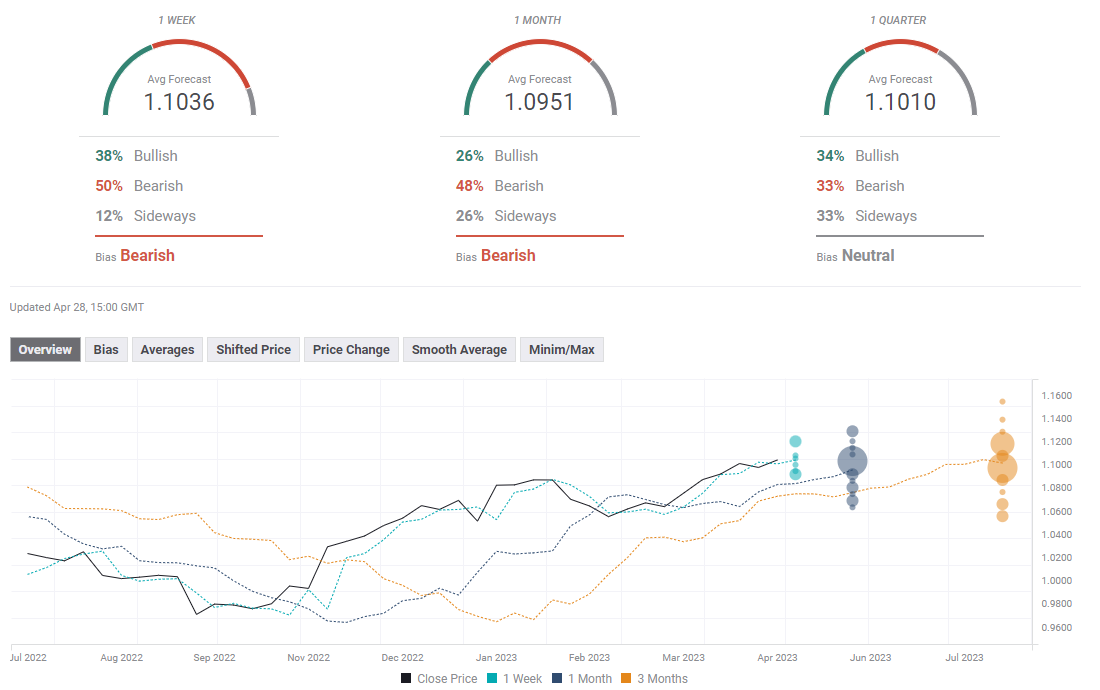
According to the FXStreet Forecast Poll, the sentiment for EUR/USD suggests that the pair will continue to consolidate over the next week, hovering around 1.1000/50. Looking at the quarterly perspective, analysts on average see the EUR/USD pair at 1.1010. Of those polled, 33% expect to see the price below current levels in three months, while 34% anticipate it to be above.
Author

Matías Salord
FXStreet
Matías started in financial markets in 2008, after graduating in Economics. He was trained in chart analysis and then became an educator. He also studied Journalism. He started writing analyses for specialized websites before joining FXStreet.














