EUR/USD Weekly Forecast: King Dollar returns by the hand of “transitory” inflation
- Soaring inflation and slowing economic growth have become global trends.
- Central bankers are chasing inflation, incapable of accurately forecasting it.
- EUR/USD trades at fresh 2021 lows without signs of an interim bottom coming.

When the US Federal Reserve announced its latest decision on monetary policy early in November, Chair Jerome Powell noted that inflation was the main theme, adding that current price pressures are “frustrating.” This week markets know that the US Consumer Price Index hit a 31-year high of 6.2% YoY in October amid soaring energy and food prices. Also, the latest data from the US Commerce Department showed that Gross Domestic Product grew at a modest annual rate of 2% in the third quarter of the year.
Massive pandemic-related stimulus, supply chain bottlenecks and labor shortages are all behind the economic disruption, which not only affects the US. The dynamic of higher inflation and slowing growth is a global trend. Just looking at Chinese figures, Q3 GDP came in at 4.9%, while inflation at factory levels jumped to its highest in 26 years.
King dollar runs on central banks’ imbalances
In such a scenario, the American dollar reached fresh 2021 highs against its European rival, with EUR/USD currently trading in the 1.1440 price zone. The greenback benefited from a sour market mood amid mounting speculation that the US Federal Reserve will have to hike rates at least twice in 2022. On the opposite side of the ring, the European Central Bank retains its conservative stance, pledging to maintain stimulus for as long as needed.
Another thing that most economies have in common is that their central banks’ representatives keep repeating that the ongoing spikes in inflation are likely to be “transitory.” But what is transitory? In its latest press conference, Fed’s Powell said that supply bottleneck effects were larger than the Fed anticipated and noted that high inflation would persist next year. Other policymakers refrained from drawing a time frame, although ECB President Christine Lagarde noted that it would be “very unlikely” they would decide to raise rates in 2022.
At this point, market participants are unaware about at which levels and after how many months policymakers will be worried about inflation. It seems that central bankers are behind the curve and incapable of projecting monetary policies sustainably in time. Risk aversion is the logical result, which in turn boosts demand for high-yielding assets such as the greenback, poised to extend its rally.
Data confirms investors’ pessimism
Meanwhile, macroeconomic data reflected global uncertainty. The German ZEW survey showed that the Economic Sentiment improved in November, although the assessment of the Current Situation plummeted. Inflation in the country was confirmed at 4.6% YoY in October, while the Wholesale Price Index jumped to 15.2% YoY.
Finally, the US released the November University of Michigan Consumer Sentiment Index, which plummeted to 66.8 from 71.7 in October, its lowest reading since November 2011. "Consumer sentiment fell in early November to its lowest level in a decade due to an escalating inflation rate and the growing belief among consumers that no effective policies have yet been developed to reduce the damage from surging inflation," said Richard Curtin, Surveys of Consumers chief economist.
For the upcoming week, the macroeconomic calendar includes the second release of the EU Gross Domestic Product for the third quarter, foreseen unchanged at 2.2%, and US October Retail Sales, both scheduled for Tuesday. The Union will release its final October inflation figures on Thursday when the US will publish the usual weekly unemployment claims figures.

EUR/USD technical outlook
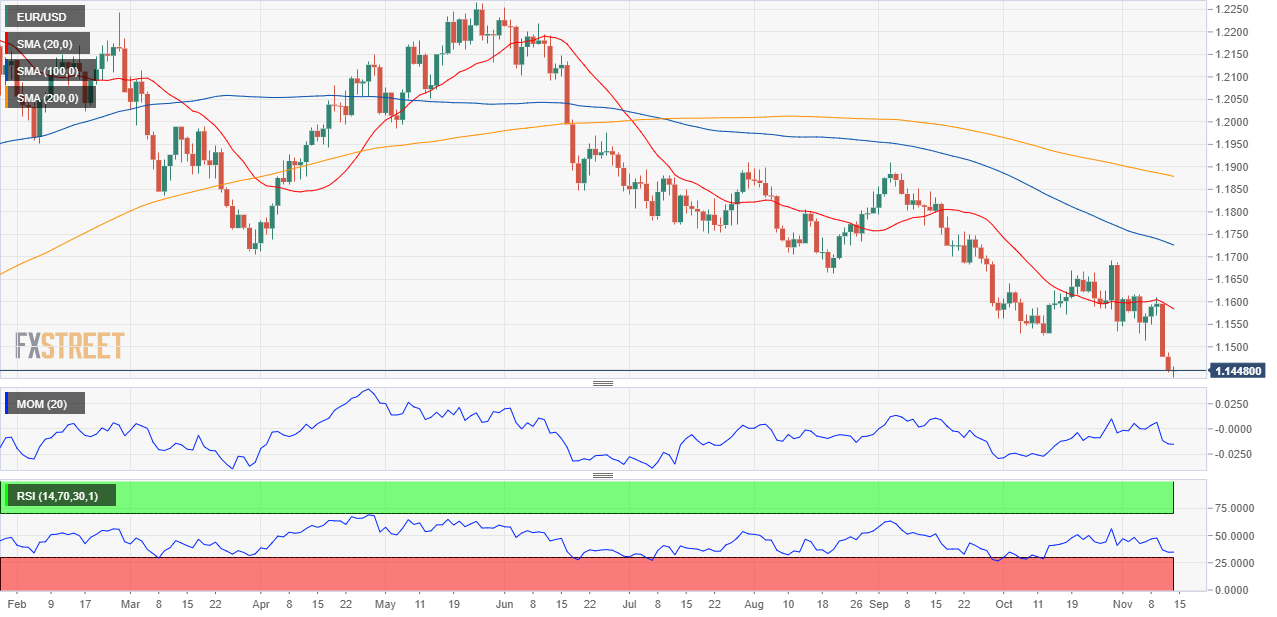
The EUR/USD pair trades at levels last seen in July 2020, and it is on track to extend its slump. The bearish potential strengthened, according to technical readings in the weekly chart. The pair has broken below its 200 SMA after over a month of struggling around it, accelerating south afterwards. The 20 SMA turned firmly south above the longer ones, reflecting the increased selling interest. At the same time, technical indicators hold within negative levels with uneven directional strength but still hint at another leg lower.
The daily chart suggests that a corrective advance may be around the corner. The Momentum indicator has turned marginally higher, while the RSI indicator has lost its bearish strength and stabilized around 34. Nevertheless, the bearish trend remains firmly in place, as all moving averages maintain their bearish slopes well above the current level.
The immediate support is the 1.1400 threshold, with a break below it, probably resulting in a test of the 1.1330 price zone. Another bearish extension exposes the 1.1260 level and long-term static support. On the other hand, a corrective advance could reach 1.1520 first and the 1.1610 area later. Sellers are likely to defend the latter.
EUR/USD sentiment poll
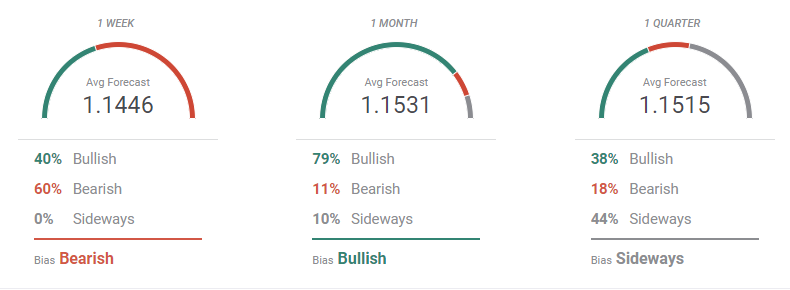
According to the FXStreet Forecast Poll, the pair is likely to extend its slump next week, as 60% of the polled experts are looking at lower levels. Speculative interest expects then a bounce, as 79% of the polled experts bet for an advance, although with the pair seen on average at 1.1531 in the monthly view. Finally, most experts see it sideways in the quarterly perspective, with the pair seen on average just above the 1.1500 level.
On the other hand, the Overview chart paints a bearish picture for the next three months. All moving averages head lower and stand and multi-month lows. The upper end of the possible targets has been downgraded in all the time frames under study, while a downward extension below 1.1200 is now on the cards.
Author

Valeria Bednarik
FXStreet
Valeria Bednarik was born and lives in Buenos Aires, Argentina. Her passion for math and numbers pushed her into studying economics in her younger years.