EUR/USD Weekly Forecast: How far can it fall?
- The US Federal Reserve will maintain a policy of aggressive quantitative tightening.
- Growth-related data coming next week is set to disappoint market players.
- EUR/USD resumed its long-term slide and is on its way to reaching fresh multi-decade lows.

The EUR/USD pair plunged this past week and is trading at the brink of parity again. The American dollar started the week with a strong footing amid risk-off flows, to later benefit from signs the US may be able to avoid a steeper economic downturn.
China spurred risk aversion at the beginning of the week after releasing soft growth-related macroeconomic figures. Additionally, the local central bank unexpectedly cut a key policy interest rate and drained liquidity after a worsening economic slowdown following covid lockdowns.
The greenback benefited from the dismal mood, while the shared currency was pressured by tepid local data that exacerbated speculation the Union is on its way to recession. The second quarter Gross Domestic Product was downwardly revised to 0.6% QoQ, from a preliminary estimate of 0.7%. Also, the German ZEW Survey showed that the Economic Sentiment plummeted in August, while inflation in the EU was confirmed at 8.9% YoY in July.
Fed´s quantitative tightening is here to stay
The final catalyst that pushed the dollar sharply up was the release of the encouraging US data after the release of the FOMC Meeting Minutes. The document indicated that US policymakers plan to keep raising interest rates to cool inflation, and are looking to push rates beyond neutral territory. Furthermore, they also announced plans to double the pace of the balance sheet shrinkage.
Market players initially saw the statement as slightly dovish but re-thought it on Thursday as economic data coming from the US suggested the country will avoid a steeper economic setback. The job sector is healthy, while business figures point to steady growth. The technical recession could soon be reversed.
US Federal Reserve officials were quick to hit the wires post-Minutes release. Minneapolis Fed Neel Kashkari said that if they keep raising rates, the risk of a recession could increase, although he did not believe the county is currently in a recession. The usual hawk, Bank of St. Louis Jim Bullard, on the other hand, said he was leaning towards another 75 bps rate hike in September.
Finally, Richmond Fed President Thomas Barkin noted on Friday that recent data on the economy had been strong, and the job market seemed healthy, as did core retail sales and industrial production.
Is recession coming or not?
We may get an answer to that question next Tuesday when S&P Global will publish the preliminary estimates of the August PMIs for the EU and the US. Most indexes are expected to have fallen further into contraction territory, suggesting a steeper deceleration in the third quarter of the year.
The US macroeconomic calendar will include a few first-tier figures, including July Durable Goods Orders, the final estimate of Q2 GDP, and core CPE inflation, the Fed’s favorite inflation measure. Finally, the Fed will hold its Jackson Hole Economic Symposium in the week ahead.

EUR/USD technical outlook
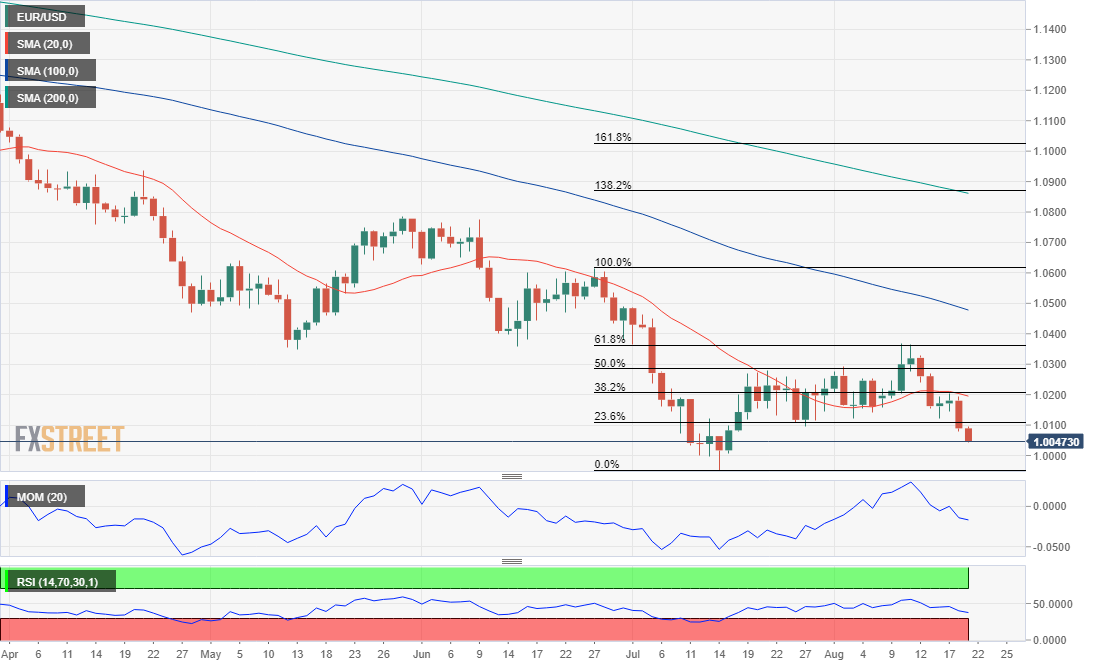
The EUR/USD pair settles at weekly lows in the 1.0040 price zone, and the latest price behavior suggests the dollar’s bearish correction is over. The pair fell further after reaching the 61.8% retracement of the 1.0614/0.9951 slide at 1.0365, and is now approaching the lower end of the range. A break below 0.9951 is on the cards in the near term.
Technical readings in the weekly chart support a bearish continuation, as the pair is developing well below bearish moving averages, with the 20 SMA far below the longer ones. Technical indicators, in the meantime, have turned back south within negative levels after correcting extreme oversold conditions reached mid-June.
The bearish case is much clearer on the daily chart, as technical indicators maintain their downward slopes well below their midlines. The 20 SMA has turned marginally lower, currently converging with the 38.2% retracement of the aforementioned decline at 1.0205. Finally, the longer moving averages have extended their slumps far above the shorter one, reflecting sellers’ strength.
The levels to watch are the multi-decade low set last July at 0.9951, followed by 0.9880. Below the latter, the pair could extend its decline towards the 0.9770 price zone. The bearish case may lose steam if the pair recovers above 1.0105, but it would need to advance beyond 1.0280 to give bulls a chance.
EUR/USD sentiment poll
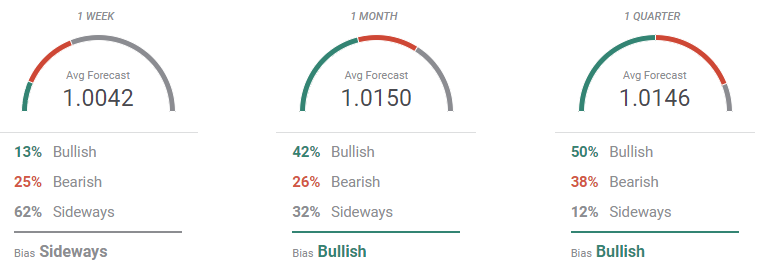
According to the FXStreet Forecast Poll, the EUR/USD pair will remain under pressure in the near term to recover some ground in a one-month view. Nevertheless and on average, the pair is seen trading around 1.0150 in the upcoming quarter, somehow reflecting the absence of buying interest around the shared currency.
In the Overview chart, the shorter moving average maintains its bearish slope, while the longer ones lack directional strength. Nevertheless, most targets in the monthly view accumulate between 0.9800 and 1.0100. The spread of potential target widens in the three-month perspective, although there are fresh lows at sight. The number of those betting for a slide below parity increased, with the 0.9500 price zone now in sight.
Author

Valeria Bednarik
FXStreet
Valeria Bednarik was born and lives in Buenos Aires, Argentina. Her passion for math and numbers pushed her into studying economics in her younger years.