EUR/USD Weekly Forecast: Fears rule, but US Dollar buyers hesitate
- Global inflationary pressures persist, spurring risk aversion among speculative interest.
- The focus shifts to US employment data as financial markets expect a big setback.
- EUR/USD daily chart supports a bearish breakout in the upcoming days.

The Euro managed to recover some ground this week, ending it at around 1.0600 against the US Dollar. EUR/USD bottomed at 1.0532, its lowest in almost two-month on Monday, with demand for the Greenback fading afterwards.
On the one hand, central bank officials fell short of providing fresh clues but spent most of their time reinforcing their well-known hawkish rhetoric. On the other, stock markets shrugged off the generally dismal mood and battled to retain ground, ending the week little changed and reflecting the absence of directional hints to lead the market sentiment.
Hot, hot inflation!
However, one thing became clear this week. Global inflation is still a big hurdle, and there’s a lot to be done on the matter. Simplifying way too much, the risk of recessions has returned to the top list of investors' concerns, as persistent price pressure means more monetary tightening from central banks.
Alongside signs of mounting inflation, macroeconomic figures show major economies are still behind in economic growth. More relevantly, consumers' confidence deteriorated further at the beginning of the year, which paints a gloomy picture for the upcoming months.
The German Harmonized Index of Consumer Prices (HICP) rose by 9.3% YoY in February, according to preliminary estimates, up from 9.2% in the previous month and higher than the 9.0% anticipated by speculative interest. The Eurozone HICP in the same period increased by 8.5%, missing the 8.2% market forecast. Spanish and French inflation figures were also hotter than anticipated. Also, the EU January Producer Price Index rose 15% YoY decreasing from 24.6% in the previous month.
The discouraging readings matched European Central Bank (ECB) officials’ words, pointing at a 50 bps rate hike in March. President Christine Lagarde noted that the decline in inflation is not stable, somehow acknowledging the continued pressures from that side. Even further, some ECB policymakers hinted at more than one 50 bps rate hike in the docket.
Fed Powell testifies
Across the pond, United States Federal Reserve officials lifted bets of higher interest rates to come, as their wording suggests the upcoming rate hike could be wider than the 25 bps. According to the CME Group FedWatch tool, odds for a 50 bps rate hike increased from 27.7% to 31.4% these days, still not enough to be worrisome, but clearly signaling a path. As a result, government bond yields run higher, with the US 2-year Treasury note yielding around 4.95%, its highest in over fifteen years.
Meanwhile, Consumer Confidence in the Eurozone remained at -19 in February, while the US CB Consumer Confidence Index declined for a second consecutive month to 102.9 in the same month. Furthermore, the report showed that “consumers may be showing early signs of pulling back spending in the face of high prices and rising interest rates.”
Finally, the United States published the ISM PMIs. Manufacturing output which unexpectedly contracted to 47.7, while the services index beat expectations with 55.1 vs the 54.5 anticipated by markets, but declined from the previous 55.2. The news gave the US Dollar a near-term boost ahead of the weekly close.
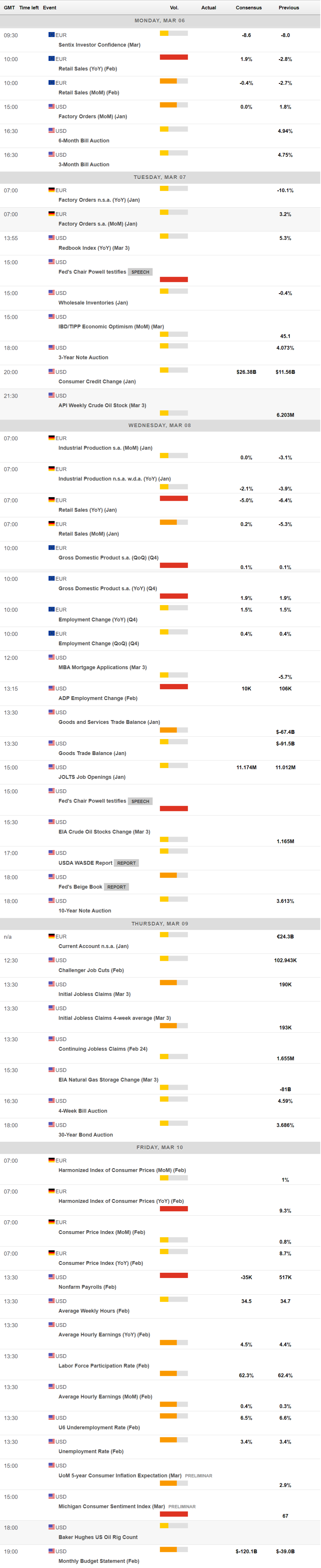
The upcoming week will start with the EU reporting February Retail Sales and Germany unveiling January Factory Orders. More relevantly US Fed Chairman Jerome Powell will testify about the semi-annual monetary policy report before the Senate Banking Committee in Washington, DC.
The focus will quickly shift to US employment figures, as the country will publish several job-related figures ahead of the Nonfarm Payrolls report on Friday. The United States is expected to have lost 57,000 job positions in February, although the Unemployment Rate is expected to remain unchanged at 3.4%. Additionally, Average Hourly Earnings are expected to have ticked higher, not good news for the Fed in its battle against inflation.
EUR/USD technical outlook
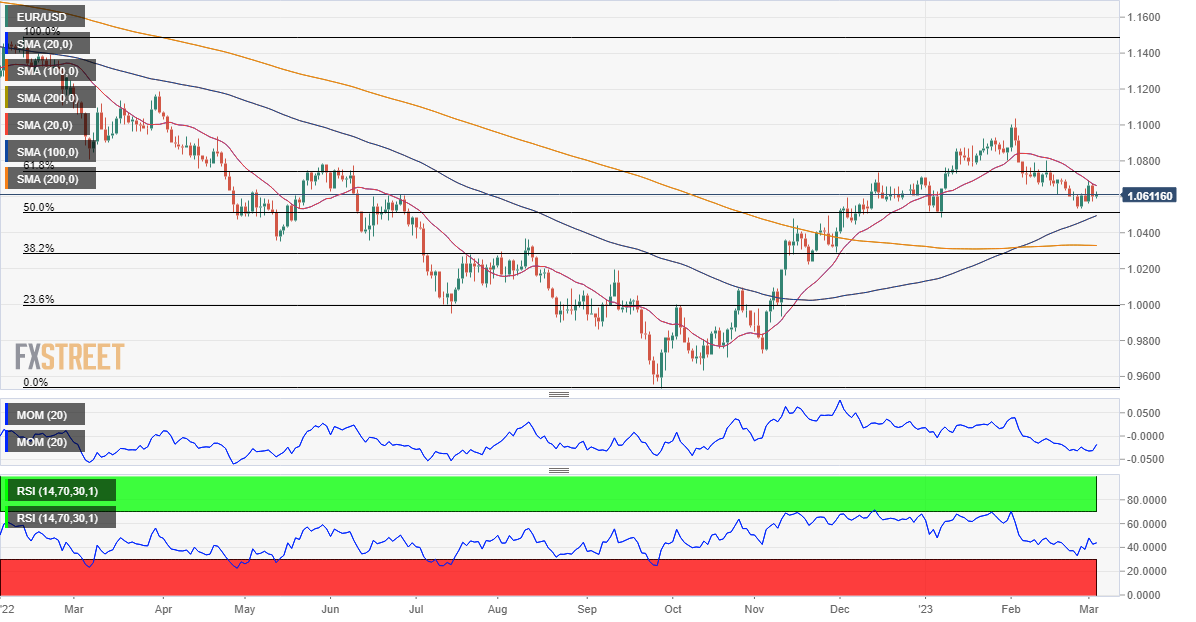
The EUR/USD pair has spent the week between Fibonacci levels, finding buyers just ahead of 1.0515, the 50% retracement of its 2022 slump, but meeting sellers on approaches to the 61.8% retracement of the same decline at 1.0745.
The weekly chart shows that bears are still to take decisive action. Technical indicators have pared their declines, with the Momentum now flat above its 100 line and the Relative Strength Index (RSI) turning higher within positive levels. At the same time, the 20 Simple Moving Average (SMA) gained upward traction and currently converges with the aforementioned Fibonacci support. On the other hand, the 100 SMA maintains its firmly bearish slope well above the current level, limiting the upside sub-1.1000.
Technical readings in the daily chart maintain the risk skewed to the downside. The 20 SMA heads south above the current level, providing dynamic resistance at around 1.0660. Technical indicators, in the meantime, hold below their midlines without clear directional strength.
A break below 1.0515 should lead to a downward extension, with the next relevant level to watch at 1.0280, the 38.2% retracement of the 2022 yearly decline. A recovery beyond 1.0660 could result in a test of the 1.0740 price zone en route to 1.0800.
EUR/USD sentiment poll
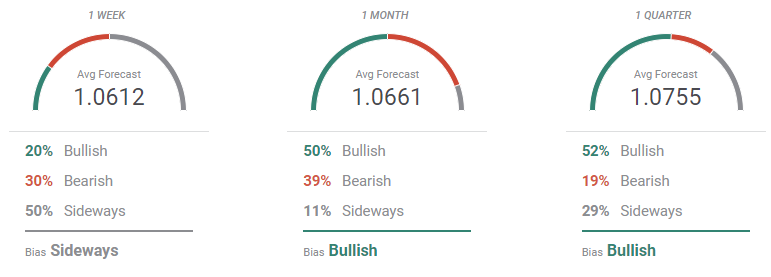
According to the FXStreet Forecast Poll, EUR/USD could remain sideways next week, but pick up afterwards. Bulls account for roughly 50% in the monthly and quarterly perspectives, while those betting for lower levels decrease in time. On average, the pair is seen holding above the 1.0600 level, but above 1.0700 in the longer-term perspective.
The Overview chart is hinting at a potenial recovery from around this area. Potential lows are mostly above the 1.0400 level in all time frames. Furthermore, moving averages are slowly turning north, although the momentum is limited at the time being.
Author

Valeria Bednarik
FXStreet
Valeria Bednarik was born and lives in Buenos Aires, Argentina. Her passion for math and numbers pushed her into studying economics in her younger years.