EUR/USD Price Forecast: US Dollar firmer in the American session

EUR/USD Current price: 1.1652
- Tepid European data undermines demand for the Euro.
- US-China trade tensions moved temporarily to the background.
- EUR/USD trades in a limited range, risk skews to the downside.
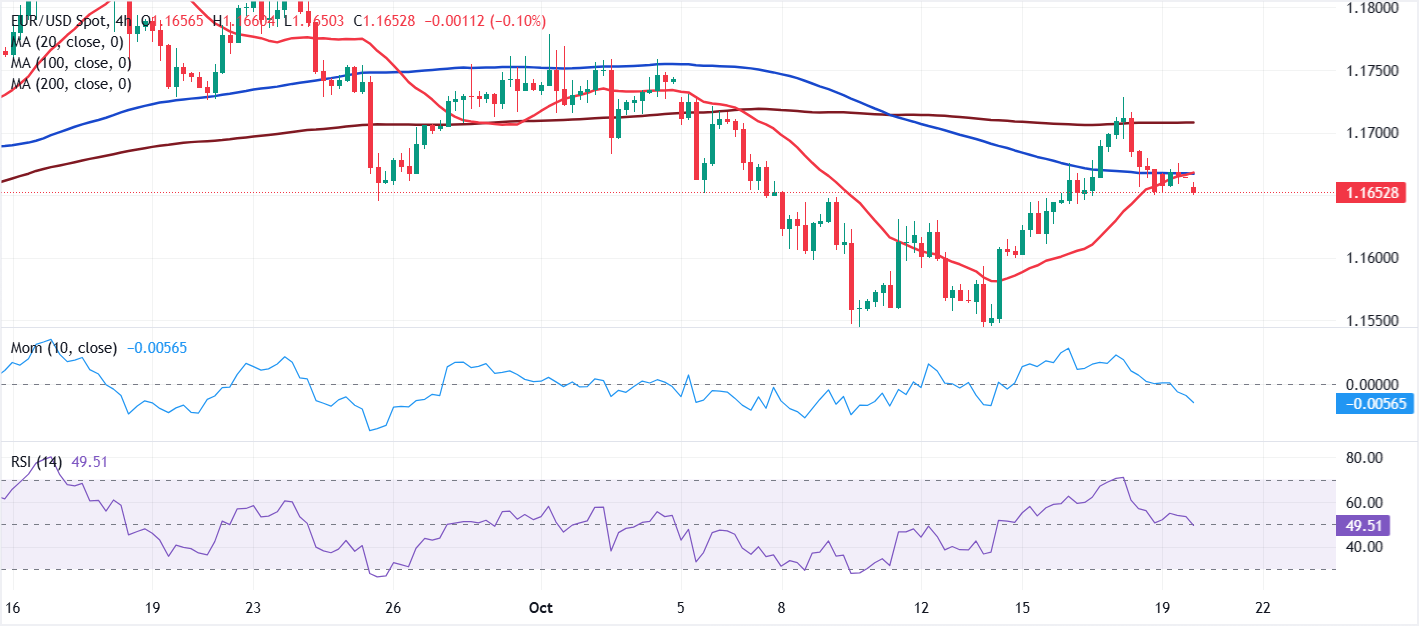
Financial markets kicked off the week with a slightly better mood, although lingering concerns in the background limit price action across the FX board. The EUR/USD pair trades with a soft tone, yet holding within familiar levels early in the American session, currently changing hands at around 1.1650.
The absence of relevant macroeconomic data maintains the focus on trade developments. Tensions between the United States (US) and China arose after the latter announced additional control on rare earths, resulting in US President Donald Trump counteracting by threatening to impose 100% levies on Chinese imports.
Over the weekend, President Trump demanded that Beijing buy more US soybeans and take action on fentanyl to avoid fresh tariffs. China “has to give us things,” Trump noted.
Data-wise, Germany released the September Producer Price Index (PPI), which printed at -0.1% on a monthly basis, missing the expected 0.1% gain but better than the previous -0.5%. Also, the Eurozone seasonally adjusted Current Account posted a surplus of €11.9 billion in August, much worse than the €22.5 billion anticipated. The US macroeconomic calendar has nothing to offer, as the US government shutdown continues, while Federal Reserve (Fed) officials entered the blackout period prior to the Federal Open Market Committee (FOMC) meeting.
EUR/USD short-term technical outlook
The EUR/USD pair daily chart shows that it trades in a tight 30 pips range ever since the day started. A mildly bearish 20 Simple Moving Average (SMA) provides resistance at around 1.1680, while the 100 SMA attracts buyers at around 1.1640. IN the meantime, technical indicators retreat from their midlines, maintaining modest downward slopes within negative levels.
The 4-hour chart shows the risk skews to the downside. The EUR/USD pair trades below all its moving averages, with the 20 and 100 SMAs converging in the 1.1670/80 area and limiting advances. Finally, technical indicators aim firmly lower, but are struggling to extend their slides below their midlines.
Support levels: 1.1640 1.1590 1.1540
Resistance levels: 1.1680 1.1710 1.1745
Author

Valeria Bednarik
FXStreet
Valeria Bednarik was born and lives in Buenos Aires, Argentina. Her passion for math and numbers pushed her into studying economics in her younger years.