EUR/USD Price Forecast: Risk aversion limits the upside despite USD broad weakness


EUR/USD Current price: 1.0974
- Global equities plunge amid United States President Trump’s reciprocal tariffs.
- Tepid European macroeconomic data limits the bullish potential of the EUR.
- EUR/USD near-term picture suggest there’s little scope for US Dollar gains.
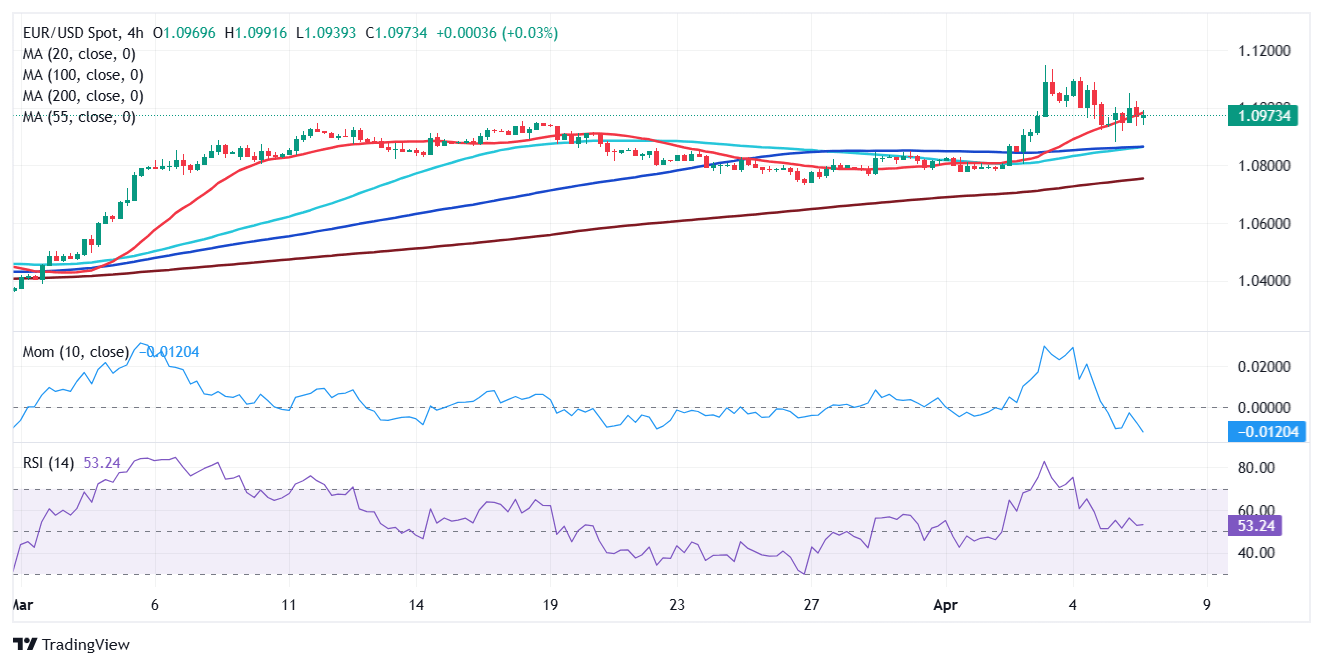
The EUR/USD pair gapped lower at the weekly opening, trading as low as 1.0881 during Asian trading hours. Risk aversion amid United States (US) President Donald Trump’s reciprocal tariffs temporarily boosted demand for the US Dollar (USD). The American currency quickly retreated, driven by the same fears that sent stock markets into a selling spiral, resulting in EUR/USD trading in the 1.0970 region early in the American session.
Financial markets are all about fears that the recently announced tariffs will push inflationary pressures higher, and hence, undermine growth. Even further, speculation mounts that central banks will not only interrupt monetary loosening but also consider rate hikes in the foreseeable future, with additional detriment to economic progress.
Meanwhile, mixed European data kept the upside limited for the Euro (EUR). German Industrial Production fell by 1.3% in February, down from the 2% advance posted in January. At the same time, the Eurozone (EU) Sentix Investor Confidence index plummeted to -19.5 in April from -2.9 in March. Finally, EU Retail Sales increased a modest 0.3% in February, missing expectations of 0.5%. The US session will be lighter, with no relevant data scheduled on Monday. With that in mind, market participants will keep taking clues from stocks.
Wall Street futures plummeted, with the three major indexes well below their Friday closing levels, anticipating a third consecutive black day in America.
EUR/USD short-term technical outlook
The daily chart for the EUR/USD pair shows the pair found buyers near a still bullish 20 Simple Moving Average (SMA) currently at around 1.0867. Technical indicators, however, remain flat, with the Momentum indicator stuck around its 100 line, but the Relative Strength Index (RSI) indicator consolidating around 63. Finally, the 100 and 200 SMAs remain far below the current level and lack directional strength.
The near-term picture indicates limited buying interest, although a steeper decline is also out of the picture. EUR/USD struggles around a firmly bullish 20 SMA, bouncing quickly on intraday slides below it. The longer moving averages offer neutral-to-bullish slopes over 150 pips below the current level, too far away to be relevant. Technical indicators, in the meantime, offer uneven clues, with the RSI indicator consolidating within positive levels but the Momentum heading south below its midline.
Support levels: 1.0960 1.0910 1.0870
Resistance levels: 1.1005 1.1060 1.1120
Tariffs FAQs
Tariffs are customs duties levied on certain merchandise imports or a category of products. Tariffs are designed to help local producers and manufacturers be more competitive in the market by providing a price advantage over similar goods that can be imported. Tariffs are widely used as tools of protectionism, along with trade barriers and import quotas.
Although tariffs and taxes both generate government revenue to fund public goods and services, they have several distinctions. Tariffs are prepaid at the port of entry, while taxes are paid at the time of purchase. Taxes are imposed on individual taxpayers and businesses, while tariffs are paid by importers.
There are two schools of thought among economists regarding the usage of tariffs. While some argue that tariffs are necessary to protect domestic industries and address trade imbalances, others see them as a harmful tool that could potentially drive prices higher over the long term and lead to a damaging trade war by encouraging tit-for-tat tariffs.
During the run-up to the presidential election in November 2024, Donald Trump made it clear that he intends to use tariffs to support the US economy and American producers. In 2024, Mexico, China and Canada accounted for 42% of total US imports. In this period, Mexico stood out as the top exporter with $466.6 billion, according to the US Census Bureau. Hence, Trump wants to focus on these three nations when imposing tariffs. He also plans to use the revenue generated through tariffs to lower personal income taxes.
Premium
You have reached your limit of 3 free articles for this month.
Start your subscription and get access to all our original articles.
Author
Valeria Bednarik
FXStreet
Valeria Bednarik was born and lives in Buenos Aires, Argentina. Her passion for math and numbers pushed her into studying economics in her younger years.