EUR/USD Price Forecast: NFP could bolster a move to the 2024 highs
- EUR/USD built on Wednesday’s gains and reclaimed the area above 1.1100.
- Extra easing of the US labour market weighed on the US Dollar.
- US Nonfarm Payrolls may be crucial for the Fed's rate cut decision.

EUR/USD gained renewed upward momentum on Thursday, adding to the advance seen in the previous day and surpassing the 1.1100 yardstick, driven by persistent selling pressure on the US Dollar (USD).
In fact, the US Dollar Index (DXY) was under further pressure, breaking below the 101.00 support to print new five-day lows following another set of disheartening prints from the US labour market. Indeed, the US private sector added fewer jobs than initially estimated in August (+99K), according to the ADP report, which in turn accelerated speculation of a potential half-point rate cut by the Fed at its September 18 event.
Furthermore, investors are closely watching signals regarding the size of the Fed's anticipated rate cut this month, particularly after Fed Chair Jerome Powell hinted at the Jackson Hole Symposium that it might be time to adjust monetary policy. He noted that, unless there are unforeseen events, the labour market is unlikely to add significantly to inflationary pressures soon and stressed the Fed's reluctance to see further cooling in labour market conditions.
In the same line, San Francisco Fed President Mary Daly suggested on Wednesday that the Federal Reserve (Fed) should cut interest rates to maintain a healthy labour market, but the extent of the cuts would depend on upcoming economic data. She noted that, while the labour market has softened, it remains healthy.
In this context, the upcoming US Nonfarm Payrolls (NFP) report is expected to be crucial, especially given the Fed's shift from focussing solely on controlling inflation to preventing job losses. The employment data could heavily influence the size of the Fed's expected rate cut.
The CME Group's FedWatch Tool currently indicates around a 61% probability of a 25 bps rate cut in September, down from nearly 70% just days earlier.
On the other hand, the European Central Bank's (ECB) recent Accounts revealed that policymakers saw no strong reason to cut interest rates last month. However, they noted that this decision could be revisited in September due to the ongoing impact of high rates on economic growth.
Recent reports suggest increasing divisions among ECB policymakers about the growth outlook, which could influence future discussions on rate cuts. Some officials are concerned about a potential recession, while others focus on persistent inflationary pressures.
Nevertheless, lower-than-expected flash CPI data for August in Germany and the Eurozone could challenge the cautious stance of some officials, potentially paving the way for the ECB to consider another rate cut at its meeting on September 12.
In summary, if the Fed opts for additional or larger rate cuts, the policy gap between the Fed and the ECB could narrow over the medium to long term, potentially benefiting EUR/USD. This is especially possible as markets anticipate two more rate cuts from the ECB this year.
However, in the longer term, the US economy is expected to outperform that of Europe, which could limit any prolonged weakness in the dollar.
Lastly, speculators (non-commercial traders) have increased their net long positions in the Euro (EUR) to levels not seen since January, while commercial traders (like hedge funds) have raised their net short positions to multi-month highs, driven by a significant increase in open interest.
EUR/USD daily chart
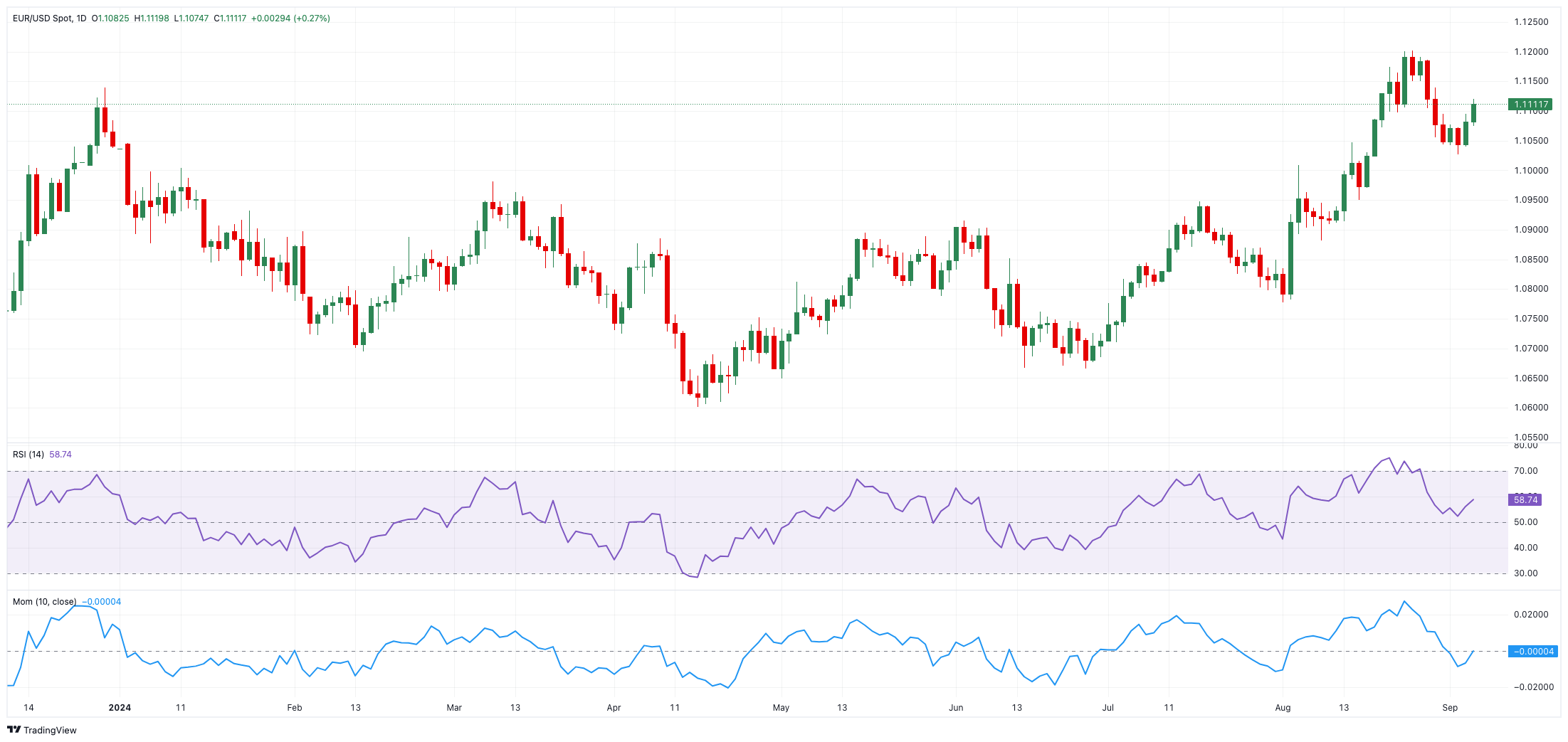
EUR/USD short-term technical outlook
Further north, the EUR/USD is likely to test its 2024 peak of 1.1201 (August 26), seconded by the 2023 high of 1.1275 (July 18), and the round level of 1.1300.
The pair's next downside objective is the September low of 1.1026 (September 3), prior to the preliminary 55-day SMA at 1.917, and the weekly low of 1.0881 (August 8). Down from here aligns the key 200-day SMA at 1.0855, ahead of the weekly low of 1.0777 (August 1), and the June low of 1.0666 (June 26).
Meanwhile, the pair's upward trend is projected to continue as long as it remains above the key 200-day SMA.
The four-hour chart indicates a slow return to bullish mood. The initial resistance level is 1.1119, followed by 1.1139, and 1.1190. Instead, there is immediate support at 1.1026, ahead of the 200-SMA of 1.0984 and then 1.0949. The relative strength index (RSI) increased to nearly 62.
Author

Pablo Piovano
FXStreet
Born and bred in Argentina, Pablo has been carrying on with his passion for FX markets and trading since his first college years.