EUR/USD Price Forecast: Immediately to the downside comes 1.0280
- EUR/USD added to Monday’s pullback and revisited the 1.0440 zone.
- The US Dollar bounced off recent lows helped by tariffs concerns.
- Investors’ attention now gyrates to FOMC Minutes on Wednesday.

EUR/USD tried to extend its recent rally at the beginning of the week but struggled to stay comfortably above 1.0500, sparking a correction to the 1.0445-1.0440 band so far.
The pair encountered decent selling pressure as the US Dollar (USD) regained part of its lost shine and rebounded from recent lows, briefly trespassing the key 107.00 barrier when gauged by the US Dollar Index (DXY).
The move higher in the Greenback was also underpinned by a decent bounce in US yields across the spectrum, as well as further advance in Germany’s 10-year bund yields, which climbed to monthly highs around 2.50%. Also underpinning the buying pressure in the US Dollar emerged steady concerns around Trump’s trade policies and the cautious stance from the Federal Reserve (Fed).
Tariff tensions kept markets on edge
Despite the absence of fresh headlines around US tariffs, global trade policies remain a major source of anxiety for traders. Although the White House delayed a 25% tariff on imports from Canada and Mexico, it kept a 10% duty on Chinese goods in place, keeping investors on their toes.
The situation escalated further when President Trump announced a 25% tariff on steel and aluminium imports, fuelling fears of more retaliation down the line. Initially, this lack of certainty around these protectionist measures led to a softer US Dollar, but the Greenback could regain traction if tariffs push US inflation higher and encourage the Federal Reserve to keep interest rates elevated.
Central banks in the spotlight
The Federal Reserve recently left its policy rate at 4.25%-4.50%, maintaining a cautious stance as it balances strong US economic growth, persistent inflation, and a robust labour market. Fed Chair Jerome Powell emphasized the importance of not cutting rates prematurely, underlining that any future moves will hinge on inflation trends and labour market performance.
Meanwhile, the European Central Bank (ECB) chose a different route by delivering a 25-basis-point rate cut aimed at supporting the eurozone’s sluggish growth. ECB President Christine Lagarde dismissed the idea of larger 50-basis-point cuts and signalled a more gradual approach, with future decisions driven by incoming data. Despite the ongoing trade tensions, Lagarde remained optimistic that inflation could return to target by 2025, suggesting a steady, measured path forward for ECB policy.
Winners and losers in a trade war
Should tariffs boost US inflation further, the Fed may lean hawkish for longer, which would likely strengthen the US Dollar. For the Euro, however, escalating trade disputes and the prospect of US tariffs on European Union (EU) imports could weigh on market sentiment, potentially dragging EUR/USD closer to parity sooner than anticipated. This scenario carries the potential to materialise at some point during Q2.
Technical outlook: Key levels to watch
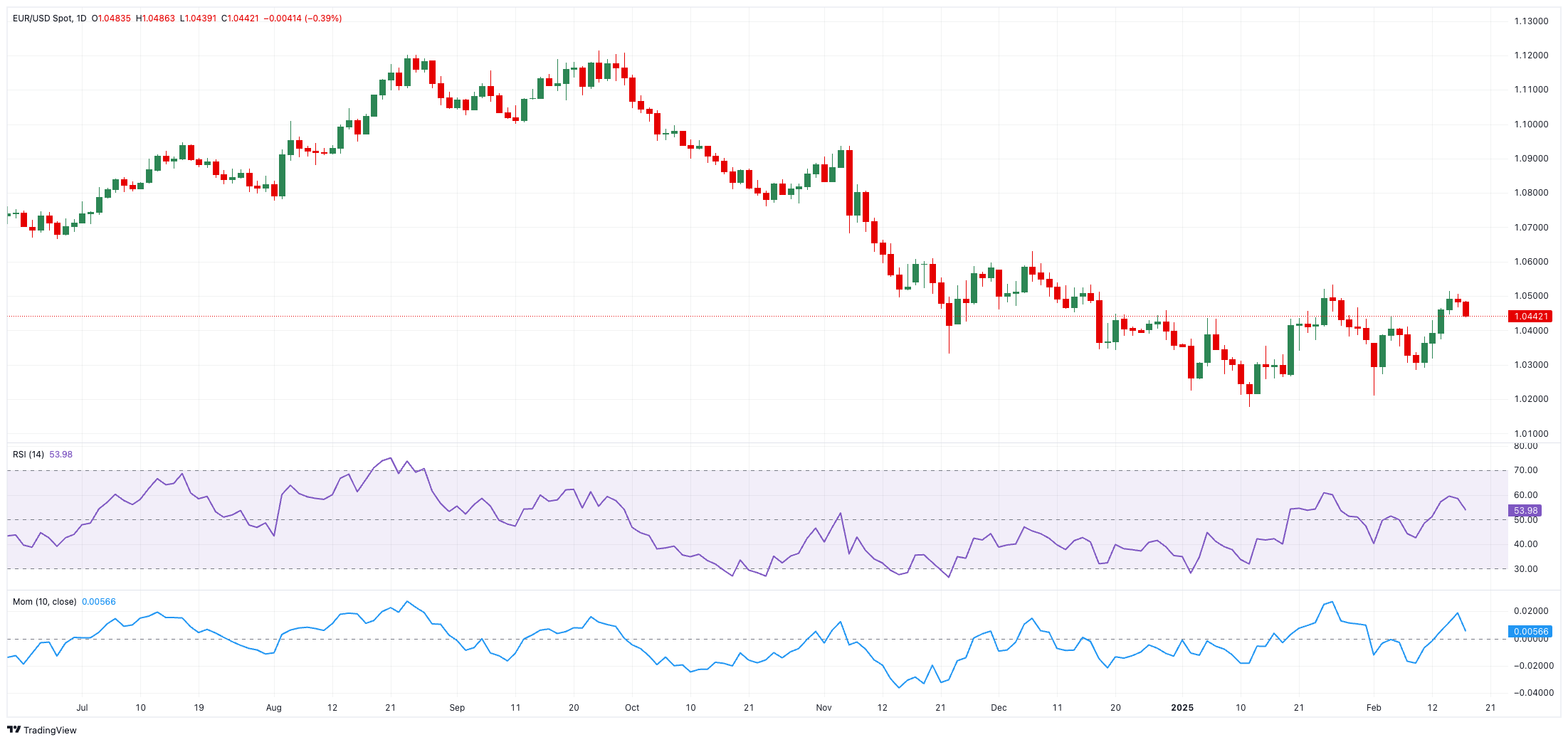
EUR/USD managed to regain its footing above 1.0500 in recent days, although that initial bull run lost impulse afterwards.
In case buyers regain the upper hand, they face an initial barrier at 1.0532 (the 2025 high from January 27), seconded by 1.0629 (the December peak), and 1.0744 (the 200-day Simple Moving Average (SMA)).
On the downside, the first layer of support stands at the transitory 55-day SMA at 1.0405, followed by the weekly low of 1.0282 recorded on February 10, and the monthly bottom of 1.0209 (February 3). A break beneath this level could open the door toward the YTD low of 1.0176 (January 13).
Technical indicators, in the meantime, send mixed signals: the Relative Strength Index (RSI) near 55 suggests building momentum, while the Average Directional Index (ADX) around 15 points to a weakening trend.
EUR/USD daily chart
What’s Next for the Euro?
At the moment, EUR/USD is being pulled in multiple directions: ongoing trade tensions, diverging central bank policies, sluggish growth across the eurozone, and political uncertainties, particularly in Germany. Although the pair could see short-lived bursts of strength, the broader outlook remains hazy until there is more clarity on trade developments and the policy paths of both the Federal Reserve and the European Central Bank.
Premium
You have reached your limit of 3 free articles for this month.
Start your subscription and get access to all our original articles.
Author

Pablo Piovano
FXStreet
Born and bred in Argentina, Pablo has been carrying on with his passion for FX markets and trading since his first college years.