EUR/USD Price Forecast: Gains still underpinned by the 200-day SMA
- EUR/USD added to Friday’s pullback, revisiting the area below 1.0800.
- The US Dollar clinched its second daily climb on the back of safe-haven demand.
- Global markets continued to grapple with recently announced tariffs.


The selling pressure in the Euro (EUR) is regaining its footing on Monday, prompting EUR/USD to briefly dip to the sub-1.0900 region to hit two-day lows on the back of another firm tone in the US Dollar (USD).
On the latter, the US Dollar Index (DXY) added to Friday’s gains and revisited the 103.50 zone helped by safe-haven inflows, persistent tariffs concerns and a decent rebound in US yields across different time frames.
Fresh tariffs: Europe’s next big economic challenge
Trump’s new trade plan imposes a baseline 10% tariff on all U.S. trading partners, plus additional levies ranging from 10% to 50% for specific countries. China faces a steep 34% surcharge on top of an existing 20% duty, while the European Union (EU) contends with a 20% tariff, the UK 10%, and Japan 24%. The baseline tariff kicked in on April 5, with the harsher reciprocal measures following on April 9.
Furthermore, President Donald Trump warned that he would impose new 50% tariffs on China if Beijing did not lift its retaliatory duties on U.S. exports by tomorrow.
Meanwhile, European Union (EU) President Ursula von der Leyen argued that while the EU was open to tariff negotiations with the U.S., the bloc was also preparing to retaliate if necessary.
Eastern Europe sees sparks of renewed hope
Meanwhile, geopolitical tensions in Eastern Europe have eased slightly after Ukrainian President Volodymyr Zelenskiy announced a ceasefire covering critical energy infrastructure and Black Sea routes—a deal partly brokered by the United States.
Moreover, President Trump also hinted at a potential US-Ukraine mineral revenue-sharing agreement, opening the door for American investment in Ukraine’s energy sector.
High seas ahead: Central banks face rising uncertainty
The Federal Reserve (Fed) recently kept interest rates unchanged, balancing the risk of inflation stoked by new tariffs against early signs of a cooling economy. Fed Chair Jerome Powell reaffirmed a “data-dependent” stance, noting that as much as 50 basis points of easing could still be on the table if growth weakens.
Additionally, Powell noted on Friday that, despite elevated uncertainty, it was becoming clear that tariff increases would be significantly larger than expected. He added that the economic fallout was likely to reflect this trend—resulting in higher inflation and slower growth—and emphasised that these factors would force the central bank to confront some challenging decisions ahead.
Across the Atlantic, the ECB lowered its key rate by 25 basis points and signalled additional easing if uncertainty persists. New projections highlight softer growth and sticky near-term inflation, though policymakers see price pressures subsiding by 2026. ECB President Christine Lagarde cautioned that a tariff showdown with the US could shave 0.5% off Eurozone GDP. Money markets currently price in an 80% chance of another rate cut this month.
Lagarde underscored the global fallout that tariffs could have, while ECB Board member Isabel Schnabel highlighted the profound impact of US policy on Europe. Robert Holzmann, however, argued that with Eurozone inflation easing and current rates not restraining growth, further cuts are unnecessary—though he conceded that a trade war might force central banks to consider unconventional measures.
Euro bulls take a breather
Speculative traders are turning bullish on the Euro, although net long positions retreated to three-week lows near 52K contracts according to the CFTC report for the week ending April 1, a day before “Liberation Day”. In the meantime, commercial players trimmed their short positions, which now stand at nearly 83K contracts.
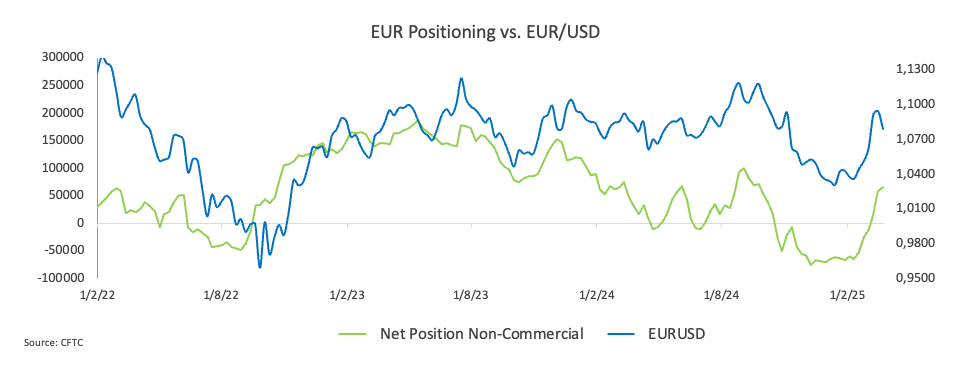
EUR/USD: Charting the next moves
Immediate upside for EUR/USD is limited by the 2025 peak at 1.1145 (April 3), with the round level at 1.1200 and the 2024 high at 1.1213 (September 25) as the next key resistance levels.
Looking south, initial support lies at the weekly low of 1.0732 (March 27), aligning with the 200-day SMA. A decisive break below this region could open the door to a deeper pullback toward the provisional 55-day SMA at 1.0616.
Technical indicators offer mixed signals. The Relative Strength Index (RSI) has eaased near 61, coming down from the overbought zone, while the Average Directional Index (ADX) above 31 points to a moderately strong trend overall.
EUR/USD daily chart

Looking ahead
Market participants will be laser-focused on any shifts in US trade policy, further developments in Eastern Europe, and fresh signals from both the Fed and ECB. The FOMC Minutes and US inflation figures will be the next salient events this week, as traders seek clues about the next moves for EUR/USD in this fast-changing landscape.
Premium
You have reached your limit of 3 free articles for this month.
Start your subscription and get access to all our original articles.
Author
Pablo Piovano
FXStreet
Born and bred in Argentina, Pablo has been carrying on with his passion for FX markets and trading since his first college years.