EUR/USD Price Forecast: Extra downside appears on the cards
- EUR/USD broke below the 1.0800 support to hit three-week lows.
- The US Dollar extended its march north to new multi-week tops
- Business activity in the region is seen picking up pace in March.


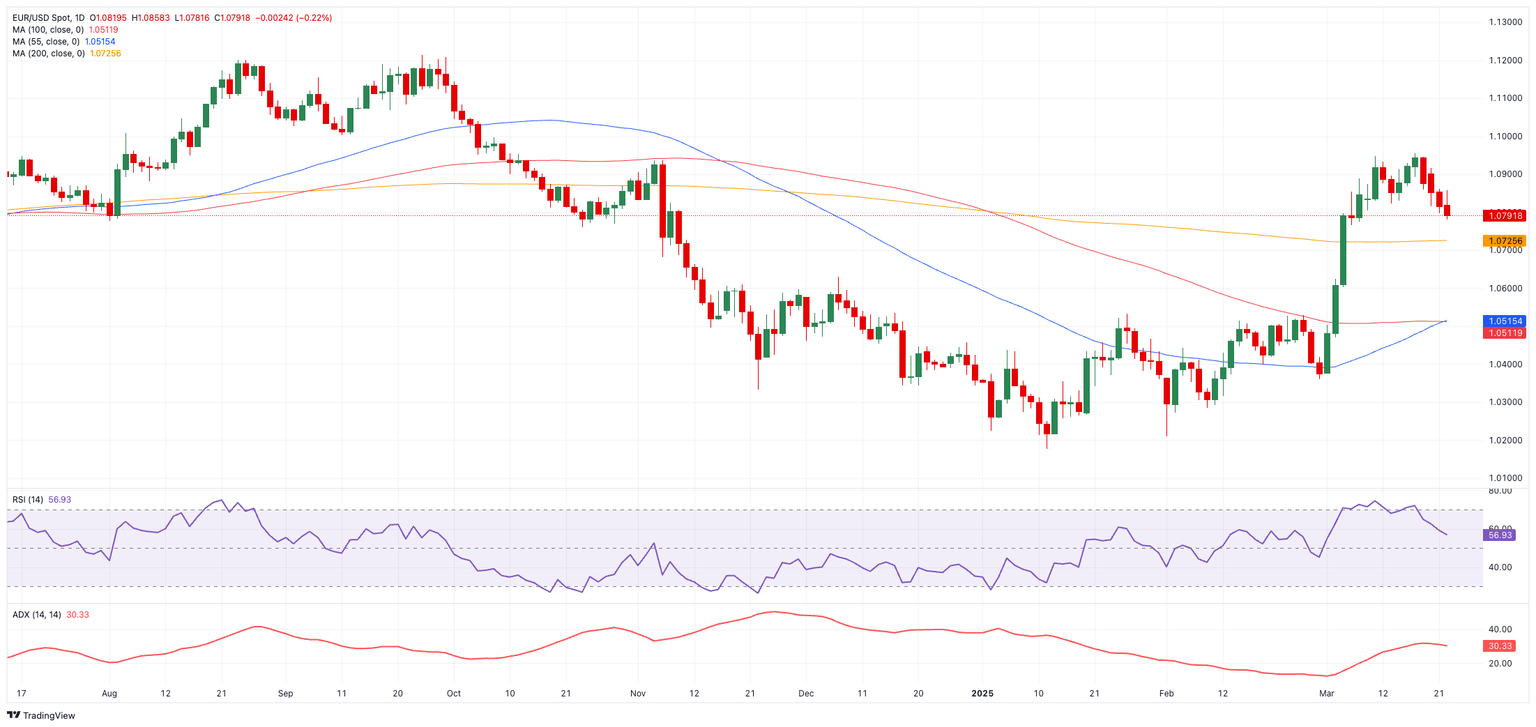
EUR/USD extended further the rejection from its recent yearly peaks in quite a negative start to the week, dipping below the 1.0800 support to reach fresh three-week troughs near 1.0780, an area also coincident with the temporary 100-day SMA.
This pullback came as the US Dollar (USD) regained extra traction, with the US Dollar Index (DXY) pushing further north of the 104.00 mark as investors kept digesting the latest developments around tariffs.
Trade tensions, stagflation, and the Dollar
Market sentiment remains tethered to shifting US trade policies, shaped by President Trump’s unpredictable stance on tariffs. While Canada and Mexico have secured a temporary reprieve until April 2, concerns over a potential global trade war persist. This anxiety clouds growth prospects and complicates the Fed’s policy outlook.
Tariffs can stoke inflation, which might nudge the Fed to maintain a tighter monetary posture. At the same time, these tariffs could undercut economic momentum, setting up a tug-of-war that leaves the Dollar’s near-term path murky.
In his latest comments, President Trump indicated on Monday that he would soon announce tariffs on automobiles, aluminium, and pharmaceuticals. Speaking to reporters at the White House, he remarked that the United States would need all those products if any problems, including wars, were to arise.
Euro gains hope from Russia-Ukraine peace efforts
The Euro (EUR) should find a measure of support on signs of progress in the Russia-Ukraine conflict. According to the Kremlin, Russian President V. Putin agreed to US President D. Trump’s proposal for a 30-day suspension of attacks on energy infrastructure—an announcement that followed nearly two hours of phone discussions between the two leaders.
On this front, Trump stated that he expected a US-Ukraine revenue-sharing agreement on Ukrainian critical minerals to be signed soon. He also mentioned to reporters during his Cabinet meeting that the United States was in discussions with Ukraine regarding the potential for American firms to acquire ownership of Ukrainian power plants.
Central banks under the spotlight
Last Wednesday, the Federal Reserve (Fed) kept interest rates steady, as expected, but hinted at a cumulative 50-basis-point rate cut by year-end. Officials cited softer economic activity and an eventual dip in inflation, even as they revised their 2025 inflation projection upward to 2.7% (from 2.5% in December). They also trimmed this year’s growth outlook to 1.7% (from 2.1%) and warned of “unusually elevated” economic risks.
Fed Chair Powell cautioned that tariff-driven price pressures could slow the inflation cooldown. While he acknowledged tariffs might already be lifting prices, he stressed that the ultimate impact on consumer behaviour and inflation expectations remains uncertain. Powell reiterated that the Fed won’t rush to cut rates further unless conditions take a turn for the worse.
Meanwhile, the European Central Bank (ECB) also lowered its benchmark rates by 25 basis points recently, signalling possible further easing if uncertainty lingers. Policymakers reduced Eurozone growth forecasts and nudged near-term inflation estimates higher, though they still anticipate a gradual moderation by 2026. Adding to the intrigue, some market participants believe the ECB may consider a pause in its easing cycle, which could alter the Euro’s trajectory.
ECB President Christine Lagarde noted that a US-EU trade war could shave up to 0.5 percentage points off Eurozone growth if both sides escalate tariffs. However, she suggested that deeper trade integration could offset those losses. Lagarde also applauded Germany’s fresh spending initiatives, despite the upward pressure on bond yields.
Euro bulls are back in town
Speculative net long positions in the Euro (EUR) continued to climb for the second consecutive week, surging toward 60K contracts—levels not seen since late September 2024. At the same time, hedge funds (commercial players) stayed net short on the single currency for the fourth straight week, but still pushed their total contracts to a multi-month high of around 92.4K, all according to the CFTC Positioning Report for the week ending March 18.

EUR/USD technical outlook
Resistance currently stands at 1.0954 (the March 18 YTD high), where a clear break could target 1.0969 (23.6% Fibonacci retracement) and potentially open the way for a test of the 1.1000 psychological barrier.
On the downside, immediate support lies at 1.0728 (the 200-day SMA), followed by 1.0520 (the provisional 100-day SMA) and 1.0514 (the 55-day SMA). If selling pressure builds, deeper downside targets include 1.0359 (February 28 low), 1.0282 (February 10 low), 1.0209 (February 3 low), and 1.0176 (2025 bottom, January 13).
Momentum indicators reversed to somewhat bearish, with the Relative Strength Index (RSI) retreating below 57, and the Average Directional Index (ADX) above 30 suggesting a strengthening trend.
EUR/USD daily chart
What to watch next
Expect EUR/USD to remain highly reactive to trade headlines, central bank policy shifts, and the broader Eurozone growth story—particularly as Germany amplifies its fiscal stimulus. Developments in the Russia-Ukraine peace talks could also move the needle quickly. Traders should keep a close eye on geopolitical updates and major economic releases that may reshape the pair’s short-term direction
Premium
You have reached your limit of 3 free articles for this month.
Start your subscription and get access to all our original articles.
Author
Pablo Piovano
FXStreet
Born and bred in Argentina, Pablo has been carrying on with his passion for FX markets and trading since his first college years.

















