EUR/USD Price Forecast: Corrective advance likely to be short-lived
EUR/USD Current price: 1.0254
- Sentiment improved amid speculation the US will gradually impose tariffs.
- The United States will publish the December Producer Price Index.
- EUR/USD bounced from recent lows, downward pressure remains intact.
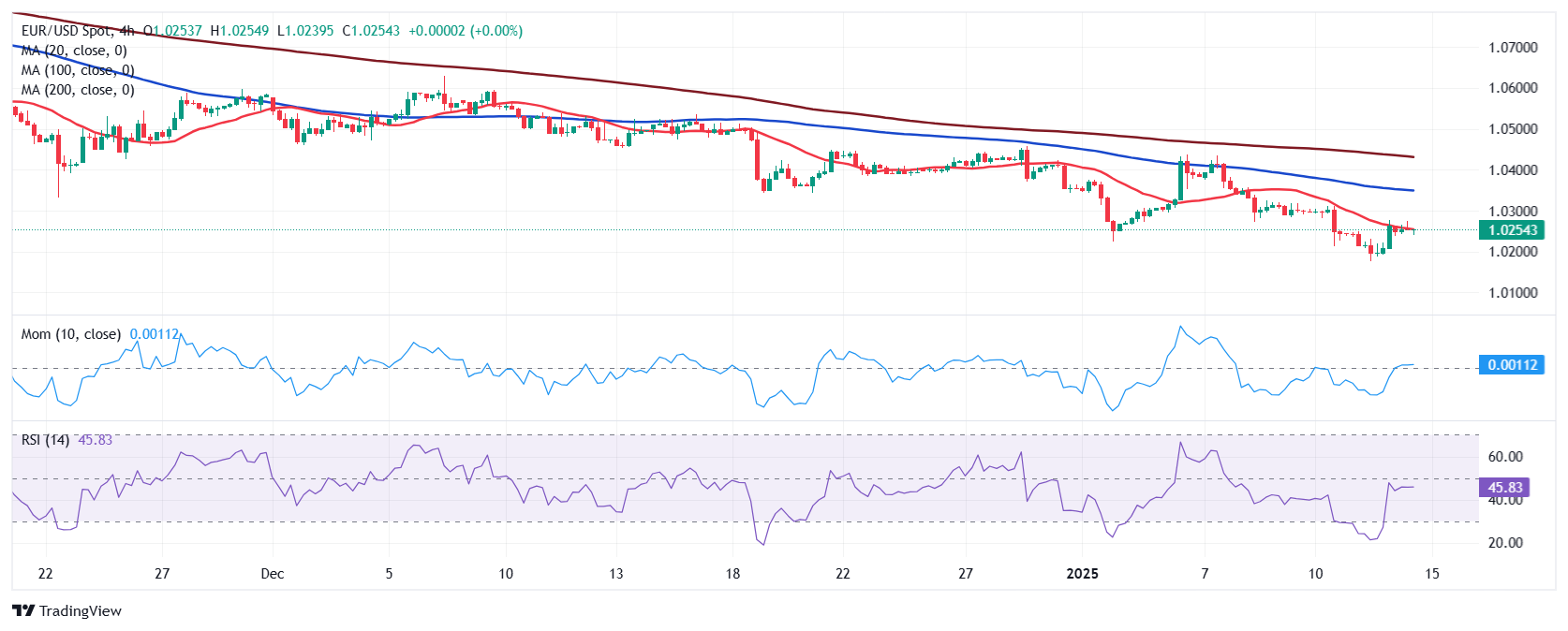
The EUR/USD pair is in recovery mode amid a better market mood. The pair trades around 1.0250, recovering from 1.0177, its lowest since November 2022. The improved sentiment results from market talks suggesting that President-elect Donald Trump’s team is looking at gradual tariff hikes month-by-month of 2-5%.
Stock markets are in better shape, but the market sentiment is far from optimistic. Wall Street futures post modest intraday losses as investors await an update on US inflation. The country will release the December Producer Price Index (PPI), ahead of the Consumer Price Index (CPI) scheduled for Wednesday. Also, a couple of Federal Reserve (Fed) speakers will be on the wires.
EUR/USD short-term technical outlook
The EUR/USD pair retains modest gains, yet technical readings in the daily chart suggest the recent recovery is just corrective, while additional gains are unclear. The 20 Simple Moving Average (SMA) maintains its downward strength well above the current level, providing dynamic resistance at around 1.0360. The 100 SMA comes next, yet in the 1.0760 region, reflecting the latest selling momentum. Finally, technical indicators have turned flat within negative levels, consolidating without clear directional clues.
In the near term, and according to the 4-hour chart, sellers retain control. EUR/USD is unable to advance beyond a bearish 20 SMA, which keeps heading south below also bearish 100 and 200 SMAs. The Momentum indicator aims higher below its midline, while the Relative Strength Index (RSI) indicator has already resumed its slide within negative levels and after correcting extreme oversold conditions.
Support levels: 1.0220 1.0175 1.0130
Resistance levels: 1.0280 1.0325 1.0360
Author

Valeria Bednarik
FXStreet
Valeria Bednarik was born and lives in Buenos Aires, Argentina. Her passion for math and numbers pushed her into studying economics in her younger years.