|

EUR/USD may extend falls as it has no significant support – Confluence Detector

The EUR/USD suffered the eventual USD strength that followed the Fed decision and the saga over the Italian budget. After dropping to around 1.1700, it does not have support and may continue falling. 

The Technical Confluences Indicator shows that the pair is capped by 1.1715 which is the convergence of the Pivot Point one-day Support 1, the Simple Moving Average 10-one-day, and the Bolinger Band one-hour Lower. 

Very strong resistance awaits at 1.1760 where we see the Fibonacci 38.2% one-day, the Bolinger Band 4h-Middle, the SMA 200-15m, the SMA 50-1h, the SMA 100-1h, the SMA 10-4h, the SMA 5-one-day, and the Fibonacci 23.6% one-week.

Looking down, we see only very weak confluences of support. 1.1690 is the Fibonacci 61.8% one-week and the BB 15-Lower. 1.1647 is the meeting point of the PP one-week S1 and the PP one-day S3. 1.1615 is where we see last week's low and the SMA 50-one-day.

All in all, the path of least resistance is down.

Here is how it looks on the tool:
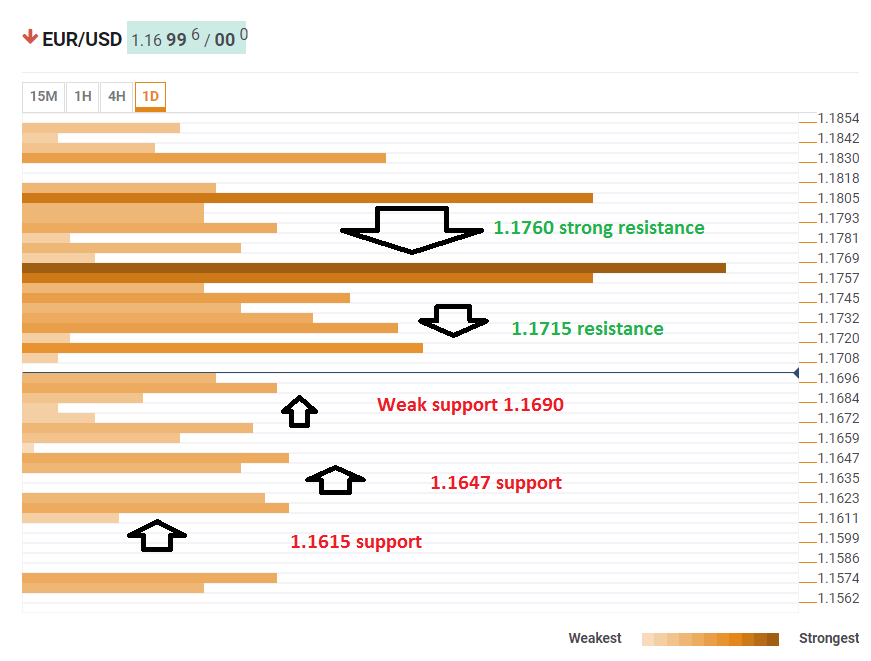
EUR USD Technical confluences September 27 2018

Confluence Detector

The Confluence Detector finds exciting opportunities using Technical Confluences. The TC is a tool to locate and point out those price levels where there is a congestion of indicators, moving averages, Fibonacci levels, Pivot Points, etc. Knowing where these congestion points are located is very useful for the trader, and can be used as a basis for different strategies.

This tool assigns a certain amount of “weight” to each indicator, and this “weight” can influence adjacents price levels. These weightings mean that one price level without any indicator or moving average but under the influence of two “strongly weighted” levels accumulate more resistance than their neighbors. In these cases, the tool signals resistance in apparently empty areas.

Learn more about Technical Confluence

Author

Yohay Elam

Yohay Elam

FXStreet

Yohay is in Forex since 2008 when he founded Forex Crunch, a blog crafted in his free time that turned into a fully-fledged currency website later sold to Finixio.


More from Yohay Elam
Share:

Editor's Picks

GBP/USD weakens to two-week lows near 1.3520

GBP/USD trades on the back foot, returning to the low 1.3500s, or two-week troughs, on Tuesday. Cable’s bearish price action follows decent gains in the Greenback at the time when investors assess latest US data releases and the persistent uncertainty in the US-Iran crisis.

EUR/USD remains offered; breaks below 1.1600

EUR/USD now accelerates its daily correction, breaching below the key 1.1600 support level on Tuesday. The pair’s daily correction comes on the back of a decent bounce in the US Dollar despite disappointing US data releases and amid persistent geopolitical concerns.

Gold bears eye $4,300 breakdown amid Fed hike bets, Iran risks, firm USD

Gold languishes near a two-and-a-half-week low, touched during the Asian session on Wednesday, awaiting a break below $4,300 before the next leg down. Escalating US-Iran tensions lift oil prices to a nearly six-week high and fuel inflation fears, reaffirming Fed rate-hike bets. This acts as a tailwind for the safe-haven US Dollar and undermines demand for the non-yielding bullion.

RBNZ set to raise interest rate to 2.75%
The Reserve Bank of New Zealand (RBNZ) is on track to deliver a follow-through interest rate hike, raising the Official Cash Rate (OCR) by another 25 basis points (bps) from 2.50% to 2.75% on Wednesday. Experts expect a consensus decision this week, unlike a deeply divided outcome predicted during the July monetary policy meeting.
Global bond market sell off haunts markets

Global sovereign bonds are selling off as we start a new month. The UK is, unsurprisingly, taking the biggest hit. Two and 10-year yields rose by 10 basis points at one point on Tuesday, and are currently higher by 7 and 8bps respectively.

Diesel’s record $100 warning: The oil shock hiding in plain sight

The Oil market may look calmer than it did a few months ago, but diesel is sending a very different message. The US diesel crack spread, the premium of ultra-low sulphur diesel futures over WTI, recently surged above $100 per barrel for the first time, reaching an intraday record of just over $102.00.














