EUR/USD Price Forecast: Lower low for the weeks at sight

EUR/USD Current price: 1.1116
- Tepid European data kept the upside limited for EUR/USD despite broad USD weakness.
- United States business activity growth remained robust in September, according to S&P Global.
- EUR/USD at risk of falling further, near-term support at around 1.1090.
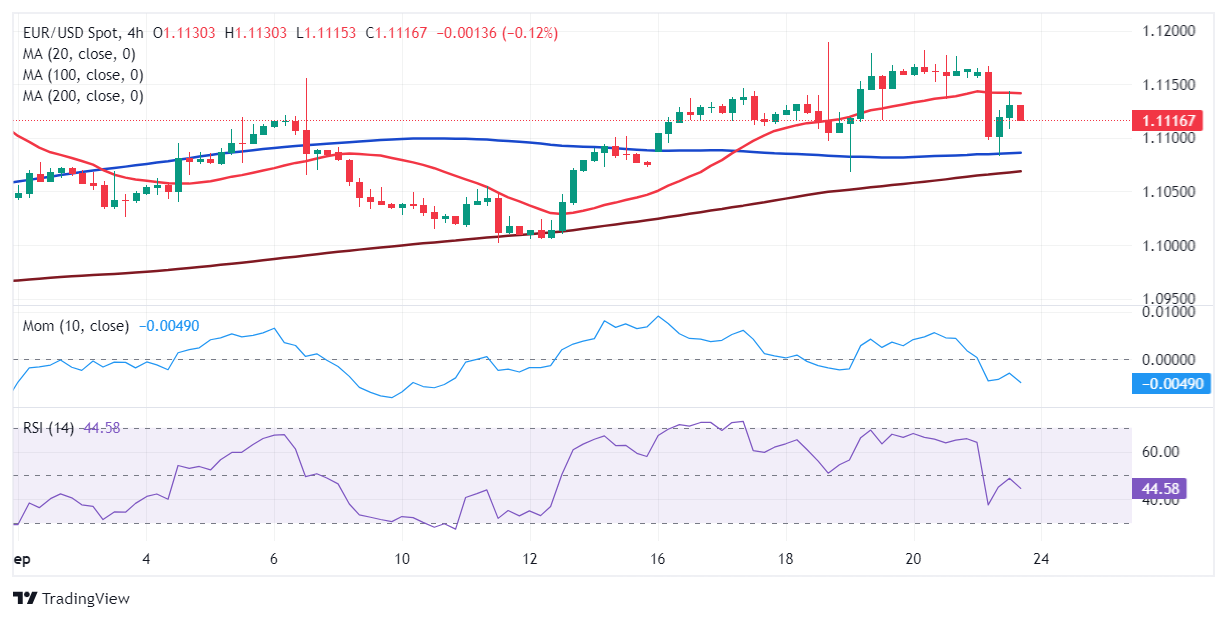
The EUR/USD pair heads into the Asian opening stable at around 1.1120, lifeless throughout the American session. The Euro failed to attract investors as tepid European data fueled speculation that the European Central Bank (ECB) would loosen the monetary policy by more than previously anticipated as the economy continues to underperform.
The Hamburg Commercial Bank (HCOB) released the flash estimates of the September Purchasing Managers Indexes (PMIs), which showed a persistent economic setback in the Eurozone. The German economy sunk “deeper into contraction,” according to the official report, as the Composite PMI fell for a fourth consecutive month, printing at 47.2 from 48.4 in August. The manufacturing index shrank to 40.3, while services output barely held within expansion levels, still declining from 51.2 previously to 50.6.
The Eurozone Composite PMI declined to 48.9, missing the 50.6 expected, with the manufacturing sector performing the worst. “The fall in output was the first in seven months and was registered amid a sustained reduction in new orders. In fact, new business decreased at the sharpest pace since January,” according to HCOB.
Across the pond, S&P Global released the preliminary estimates of the United States (US) PMIs, which showed business activity growth remained robust in September. The Manufacturing PMI declined to 47 from the previous 47.9, missing the 48.5 anticipated by financial markets. On the other hand, the Services PMI posted 55.4, better than the 55.2 expected. Finally, the Composite PMI was reported at 54.4, slightly below the previous 54.6. Meanwhile, multiple Federal Reserve officials hit the wires. Dovish comments came as no surprise but maintained the US Dollar on the back foot.
Germany will release the IFO Survey on Business Climate on Tuesday, while during American trading hours, the focus will be on September CB Consumer Confidence.
EUR/USD short-term technical outlook
The daily chart for the EUR/USD pair suggests the pair could extend its slide. Technical indicators gain bearish traction, although still within positive levels, falling short of confirming another slide. At the same time, a mildly bearish 20 Simple Moving Average (SMA) provides dynamic support at around 1.1090. The bearish case will be stronger should the level give up.
In the near term, and according to the 4-hour chart, the risk skews to the downside. The pair found intraday support at around a flat 100 SMA, but sellers contained advances around a directionless 20 SMA. At the same time, technical indicators hold within negative levels, with the Relative Strength Index (RSI) indicator gaining bearish traction and supporting a lower low for the week.
Support levels: 1.1090 1.1050 1.1010
Resistance levels: 1.1160 1.1200 1.1250
Author

Valeria Bednarik
FXStreet
Valeria Bednarik was born and lives in Buenos Aires, Argentina. Her passion for math and numbers pushed her into studying economics in her younger years.