EUR/USD is locked in a tight range but the upside is slightly more appealing – Confluence Detector

EUR/USD tumbled down as the global mood soured. Yet after the big drops in stocks and oil, things look calmer now. What's next?.
The Technical Confluences Indicator shows that the world's most popular currency pair faces some resistance around 1.1405 as this is the convergence of the Bollinger Band 4h-Middle and the Fibonacci 38.2% one-day.
Much more robust resistance awaits around 1.1423 where we see a dense cluster including the Simple Moving average 10-4h, the Fibonacci 38.2% one-month, the SMA 200-15m, the SMA 50-1h, last week's high, and the Bollinger Bands one-hour Upper.
Support awaits at 1.1375 where we see the confluence of the Fibonacci 23.6% one-month, the SMA 5-1h, the Fibonacci 23.6% one-month, the SMA 10-1h, the Bollinger Band 15m-Lower, and the BB one-day Middle.
The next support line is closer: 1.1357 is the meeting point of the SMA 10-one-day, the BB 1h-Lower, and the Fibonacci 38.2% one-week.
All in all, EUR/USD is surrounded by quite a few levels that should, in theory, keep it tight. However, a look at the chart shows that upside resistance is slightly weaker than downside support.
Here is how it looks on the tool:
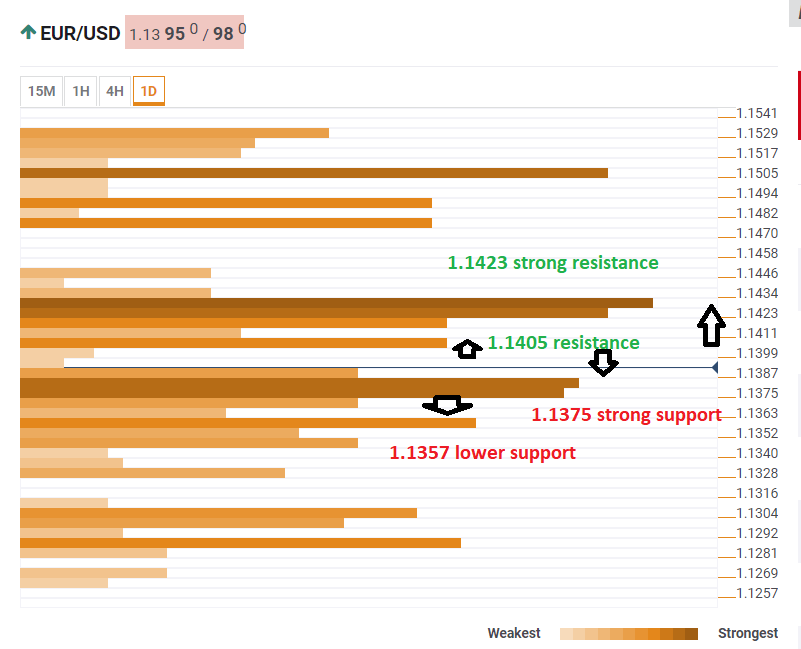
Confluence Detector
The Confluence Detector finds exciting opportunities using Technical Confluences. The TC is a tool to locate and point out those price levels where there is a congestion of indicators, moving averages, Fibonacci levels, Pivot Points, etc. Knowing where these congestion points are located is very useful for the trader, and can be used as a basis for different strategies.
This tool assigns a certain amount of “weight” to each indicator, and this “weight” can influence adjacents price levels. These weightings mean that one price level without any indicator or moving average but under the influence of two “strongly weighted” levels accumulate more resistance than their neighbors. In these cases, the tool signals resistance in apparently empty areas.
Author

Yohay Elam
FXStreet
Yohay is in Forex since 2008 when he founded Forex Crunch, a blog crafted in his free time that turned into a fully-fledged currency website later sold to Finixio.
















