EUR/USD Forecast: What’s next after testing 1.0760?

EUR/USD Current Price: 1.0834
- Trading is expected to be dull at the end of the week as most countries celebrate Good Friday.
- The European Central Bank decided to maintain its monetary policy on hold.
- EUR/USD recovered from a fresh 2-year low of 1.0756 but is still on the bearish path.
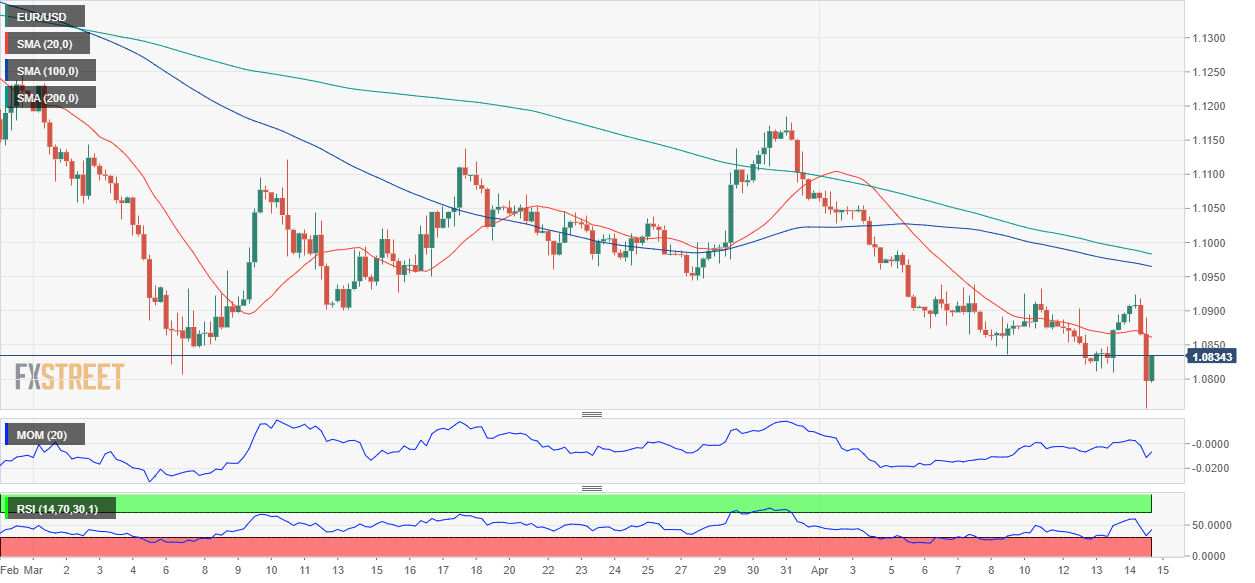
The EUR/USD pair plunged to 1.0756, its lowest since May 2020, following tepid US data and a dovish European Central Bank monetary policy decision. The central bank kept rates on hold as widely anticipated and repeated that it would end its bond-buying program in the third quarter of the year. Monthly net purchases will amount to €40 billion in April, €30 billion in May and €20 billion in June.
The statement was quite dovish, as it noted that Russia's aggression is affecting the economies in Europe and beyond. Higher energy and commodity prices are affecting demand and slowing production, which results in higher inflation. Also, trade disruptions are leading to new shortages of materials and inputs, another factor weighing on prices pressure. President Christine Lagarde said it was “premature” to discuss quantitative tightening, adding that rate hikes could begin “sometime after” the end of the APP program.
Across the pond, the US released March Retail Sales, which were up by 0.5% MoM, below the 0.6% expected. Also, Initial Jobless Claims for the week ended April 8 printed at 185K, worse than anticipated. Finally, the country published the preliminary estimate of the April Michigan Consumer Sentiment Index, which printed at 65.7, better than the 59 expected. Additionally, New York Federal Reserve President John Williams hit the wires, saying that the central bank should reasonably consider hiking by 50 bps in May.
Most financial markets will be closed on the last day of the week amid the Good Friday holiday. Nevertheless, the US will release some macroeconomic figures, including March Industrial Production and Capacity Utilization and the April New York State Manufacturing Index.
EUR/USD short-term technical outlook
The EUR/USD pair bounced from the mentioned low, heading into the daily close trading around the 1.0830 level. The daily chart shows that the bearish case remains firmly in place as it trades below bearish moving averages, while technical indicators turned lower within negative levels, with room to extend their slides.
The near-term picture is also bearish. The 4-hour chart shows that the pair settled below bearish moving averages, with the 20 SMA currently providing dynamic resistance at around 1.0860. The longer moving averages maintain their bearish slopes above the level, while the Momentum indicator heads firmly lower within negative levels. The RSI indicator, in the meantime, consolidates at around 41.
The 1.0760 level is a strong long-term static support level, and the pair bounced after testing it. Nevertheless, it remains on the losing side and could only turn bullish once above the 1.0960 region. The next relevant bearish target is 1.0635, the March 2020 low.
Support levels: 1.0800 1.0760 1.0720
Resistance levels: 1.0860 1.0920 1.0965
Author

Valeria Bednarik
FXStreet
Valeria Bednarik was born and lives in Buenos Aires, Argentina. Her passion for math and numbers pushed her into studying economics in her younger years.