|

EUR/USD Forecast: still bearish, despite strong EU PMIs

The EUR/USD pair bounced modestly in the European morning, following the release of generally positive European PMIs, although the pair remains below the 1.0900 level, not far from the 7-month low set at 1.0859. Preliminary October figures show that the EU as a whole grew at it’s a fastest pace so far this year, led by Germany. The EU Markit PMI composite printed 53.7, against previous 52.6, while German one came in at 55.1, against previous 52.8, both beating expectations. Later on the day, the US will offer a couple of FED's speakers, and the preliminary Markit Manufacturing PMI.
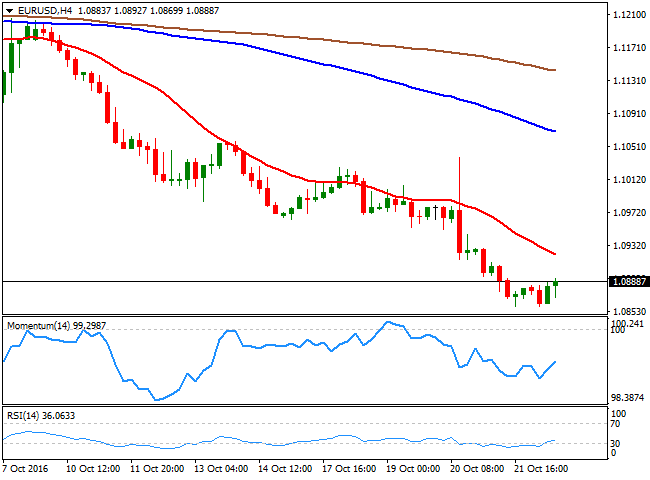
In the meantime, the 4 hours chart shows that the pair has bounced twice from the mentioned low, on Friday and today, and that the price is already above the neckline of the small figure that has a height of 25 pips and would be complete if the pair reaches 1.0910. In the same chart, technical indicators have corrected extreme oversold conditions, but present a limited upward momentum well below their mid-lines, whilst the 20 SMA maintains a strong bearish slope above the current level, around 1.0925.

Overall, the dominant bearish trend remains firm in place and failure to regain the 1.0900 level should lead to a test of 1.0800, en route to 1.0760. Should the price recover beyond the 1.0910/20 region, the pair can correct up to 1.0960, particularly on disappointing US data.

View live chart of the EUR/USD

Author

Valeria Bednarik

Valeria Bednarik was born and lives in Buenos Aires, Argentina. Her passion for math and numbers pushed her into studying economics in her younger years.


More from Valeria Bednarik
Share:

Editor's Picks

AUD/USD hits nine-week lows below 0.7000 on RBA Bullock's remarks

AUD/USD reverses a brief uptick and turns lower to hit nine-week lows below 0.7000 in the European morning on Tuesday, as traders digest cautious remarks from Reserve Bank of Australia (RBA) Governor Michele Bullock during the press conference. Earlier on, the RBA raised the cash rate to 4.60%, as widely expected, leaving the door open to further rate hikes if needed.

USD/JPY consolidates near 157.50 as a bullish USD counters intervention risks

USD/JPY struggles to capitalize on the overnight bounce from a one-week low, consolidating around 157.50 in the Asian session on Tuesday. Trump's concerns about the Japanese Yen's weakness fueled speculation about another US-Japan joint intervention. This, along with the hawkish BoJ, underpins the JPY and caps the currency pair. Meanwhile, rising Fed rate-hike bets and oil-driven inflation fears continue to push US bond yields to multi-year highs, keeping the US Dollar pinned near a two-month high and supporting the pair.

Gold regains some traction; focus remains on $4,100

Gold manages to gather some composure and bounces off recent lows near the key $4,100 mark per troy ounce on Tuesday. The move higher in the precious metal comes despite the firmer US Dollar and rising US Treasury yields across the board, while escalating geopolitical tensions appear to limit the downside potential.

Crypto Today: Bitcoin, Ethereum, XRP correct upward amid declining ETF inflows

The cryptocurrency market upholds a neutral-to-bullish bias on Tuesday, with Bitcoin edging closer to a breakout above $84,000. Altcoins mirror BTC’s outlook, with Ethereum holding above $2,700 and Ripple pushing past the reclaimed $1.50 level.

RBA recap: Rate hikes are on the table as demand stays too strong

The Reserve Bank of Australia unanimously tightened monetary policy, warning that inflation remained too high and that several upside risks had begun to materialise. Governor Michele Bullock said the Board would raise rates again if necessary.

Fed vs BoJ: Both hiked. The market only believes one of them – and the chart shows which

The Fed and the BoJ have just done something remarkably similar. Both central banks raised interest rates by 25 bps last week, both are confronting inflation risks, and both signal that future decisions will depend on incoming economic data.