|premium|

EUR/USD Forecast: Poised to challenge a critical resistance level

EUR/USD Current Price: 1.1862

  • Dollar in sell-off mode amid renewed optimism about a US stimulus package.
  • US Treasury yields advanced to fresh multi-week highs, play against the greenback.
  • EUR/USD is technically bullish and could regain the 1.1900 threshold.
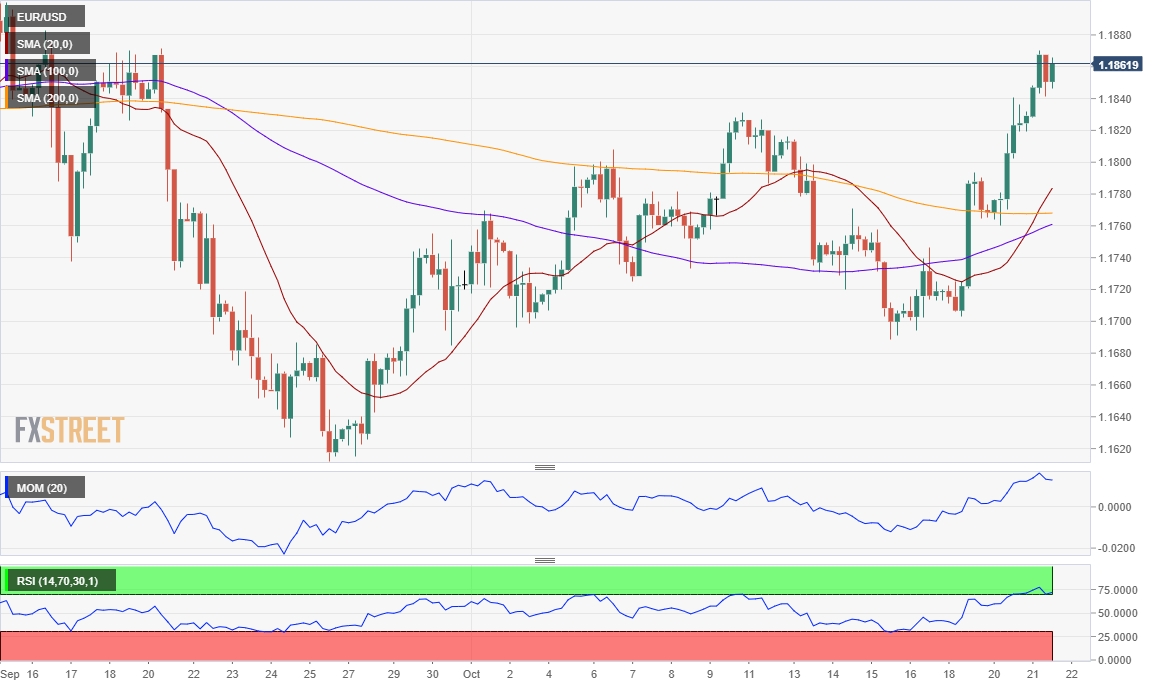
The EUR/USD pair has extended its weekly advance to 1.1870 this Wednesday, amid persistent dollar’s weakness. Overnight, talks about a US stimulus aid package provided support to the high-yielding EUR, as US Treasury Secretary Steven Mnuchin and House Leader Nancy Pelosi reported progress in trade talks, and said they would continue negotiations this Wednesday.

The greenback remained under pressure, despite the sour tone of equities, with European indexes in the red, dragging US futures lower. A sign of diminished dollar’s demand comes from government bonds, as US Treasury yields are sharply up and at fresh multi-week highs.

The macroeconomic calendar has no saying in price action, particularly considering there’s only minor data in the docket. The EU didn’t publish relevant numbers, while the US unveiled MBA Mortgages Applications for the week ended October 16, which were down 0.6%.

EUR/USD short-term technical outlook

The EUR/USD pair is poised to challenge the mentioned high, also a static resistance level. The 4-hour chart shows that the advance extended above all of the moving averages, while the 20 SMA accelerated north and crossed above the larger ones. Technical indicators, in the meantime, maintain their bullish slopes, despite being in overbought territory. A break through 1.1870 should see the pair regaining the 1.19 threshold during the upcoming sessions.

Support levels: 1.1830 1.1780 1.1740

Resistance levels: 1.1870 1.1915 1.1950

 View Live Chart for the EUR/USD

Premium

You have reached your limit of 3 free articles for this month.

Start your subscription and get access to all our original articles.

Subscribe to PremiumSign In

Author

Valeria Bednarik

Valeria Bednarik was born and lives in Buenos Aires, Argentina. Her passion for math and numbers pushed her into studying economics in her younger years.


More from Valeria Bednarik
Share:

Editor's Picks

GBP/USD gains as easing Fed hike bets weigh on US Dollar

GBP/USD continues its winning streak for the ninth consecutive day, trading around 1.3390 during the Asian hours on Tuesday. The currency pair rises as the US Dollar faces headwinds as market participants scale back expectations for Federal Reserve rate hikes this month and in September. 

EUR/USD eases toward 1.1400 as Hormuz risks support USD

EUR/USD is easing toward 1.1400 in European trading on Tuesday, facing rejection at the 1.1450 level. The pair loses ground amid a modest recovery in the safe-haven US Dollar, as renewed tensions in the Strait of Hormuz and Asian tech sell-off fuel risk aversion.

Gold sticks to losses as inflation fears lift US bond yields and USD amid Hormuz risks

Gold maintains its offered tone heading into the European session, albeit it holds above the $4,100 mark. Crude oil prices edge higher amid renewed tensions in the Strait of Hormuz, reviving inflationary concerns. This, in turn, triggers a fresh leg up in US Treasury bond yields, offering some support to the US Dollar, and weighing on the non-yielding yellow metal for the second straight day.

Bonk extends correction after $20 million hack from BonkDAO treasury

Bonk remains under pressure, trading below $0.0000044 after losing over 10% in the previous day. Monday’s correction occurred as Bonk Decentralized Autonomous Organization announced a governance exploit that resulted in the theft of $20 million worth of BONK tokens from its treasury.

Bye, forward guidance: How to trade when central banks choose silence
Central banks have spent years telling markets what might come next. Now, traders face the possibility that they say a lot less. From the Federal Reserve to the European Central Bank and the Bank of England, policymakers are pushing back against forward guidance, arguing that the current world demands more flexibility.
Bye, forward guidance: How to trade when central banks choose silence

Central banks have spent years telling markets what might come next. Now, traders face the possibility that they say a lot less. From the Federal Reserve to the European Central Bank and the Bank of England, policymakers are pushing back against forward guidance.