EUR/USD Forecast: How aggressive would the Fed be after today?

EUR/USD Current Price: 1.0542
- The European Commission announced the sixth package of sanctions on Russia.
- US ADP survey missed the market’s expectations, while investors await Fed’s decision.
- EUR/USD grinds marginally higher, but bears are still in the drivers’ seat.
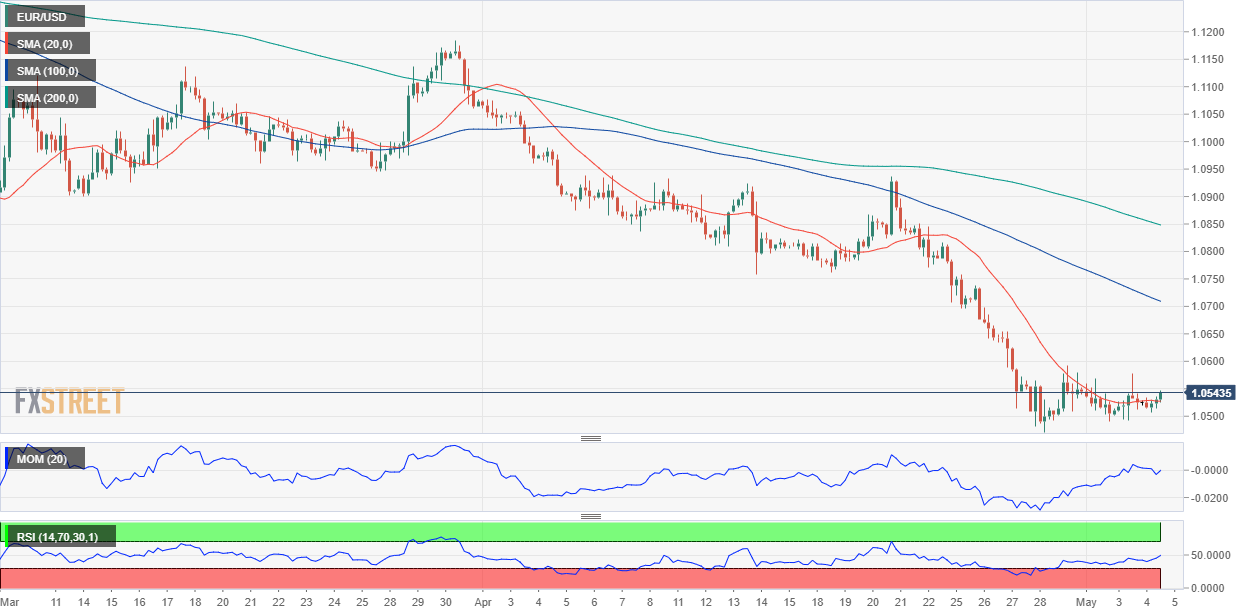
The EUR/USD pair trades around the 1.0540 level, confined to a tight range ahead of the US Federal Reserve monetary policy announcement. The central bank has widely anticipated it would become more aggressive amid overheating inflation. Market players are predicting a 50 bps rate hike, alongside details about the balance sheet reduction, most of which have been already priced in.
Policymakers are determined to drain the massive liquidity introduced to support the economy at the early stages of the COVID-19 pandemic. The focus will be on what they are planning next and how aggressive they’ll continue to be. If US policymakers consider next hikes should not be as aggressive, there is a good chance for equities to rally on relief, to the detriment of the greenback. On the other hand, if they suggest another 50 bps movement in the next meeting, high-yielding assets may take a hit, and the American currency soar.
Meanwhile in Union, European Commission President Ursula von der Leyen presented the sixth pack of Russian sanctions. She said the region would phase out the Russian supply of crude oil and refined products by the end of the year. The news weighed on high-yielding assets, keeping European indexes trading in the red amid the potential effects on economic growth.
Data wise, S&P Global published the final readings of the April Services PMIs. The German index was downwardly revised to 57.6, while the EU one was confirmed at 57.7. Retail Sales in the Union were worse than anticipated in March, down 0.4% MoM. The US ADP survey on private job creation showed 247K new positions were added in April, missing the expected 395K increase. Also, the March Goods and Services Trade Balance posted a deficit of $109.8 billion, wider than anticipated. The US will later release the April ISM Services PMI, foreseen at 58.5.
EUR/USD short-term technical outlook
The EUR/USD pair keeps trading near a multi-year low of 1.0470 achieved last week, consolidating yearly losses. The daily chart shows that bears are still in the drivers’ seat, given that technical indicators remain lifeless near oversold readings, reflecting absent buying interest. At the same time, the pair is far below all of its moving averages, with a bearish 20 SMA providing dynamic resistance around 1.0730.
In the near term, and according to the 4-hour chart, the pair is neutral. It keeps seesawing around a flat 20 SMA while the longer moving averages maintain their downward slopes far above the current level. Technical indicators aim to cross their midlines into positive territory but without enough momentum to confirm a firmer recovery. Bulls will have better chances if the pair extends its rally above 1.0595, April 29 daily high and the immediate resistance level.
Support levels: 1.0505 1.0470 1.0420
Resistance levels: 1.0595 1.0630 1.0680
Author

Valeria Bednarik
FXStreet
Valeria Bednarik was born and lives in Buenos Aires, Argentina. Her passion for math and numbers pushed her into studying economics in her younger years.