Weekly market analysis: Euro, S&P 500, and Crude Oil through Elliott Wave theory [Video]
![Weekly market analysis: Euro, S&P 500, and Crude Oil through Elliott Wave theory [Video]](https://editorial.fxsstatic.com/images/i/eur-usd-002_XtraLarge.jpg)

This weekly market analysis provides a structured examination of the euro, S&P 500, and crude oil, combining Elliott Wave theory, quantitative models, backtesting, and artificial intelligence tools. The objective is to identify opportunities while maintaining controlled drawdowns and enabling stable growth curves.
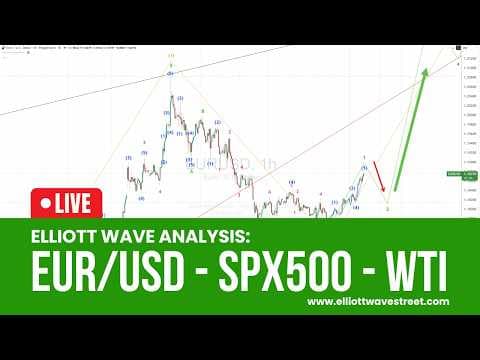
The following sections offer a clear breakdown of probable scenarios, the logic behind each hypothesis, and practical applications of these concepts for systematic trading plans.
Why win rate is insufficient for evaluating trading systems
The win rate fallacy
In financial trading, a common misconception persists: "the higher the win percentage, the better the strategy." However, in-depth system examination reveals that very high win rates can conceal devastating drawdowns.
A system can achieve 80% winning trades and still result in account ruin. This occurs when risk management is deficient—the few losses produced become so large they absorb months of gains. This frequently happens in systems that don't use stop losses or place them too far away, trusting that "the market will eventually return."
The risk unit framework
Critical shift in evaluation methodology:
Evaluate results in risk units rather than solely in win percentage. A system generating 46 risk units of return over six months with a 42% win rate can be substantially more robust than another with 80% accuracy but extreme drawdowns.
Advantages of this framework:
- Determines if the strategy grows consistently or depends on unrepeatable lucky streaks
- Provides clarity on risk-adjusted performance
- Reveals true system robustness beyond superficial metrics
The sharpe ratio and equity curve health
Understanding equity curve quality
The Sharpe ratio quantifies the relationship between average returns and return volatility. In practical terms, it indicates how "smooth" the account growth curve is.
Equity curve characteristics
Healthy system:
- Curve rises with small, controlled drawdowns
- Reflects a healthy Sharpe ratio
- Sustainable growth pattern
Problematic system:
- Curve rises then falls with deep drawdowns
- Poor Sharpe ratio despite a positive ending
- High risk of future collapse
Practical application
When analyzing trading history, the equity curve analysis should answer:
"Does this show a line growing with moderate corrections or chaotic saw-tooth movement with drops erasing months of progress?"
Benefits of adopting the Sharpe ratio as a compass:
- Detects if the risk per trade is coherent
- Enables position size adjustment during increased volatility
- Protects funded accounts where a drawdown limit can mean immediate account loss
This approach doesn't just seek profits—it seeks sustainable profits, critical for professional trading longevity.
Risk management in funded accounts: Avoiding account loss
The funded account challenge
Funded accounts have opened attractive opportunities for traders seeking to operate with larger capital without risking personal funds. However, they've also revealed a recurring pattern: most participants fail by not adapting risk management to the funding firm's rules.
Practical implementation example
Operating a $100,000 account with 0.5% risk per trade allows system design where each risk unit perfectly aligns with daily and total loss limits.
When connecting a trading strategy with these risk units:
- Precise estimation of how many consecutive losing trades can be sustained without violating rules
- Better understanding of tolerable adverse streaks and when size reduction or stopping is mandatory
- Avoidance of impulsive decisions to "recover quickly"—a primary cause of funded account expulsion
This discipline protects not only borrowed capital but also credibility and continuity as a funded trader. The approach enables longer operational periods and capitalizes on the best opportunities when they truly appear.
Elliott Wave analysis on the Euro: Impulse, correction, and high-probability zones
Current structure
The euro versus the dollar exists in a bullish context, while the dollar shows relative weakness. From an Elliott Wave perspective, this translates to a five-wave impulsive move upward, followed by a three-wave correction.
Structural breakdown
Working Scenario:
- Five-wave impulse upward (waves 1-5), marking the market's dominant direction
- Corrective wave 2 retracing part of the initial movement, creating a high-probability zone for long entries
Integration with price action and smart money concepts
Key identification points:
- Change of behavior moments where market dynamics shift
- Liquidity accumulation zones, typically near significant previous lows
- Fibonacci retracement levels (e.g., 38.2%–61.8%) where trend resumption probabilities increase
Strategic advantage:
This approach prevents chasing price at highs, instead waiting for mature pullbacks to enter with superior risk/reward ratios. This avoids common losses from those who buy late, just before inevitable corrections.
S&P 500: Accumulation, breakout potential, and long-only strategy
Long-term structural analysis
The S&P 500 remains in a phase where long-term structure continues bullish despite intermediate pullbacks. Using Elliott Wave theory, the market appears to be transitioning through a corrective wave 4, prior to a fifth wave upward that could carry the index toward the 7,000-point zone or higher.
Strategic framework
Sensible approach in this context:
- Maintain a long-only perspective on the index, prioritizing trades favoring the dominant trend
- Use deep pullbacks as accumulation zones rather than attempting to sell each correction
- Integrate Fibonacci projections to estimate fifth-wave targets, such as 100% or 161.8% of the 1–3 leg
Operational Benefits:
This framework aligns decisions with the market's larger structure, avoiding the temptation to fight against a trend that repeatedly punishes those insisting on selling each rise. Capital becomes positioned on the side of probability rather than impulsive intuition.
Crude Oil: Bearish trend and AI model support
Bearish bias and quantitative integration
Crude oil shows a bearish bias, with short opportunities becoming clearer when integrated with an AI-assisted quantitative model. In this case, AI doesn't replace the trader but acts as an assistant that:
AI model functions:
- Scans price structures across multiple timeframes
- Detects statistically favorable patterns for short positions
- Suggests entries, stop losses, and targets based on the asset's historical behavior
Operational advantage
The significant benefit of this approach is the reduction of emotional noise in decision-making. With clear rules per instrument, optimal timeframes, and data-based filter criteria, bearish trades in crude oil cease being isolated impulses and become part of a repeatable methodology.
With this type of system, execution can focus on disciplined implementation, knowing that behind each signal exists a research and backtesting process supporting the probabilities.
Integration: Psychology, discipline, and technology
The critical missing component
No technical strategy, however sophisticated, will function favorably without solid trading psychology support. When working with Elliott Waves, quantitative tools, and artificial intelligence, the primary challenge lies not only in market reading but in trusting the plan and executing it consistently.
Critical success factors
Key discoveries in systematic trading:
- Patience to wait for wave 2 in the euro or wave 4 in the S&P can differentiate between a mediocre entry and a high-quality trade
- The capacity to respect position sizing in funded accounts prevents normal losing streaks from becoming disasters
- The decision to rely on quantitative models and algorithms reduces emotional weight in each execution
Integrated Approach Components:
- Technical analysis (Elliott Wave, Fibonacci)
- Quantitative framework (backtesting, risk units, Sharpe ratio)
- Psychological discipline (patience, consistency, plan adherence)
This integrated approach—technical, quantitative, and psychological—enables construction of a more robust operating style with less improvisation and greater clarity at each process stage.
Operational conclusions
Key Takeaways for professional trading
Euro strategy:
- Wait for wave 2 corrections to high-probability zones
- Use Fibonacci retracements combined with liquidity analysis
- Enter with defined risk at support areas rather than chasing breakouts
S&P 500 strategy:
- Maintain long-only bias aligned with the dominant trend
- Use deep pullbacks as accumulation opportunities
- Apply wave 5 projections for target setting
Crude Oil strategy:
- Implement AI-assisted quantitative models for short entries
- Follow systematic rules, reducing emotional decision-making
- Execute with disciplined adherence to backtested parameters
Universal risk management principles
- Evaluate systems by risk units, not win percentage
- Monitor Sharpe ratio for equity curve health assessment
- Align position sizing with account rules and risk tolerance
- Integrate technology to reduce psychological burden
- Practice patience for high-probability setups
The objective extends beyond viewing this week's charts—it's adopting a thinking framework that has served traders for years, evolving from impulsive operators to disciplined managers of risk and probability.
Author
Juan Maldonado
Elliott Wave Street
Juan Maldonado has a University degree in Finance, and Foreign trade started his trading career in 2008. Since 2010 has been analyzing the markets using Elliott Wave with different strategies to spot high probability trades.