Australian Dollar Price Forecast: Upside target is at 0.7100 and beyond
- AUD/USD reaches fresh yearly highs, just pips away from the 0.7100 hurdle.
- The US Dollar comes under heavy downside pressure, mostly vs. the Yen.
- Australian Household Spending contracted more than expected in December.

The Aussie Dollar (AUD) resumes its upside momentum on Monday, backed by the broad-based downward movement in the US Dollar (USD) and the improvement in the risk-linked space, all exposing a potential continuation of the ongoing leg higher and a break above yearly highs.
AUD/USD adds to Friday’s gains and flirts with the 0.7100 barrier, hitting at the same time new yearly highs in quite a promising start to the new trading week.
The continuation of the pair’s recovery comes in tandem with fresh and strong selling pressure on the US Dollar, particularly as market participants continue to assess the latest elections in Japan.
Adding to the upbeat tone surrounding the AUD also comes the Reserve Bank of Australia’s (RBA) hawkish message at its latest meeting, when it hiked its OCR by 25 basis points to 3.85%.
Australia, cooling without cracking
Recent Australian data have not exactly dazzled, but they continue to tell a fairly reassuring story. Growth is slowing, yes, but it is doing so in an orderly fashion. Momentum has eased rather than collapsed, keeping the soft landing narrative firmly in place.
January Purchasing Managers’ Index (PMI) surveys fit neatly into that picture, as both Manufacturing and Services improved and stayed in expansion, printing at 52.3 and 56.3 respectively. Retail sales are still holding up reasonably well, while the trade surplus widened to A$3.373 billion in December.
Growth is moderating only gradually after the Gross Domestic Product (GDP) rose by 0.4% QoQ in Q3, while annual growth printed at 2.1%, exactly in line with forecasts from the RBA.
The labour market continues to outperform expectations. Employment jumped by 65.2K in December, and the Unemployment Rate unexpectedly fell to 4.1% from 4.3%.
Inflation remains the awkward part of the story: the December Consumer Price Index (CPI) surprised to the upside, with headline inflation rising to 3.8% YoY from 3.4%. The trimmed mean increased to 3.3%, in line with consensus but slightly above the RBA’s 3.2% projection. On a quarterly basis, trimmed mean inflation rose to 3.4% over the year to Q4, the highest reading since Q3 2024.
China, supportive but still missing momentum
China continues to provide a broadly supportive backdrop for the Australian Dollar, though without the spark needed to drive a sustained rally.
The economy grew at an annualised pace of 4.5% in Q4, with quarterly growth at 1.2%. Retail sales rose by 0.9% YoY in December, solid enough, but hardly eye-catching.
More recent indicators point to renewed softness, as both the National Bureau of Statistics (NBS) Manufacturing PMI and the Non-Manufacturing PMI slipped back into contraction territory in January, at 49.3 and 49.4 respectively.
The Caixin surveys were slightly more encouraging. Manufacturing edged up to 50.3, staying just in expansion, while Services rose to 52.3.
Trade was one of the clearer bright spots after the surplus widened sharply to $114.1 billion in December, helped by a near 7% jump in exports and a solid 5.7% rise in imports.
Inflation remains mixed. Consumer prices were unchanged at 0.8% YoY, while producer prices stayed firmly negative at minus 1.9%, a reminder that deflationary pressures have not fully disappeared.
For now, the People's Bank of China (PBoC) is sticking with caution. Loan Prime Rates (LPR) were left unchanged in January at 3.00% for the one year and 3.50% for the five year, reinforcing the view that policy support will remain gradual rather than aggressive.
RBA, hawkish lean but no hurry to reverse
The RBA lifted its Official Cash Rate (OCR) to 3.85% in a clearly hawkish move that broadly matched expectations. Upgrades to growth and inflation forecasts point to firmer momentum in activity and price pressures that are becoming more widespread. Core inflation is now expected to remain above the 2 to 3% target band for most of the forecast horizon, strengthening the case for policy restraint.
The key message is that inflation is increasingly demand driven. Stronger than expected private demand was cited as a reason for tighter policy, even as productivity growth remains weak. Governor Bullock framed the move as an adjustment rather than the start of a new hiking cycle, but the signal was unambiguous: policymakers are uncomfortable with the upward drift in inflation.
For markets, this implies rates are likely to stay restrictive for longer, limiting the scope for near-term easing. From an FX perspective, that offers modest support to the Aussie, particularly against low-yielding currencies, even if the RBA’s focus on full employment caps the odds of a more aggressive tightening phase.
In the meantime, markets are now pricing in just over 40 basis points of additional tightening by year-end.
Positioning: are bulls back in charge?
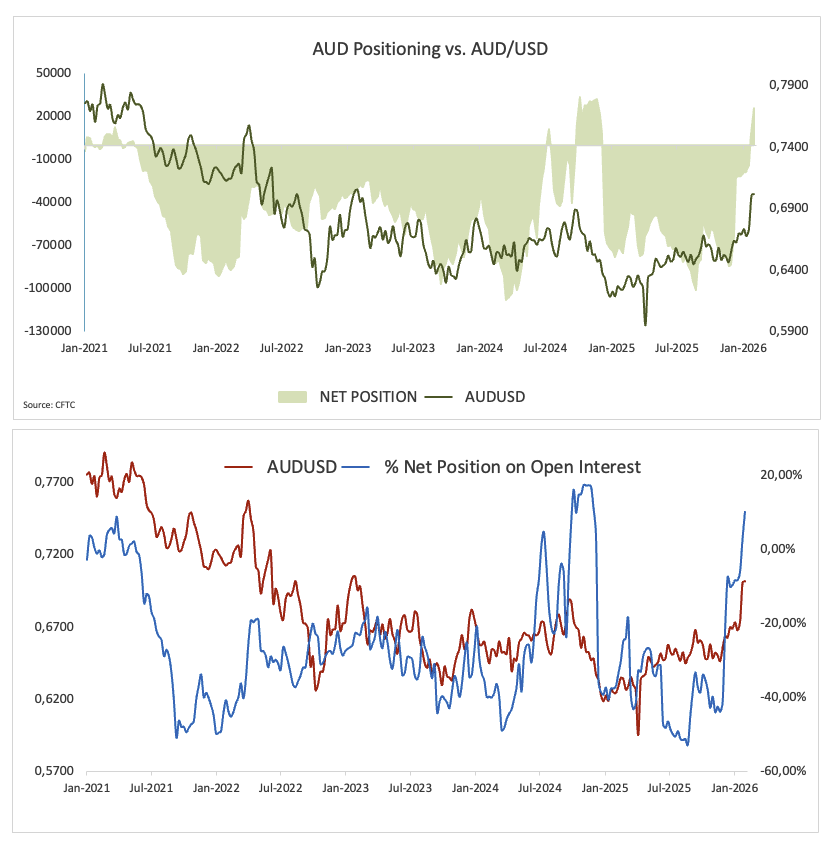
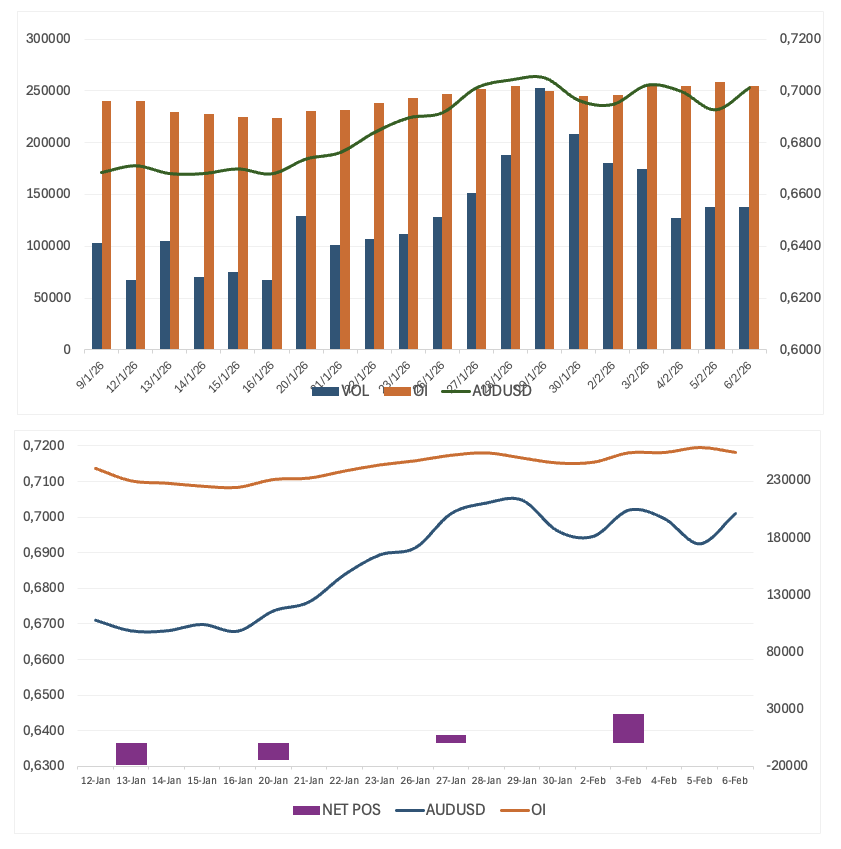
Positioning data suggest optimism has returned to the Aussie. According to the Commodity Futures Trading Commission, non-commercial traders lifted their net long exposure to around 26.1K contracts in the week to February 3, levels last seen in late November 2024.
Open interest has also risen for a third consecutive week, reaching roughly 254.2K contracts. That trend supports the view that fresh money continues to enter the market rather than positions merely being rolled.
A look at last week’s open interest and volume data also reinforces the constructive tone surrounding the pair.
What matters next
Near term: Attention swings back to the US. Incoming data, tariff headlines and geopolitical noise are likely to dominate USD price action. For the AUD, the key swing factors remain domestic labour market and inflation releases, and what they imply for the RBA’s next move.
Risks: The Aussie is still highly sensitive to global risk sentiment. A sudden deterioration in risk appetite, renewed concerns around China, or a stronger USD could quickly unwind recent gains.
The technical landscape
On the upside, immediate resistance for AUD/USD sits at the 2026 ceiling at 0.7093 from January 29, followed by the 2023 high at 0.7157 from February 2.
On the downside, a break below the February floor at 0.6896 from February 26 could open the door to a move toward the interim 55 day Simple Moving Average at 0.6721. That is followed by the 2026 bottom at 0.6663 from January 9, the provisional 100 day Simple Moving Average at 0.6638, the key 200 day Simple Moving Average at 0.6572, and the November base at 0.6421 from November 21.
Momentum indicators are firming. The Relative Strength Index is approaching overbought territory, while the Average Directional Index above 48 points to a robust trend for now.
-1770655965483-1770655965483.png)
Bottom line
AUD/USD remains tightly linked to global risk sentiment and China’s growth outlook. A sustained break above the 0.7000 handle would help turn the current constructive bias into a more convincing bullish signal.
For now, a softer USD, steady if unspectacular domestic data, a clearly hawkish RBA, and a broadly supportive, if uninspiring, China backdrop keep the balance of risks tilted toward further upside rather than a meaningful reversal.
RBA FAQs
The Reserve Bank of Australia (RBA) sets interest rates and manages monetary policy for Australia. Decisions are made by a board of governors at 11 meetings a year and ad hoc emergency meetings as required. The RBA’s primary mandate is to maintain price stability, which means an inflation rate of 2-3%, but also “..to contribute to the stability of the currency, full employment, and the economic prosperity and welfare of the Australian people.” Its main tool for achieving this is by raising or lowering interest rates. Relatively high interest rates will strengthen the Australian Dollar (AUD) and vice versa. Other RBA tools include quantitative easing and tightening.
While inflation had always traditionally been thought of as a negative factor for currencies since it lowers the value of money in general, the opposite has actually been the case in modern times with the relaxation of cross-border capital controls. Moderately higher inflation now tends to lead central banks to put up their interest rates, which in turn has the effect of attracting more capital inflows from global investors seeking a lucrative place to keep their money. This increases demand for the local currency, which in the case of Australia is the Aussie Dollar.
Macroeconomic data gauges the health of an economy and can have an impact on the value of its currency. Investors prefer to invest their capital in economies that are safe and growing rather than precarious and shrinking. Greater capital inflows increase the aggregate demand and value of the domestic currency. Classic indicators, such as GDP, Manufacturing and Services PMIs, employment, and consumer sentiment surveys can influence AUD. A strong economy may encourage the Reserve Bank of Australia to put up interest rates, also supporting AUD.
Quantitative Easing (QE) is a tool used in extreme situations when lowering interest rates is not enough to restore the flow of credit in the economy. QE is the process by which the Reserve Bank of Australia (RBA) prints Australian Dollars (AUD) for the purpose of buying assets – usually government or corporate bonds – from financial institutions, thereby providing them with much-needed liquidity. QE usually results in a weaker AUD.
Quantitative tightening (QT) is the reverse of QE. It is undertaken after QE when an economic recovery is underway and inflation starts rising. Whilst in QE the Reserve Bank of Australia (RBA) purchases government and corporate bonds from financial institutions to provide them with liquidity, in QT the RBA stops buying more assets, and stops reinvesting the principal maturing on the bonds it already holds. It would be positive (or bullish) for the Australian Dollar.
Author

Pablo Piovano
FXStreet
Born and bred in Argentina, Pablo has been carrying on with his passion for FX markets and trading since his first college years.
















