EUR/USD Forecast: Hopes of recovery dissipate as Fed tapers, ECB dismisses 2022 hike
- EUR/USD has come under renewed bearish pressure on Thursday.
- ECB policymakers want markets to know that they are not looking to hike rates in 2022.
- Dollar gains traction as Fed starts reducing asset purchases.

EUR/USD has turned south following Wednesday's modest rebound and started to move toward its 2021 lows on Thursday.
European Central Bank (ECB) policymakers' comments on the rate outlook and the US Federal Reserve's decision to reduce monthly asset purchases highlighted the diverging policies between these central banks.
ECB President Christine Lagarde said on Wednesday the conditions needed for the bank to hike its policy rate was "very unlikely" to be satisfied next year. On a similar note, "ECB's forward guidance does not support the market view of a first interest rate hike in the third quarter of 2022 nor any time soon afterwards," noted ECB Governing Council member Pablo Hernandez de Cos. Finally, Governing Council member Francois Villeroy de Galhau reflected the same sentiment by stating that there is no need for the ECB to raise its policy rate next year.
On the other hand, the Fed decided to reduce its asset purchases by $15 billion per month, starting in mid-November.
FOMC Chairman Jerome Powell reiterated that they would not automatically hike the policy rate when the quantitative easing program ends but that comment doesn't seem to be having a noticeable impact on the market expectation.
According to the CME Group FedWatch Tool, markets are pricing a 61.5% chance of a rate increase by June 2022, virtually unchanged from the day before.
As it currently stands, EUR/USD recovery attempts are likely to be technical in nature and remain limited with fundamentals favouring the dollar over the common currency.
EUR/USD Technical Analysis
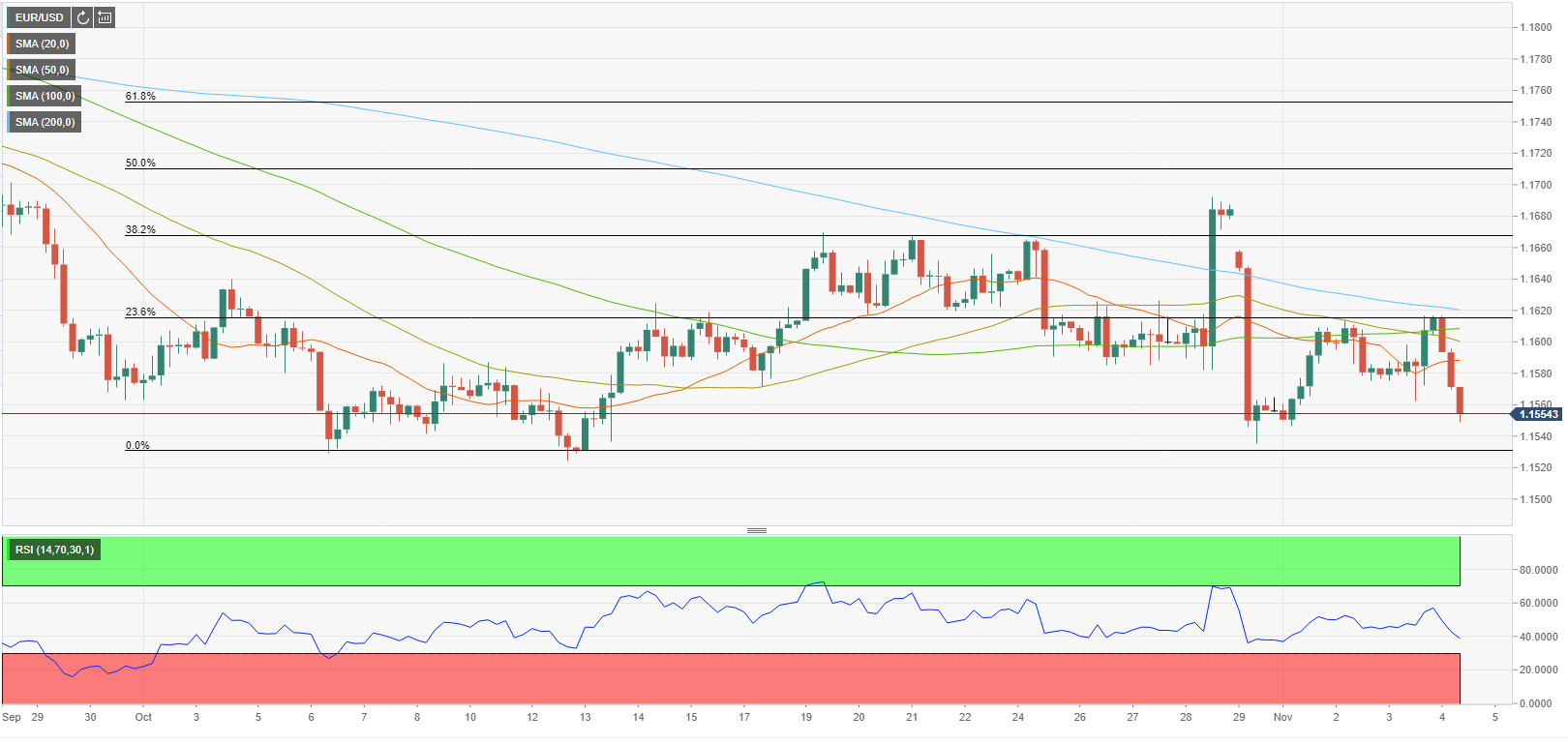
The 2021-low set at 1.1524 aligns as the next target on the downside. With a decisive move below that support, the pair could extend its slide toward 1.1500 (psychological level) and 1.1440 (previous resistance). Meanwhile, the Relative Strength Index (RSI) indicator on the four-hour chart is now around 40, suggesting that there is more room on the downside before the pair becomes technically oversold.
On the other hand, the first line of resistance is located at 1.1600 (psychological level) before 1.1620 (200-period SMA, 100-period SMA, Fibonacci 23.% retracement of September downtrend). In case buyers manage to lift the price above the latter, the next hurdle could be seen at 1.1670 (Fibonacci 38.2% retracement).
Author

Eren Sengezer
FXStreet
As an economist at heart, Eren Sengezer specializes in the assessment of the short-term and long-term impacts of macroeconomic data, central bank policies and political developments on financial assets.