EUR/USD Forecast: Fed expected to hike and pause, sealing USD fate for Q1 2019
- EU economic slowdown deepens in December according to Markit.
- US Federal Reserve expected to clarify whether it stands ahead of neutral rate levels.

After spending the week directionless, the EUR/USD pair pierced the base of its latest range at around 1.1300 and fell to 1.1269, as following a dovish Draghi on Thursday, macroeconomic releases Friday highlighted once again, slowing economic growth in the Union.
The ECB had its planned monetary policy and as expected, maintained rates unchanged and formally announcing the end of QE, something largely priced in. However, policymakers were utterly cautious about the future. The statement showed that no changes have been made to the perspective of keeping rates unchanged at least through the summer of 2019, or as long as necessary "to ensure the continued sustained convergence of inflation to levels that are below, but close to 2.0% over the medium term." The documents also showed that they want to enhance its forward guidance on reinvesting, announcing intentions to reinvest in full the securities purchased under the APP "for an extended period" that could be past the date of rising rates. Economic projections weren't optimistic, as growth perspectives were downwardly revised for this year and the next, while inflation ones where "by and large what they were before," according to Draghi, still foreseen below the magical 2.0% threshold. The only positive comment within a sea of dovish words was referred to wage growth, as Draghi said: "underlying inflation is expected to increase further over the coming months as the tightening labor market is pushing up wage growth."
The December preliminary Markit PMIs add to the doom and gloom of Union, as French figures showed that the country entered contraction, while German readings posted their lowest in four years. For the whole Union manufacturing activity shrank to its lowest in 34-month, services activity to its lowest in 49-month, while the Composite Index declined from 53.4 in November to 51.4 an over 4-year low. According to the official report, new business inflow almost stalled, job creation slipped to a two-year low and business optimism deteriorated.
Not that things are brighter in the US, as data has been lackluster, to say the least. Inflation was confirmed flat monthly basis in November, and up by 2.2% YoY, below the previous reading of 2.5%. According to Markit, the private sector output expanded at the weakest pace since May 2017, as the preliminary estimates for December showed that the services index fell to its lowest in 11 months, while the manufacturing on to its lowest in 13 months. Retail Sales were the only outstanding figure, up in November as expected by 0.2%, although with the Control Group reading up to 0.9%, more than doubling the expected 0.4%. October readings were upwardly revised. The greenback gained on EUR weakness and political turmoil in the Old Continent, but the ghost of slowing economic growth is also overflying the US, therefore preventing the greenback from running on self-strength.
And here comes the Fed. The US Central Bank will have its last monetary policy meeting this week. It's one of those so-called "live" meetings, as policymakers will present alongside fresh economic forecasts, while Chief Powell will offer a press conference. The Fed is expected to deliver its fourth rate hike this year, so no surprises coming from there. The focus will be on future moves, as Powell went from "long way " in October to "just below" neutral in November, when referring to the level of rates, implying fewer interest-rate hikes to come. He also added that the FOMC has no pre-set course on monetary policy, but the damage was done. The latest dot-plot indicated chances of three rate hikes coming in 2019, and any change there could deteriorate the dollar's fragile positive stance.
EUR/USD technical outlook
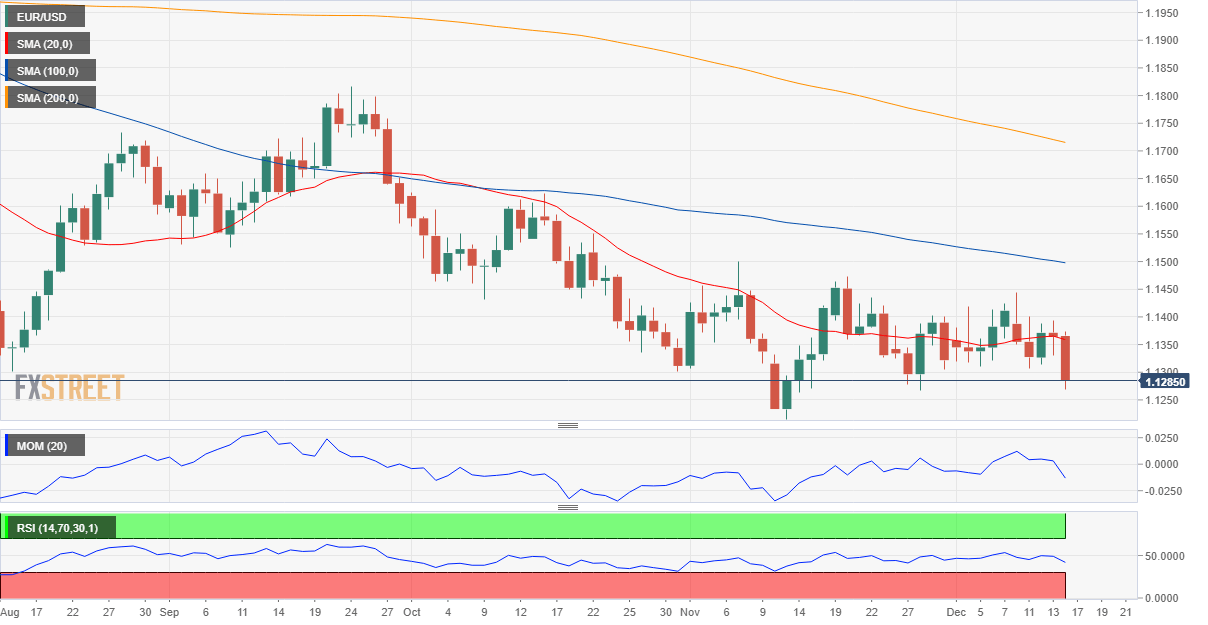
The EUR/USD pair is finishing the week below 1.1300 and poised to remain under pressure, as it broke this Friday below the daily ascendant trend line coming from the yearly low of 1.1215. The weekly chart shows that the pair is closing below the 200 SMA after being battling with it since mid-October, quite a discouraging sign for bulls. Technical indicators in the mentioned chart offer a neutral-to-bearish stance within negative levels, skewing the risk to the downside.
In the daily chart, the pair finally moved below its 20 DMA, after spending the last three weeks seesawing around it, while technical indicators turned lower, the Momentum still attached to neutral levels and the RSI currently at 42, favoring another leg lower without confirming it just yet. An immediate support comes at 1.1266, November 28 low, followed by 1.1215, the yearly low. Below this last, the decline could extend down to 1.1140/60. The pair bottomed lately between 1.1310 and 1.1330, making of the area an immediate resistance, with the next relevant one being the 1.1420 price zone, a level that could be reached with a discouraging Federal Reserve.
EUR/USD sentiment poll
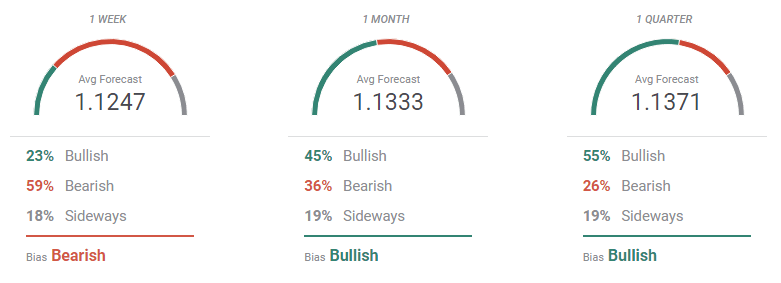
The FXStreet Forecast Poll indicates that the decline could continue next week, with bears accounting 59% of the total of experts targeting on average 1.1247. A Fed's pause is being priced in cautiously, as the monthly and 3-month perspective are dominated by bulls, although the average targets are below the ones from last week with the 3-month perspective downgraded to 1.1371 from 1.1426. The range of possible long-term targets goes from 1.000 to 1.2400, showing the absence of a clear dominant trend, although the Overview chart shows that the largest accumulation of possible targets is above the current level, around 1.1600. The same chart shows that bears dominate the short-term, losing conviction as time goes by.
Related content:
Author

Valeria Bednarik
FXStreet
Valeria Bednarik was born and lives in Buenos Aires, Argentina. Her passion for math and numbers pushed her into studying economics in her younger years.