|

EUR/USD Forecast: Euro needs to clear 0.9850 to extend recovery

  • EUR/USD has gone into a consolidation phase above 0.9800.
  • The pair needs to clear 0.9850 resistance to continue to stretch higher.
  • The ISM will release September Manufacturing PMI data later in the day.

After having snapped a two-week losing streak, EUR/USD has been struggling to preserve its bullish momentum on Monday. The pair fluctuates in a tight range above 0.9800 in the European morning and the near-term technical outlook suggests that additional gains could be witnessed if 0.9850 resistance fails.

In the absence of high-impact macroeconomic data releases early Monday, the US Dollar Index (DXY) failed to build on Friday's recovery gains and edged lower during the Asian trading hours. Nevertheless, the negative shift witnessed in the risk mood helps the DXY limit its losses and makes it difficult for EUR/USD to gather bullish momentum.

The Euro Stoxx 600 and Germany's DAX 30 indexes were both losing around 1.5% at the time of press. The data published by S&P Global confirmed that the business activity in the manufacturing sector contracted in September.

In the second half of the day, the ISM Manufacturing PMI from the US will be looked upon for fresh impetus. Investors are likely to pay close attention to the Prices Paid sub-index of the survey, which is forecast to decline to 51.8 in September from 52.5 in August. A lower-than-expected print in the inflation component is likely to hurt the dollar in the second half of the day and vice versa.

Meanwhile, US stock index futures are trading mixed. A solid rebound in Wall Street's main indexes on the first trading day of the fourth quarter could allow EUR/USD to extend its recovery. On the other hand, the dollar should be able to gather strength in case safe-haven flows start to dominate the markets during the American trading hours.

EUR/USD Technical Analysis
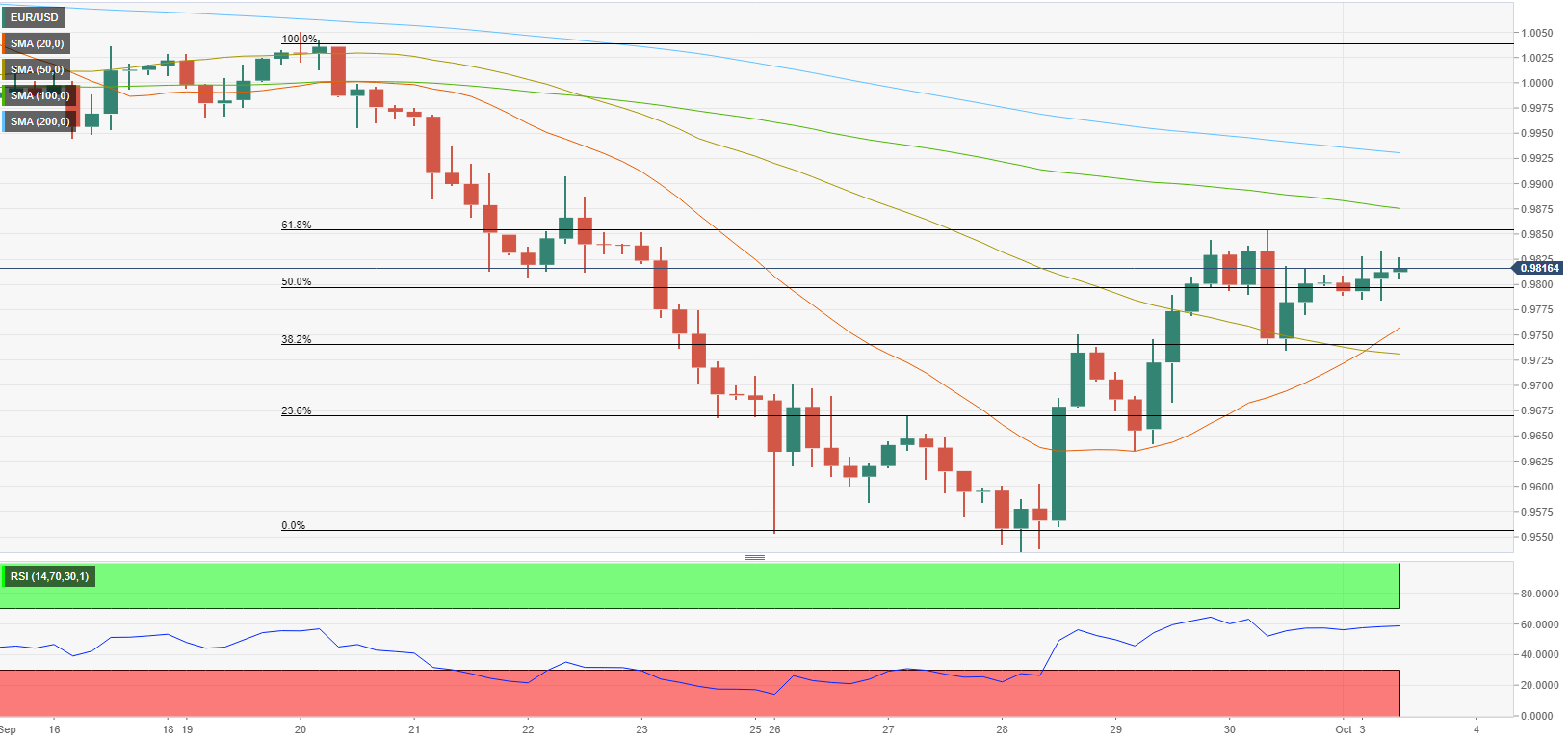
The Relative Strength Index (RSI) indicator on the four-hour chart holds comfortably above 50 on Monday. Additionally, the 20-period SMA crossed above the 50-period SMA, confirming the bullish bias in the near term.

On the upside, the Fibonacci 61.8% retracement of the latest downtrend forms initial resistance at 0.9850 ahead of 0.9875 (100-period SMA). With a four-hour close above the latter, the pair could target 0.9925 (200-period SMA) next.

0.9800 (psychological level, Fibonacci 50% retracement) aligns as first support before 0.9750 (Fibonacci 38.2% retracement, 50-period SMA) and 0.9700 (psychological level).

Premium

You have reached your limit of 3 free articles for this month.

Start your subscription and get access to all our original articles.

Subscribe to PremiumSign In

Author

Eren Sengezer

As an economist at heart, Eren Sengezer specializes in the assessment of the short-term and long-term impacts of macroeconomic data, central bank policies and political developments on financial assets.


More from Eren Sengezer
Share:

Markets move fast. We move first.

Orange Juice Newsletter brings you expert driven insights - not headlines. Every day on your inbox.

By subscribing you agree to our Terms and conditions.

Editor's Picks

EUR/USD edges higher to mid-1.1600s; looks to US PCE Price Index for fresh impetus

The EUR/USD pair attracts some dip-buyers during the Asian session on Friday and recovers a part of the previous day's retracement slide from the 1.1680 region, or the highest level since October 17. Spot prices currently trade around mid-1.1600s and remain on track to register gains for the second straight week.

GBP/USD: Constructive view prevails above 1.3300 ahead of US PCE inflation data

The GBP/USD pair trades on a flat note near 1.3330 during the Asian trading hours on Friday. Traders prefer to wait on the sidelines ahead of the key US inflation report later on Friday. The US delayed Personal Consumption Expenditures Price Index report for September could offer some hints about the US interest rate path.

Gold edges higher amid dovish Fed expectations; traders await US PCE inflation data

Gold struggles to capitalize on the overnight bounce from the $4,175 area, or the vicinity of the weekly trough, and oscillates in a narrow trading range during the Asian session on Friday. Traders now seem reluctant and opt to move to the sidelines ahead of the September Personal Consumption Expenditures Price Index, or the Federal Reserve's preferred inflation gauge. 

Pi Network: Bearish streak nears critical support trendline

Pi Network edges lower on Friday for the third consecutive day, approaching a local support trendline. The on-chain data suggests an increase in supply pressure as Centralized Exchanges experience a surge in inflows. Technically, the pullback in PI risks further losses, as the Moving Average Convergence Divergence indicator is flashing a sell signal. 

Why the Fed may cut rates in December: Understanding the policy shift

The Fed has gone through a noticeable policy swing in recent months - from initiating a rate cut, to signaling a potential pause, and now shifting once again toward another cut in December. This has created understandable confusion among traders and investors trying to interpret the Fed’s reaction function.

XRP edges lower despite record on-chain activity and steady ETF inflows

Ripple is trading under pressure at the time of writing on Thursday, after bulls failed to break the short-term resistance at $2.22. The reversal may extend toward Monday’s low of $1.98, especially if risk-off sentiment persists in the broader cryptocurrency market.