EUR/USD Forecast: Euro may rise with retail sales and fall with the Fed, sell opportunity?
- EUR/USD has fallen back to range ahead of US retail sales and the Federal Reserve decision.
- Lack of government support may weigh on spending while the Fed may fall short of market expectations.
- Tuesday's four-hour chart is painting a mixed picture for euro/dollar.

Time to get off the fence – the world's most popular currency pair has been "hugging" the 1.1850 level and that is likely to make way for a sharp move. To what direction? Limited range trading is typical ahead of a decision by the Federal Reserve – and the recent moves fall in line with previous such behaviors.
Nevertheless, there are two notable changes. First, it is the Fed's last decision before the elections, implying no change in interest rates nor in its bond-buying scheme. However, the world's most powerful central bank publishes new forecasts for growth, employment, inflation, and interest rates.
Jerome Powell, Chairman of the Federal Reserve, laid out a new policy framework back in August. The Fed will focus on employment and let inflation overheat. While he may provide more details about how high the bank would tolerate rising prices, the lax approach is already priced in.
Stock markets had a good run over the summer but now seem to suffer from some altitude sickness, retreating from the highs. The reports that the Federal Trade Commission has opened an antitrust probe into Facebook is adding to pressure on tech stocks.
If the Fed paints a worrying picture on growth but does not propose any imminent action – such as controlling the yield curve or setting negative rates – equities could dive. In turn, the safe-haven US dollar could find demand and gain ground against the euro in this case.
See:
- September FOMC Preview: Projections, projections, projections
- How the Fed could drown markets while trying not to rock the boat
Secondly, another event may steal the show. While there is a significant probability that EUR/USD to fall in response to the Fed, it is unlikely to remain idle before the event. The US releases the all-important retail sales report for August – the first month in which the $600/week federal unemployment top-up epired. Has expenditure dropped?
Expectations stand at a modest increase once again, but surprises are not uncommon. As consumption consists of around 70% of the economy, any downside surprise could weigh on the dollar.
See US Retail Sales August Preview: Surprising facts on retail sales
Therefore, EUR/USD may rise in response to weaker than projected retail sales but drop if the Fed fails to hint any imminent policy changes.
Elsewhere, coronavirus cases continue rising in the old continent and are also tentatively increasing in the US. Investors seem undettered by the disease at this point and are hopeful for a vaccine – or more than one – to be available in coming months.
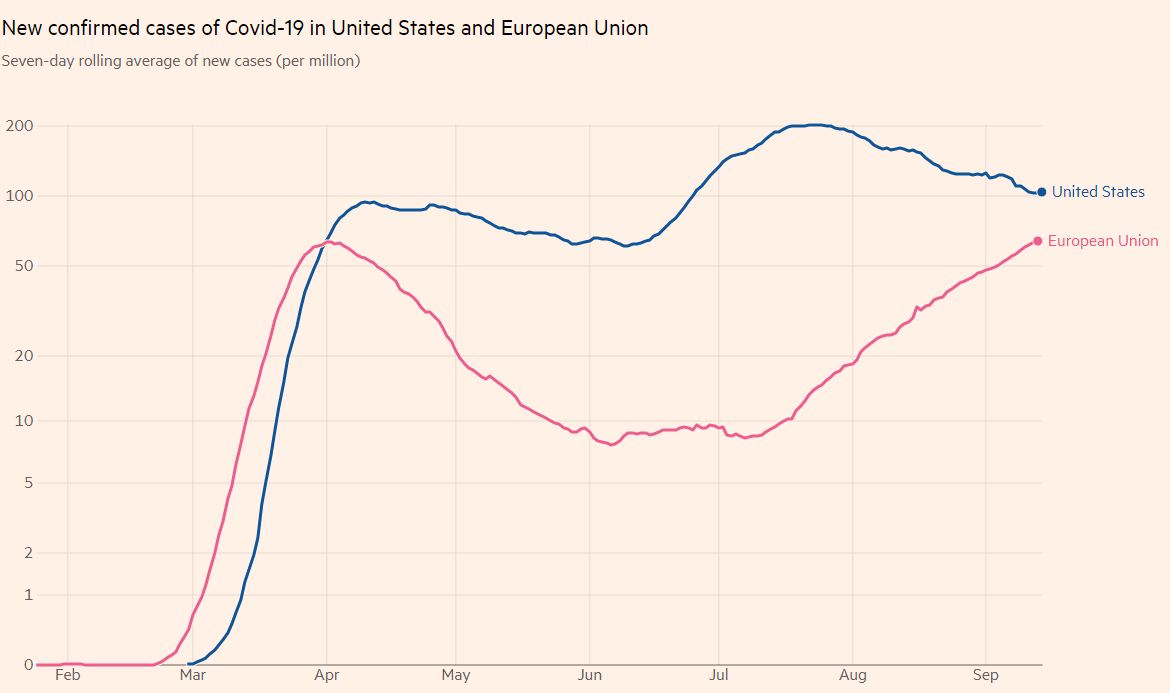
Source: FT
Overall, the focus is on US events, which are set to trigger high volatility.
EUR/USD Technical Analysis
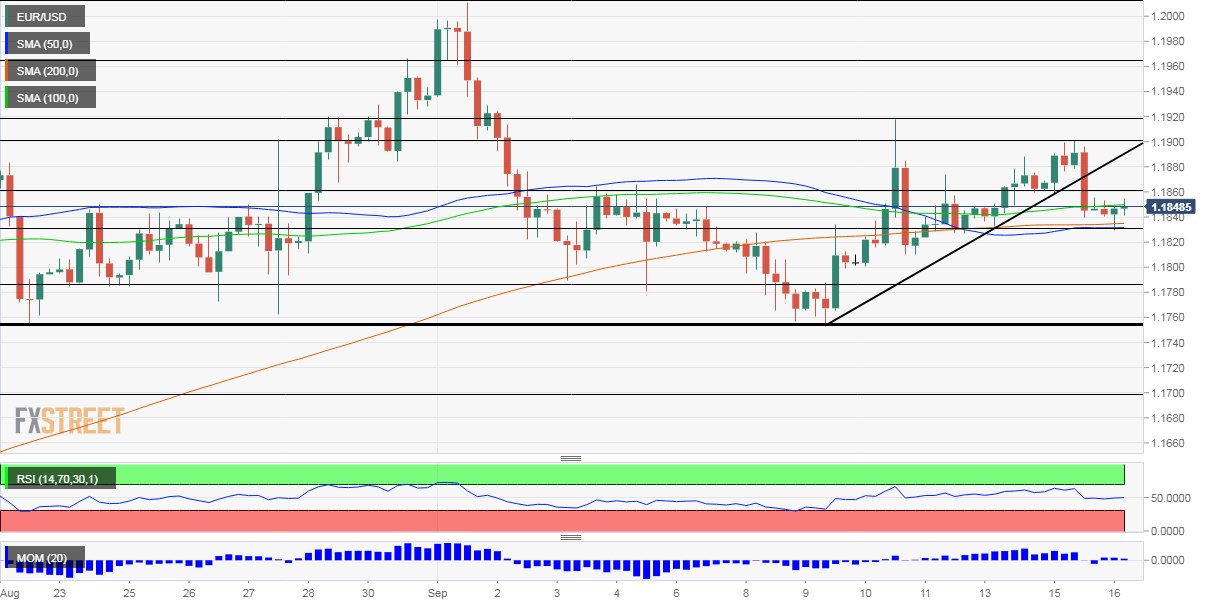
Euro/dollar is trading around the 100 Simple Moving Average on the four-hour chart and just above the 50 and 200 SMAs. Momentum has al but disappeared while the Relative Index is stable. The currency pair dropped below the uptrend support that accompanied it in the past week.
All in all, the picture is balanced.
Some resistance awaits at 1.1860, which provided support in recent days. It is followed by 1.19, which capped EUR/USD on Tuesday. Further above, 1.1920 was a swing high and 1.1965 is the next level to watch.
Support awaits at 1.1830, the daily low, followed by 1.1785, which was a trough early in the month. The next levels to watch are 1.1755, and 1.17, both double bottoms.
More 2020 Elections: How stocks, gold, dollar could move in four scenarios, nightmare one included
Author

Yohay Elam
FXStreet
Yohay is in Forex since 2008 when he founded Forex Crunch, a blog crafted in his free time that turned into a fully-fledged currency website later sold to Finixio.