EUR/USD Forecast: Euro defines range before next breakout
- EUR/USD has extended its sideways grind below 1.1000 to start new week.
- Technical outlook highlights the pair's indecisiveness in the short term.
- Risk aversion could hurt EUR/USD in the absence of high-tier data releases.

EUR/USD has been struggling to find direction with investors still searching for the next significant catalyst. The pair's short-term technical outlook reflects the lack of commitment from both buyers and sellers. In the absence of high-impact data releases, the risk perception could impact EUR/USD's action on Monday.
Although the data from the US revealed on Friday that the business activity in the private sector expanded at a strengthening pace in early April, the US Dollar (USD) failed to outperform its rivals. Investors are fairly certain that the US Federal Reserve will raise its policy rate by 25 basis points at the upcoming meeting and S&P Global's PMI surveys did little to nothing to change that view.
Meanwhile, European Central Bank (ECB) Governing Council member Pierre Wunsch told the Financial Times that they will need to continue to hike rates until they monitor a slowdown in wage growth. “I would not be surprised if we had to go to 4% at some point,” Wunsch added. These comments seem to be limiting the Euro's losses for the time being.
In the second half of the day, the Federal Reserve Bank of Chicago's National Activity Index and the Federal Reserve Bank of Dallas' Texas Manufacturing Survey will be featured in the US economic docket.
Market participants are, however, unlikely to react to these reports while keeping a close eye on risk perception. US stock index futures are down around 0.4% in the European morning and the USD is likely to benefit from the risk-averse atmosphere in the second half of the day and vice versa.
EUR/USD Technical Analysis
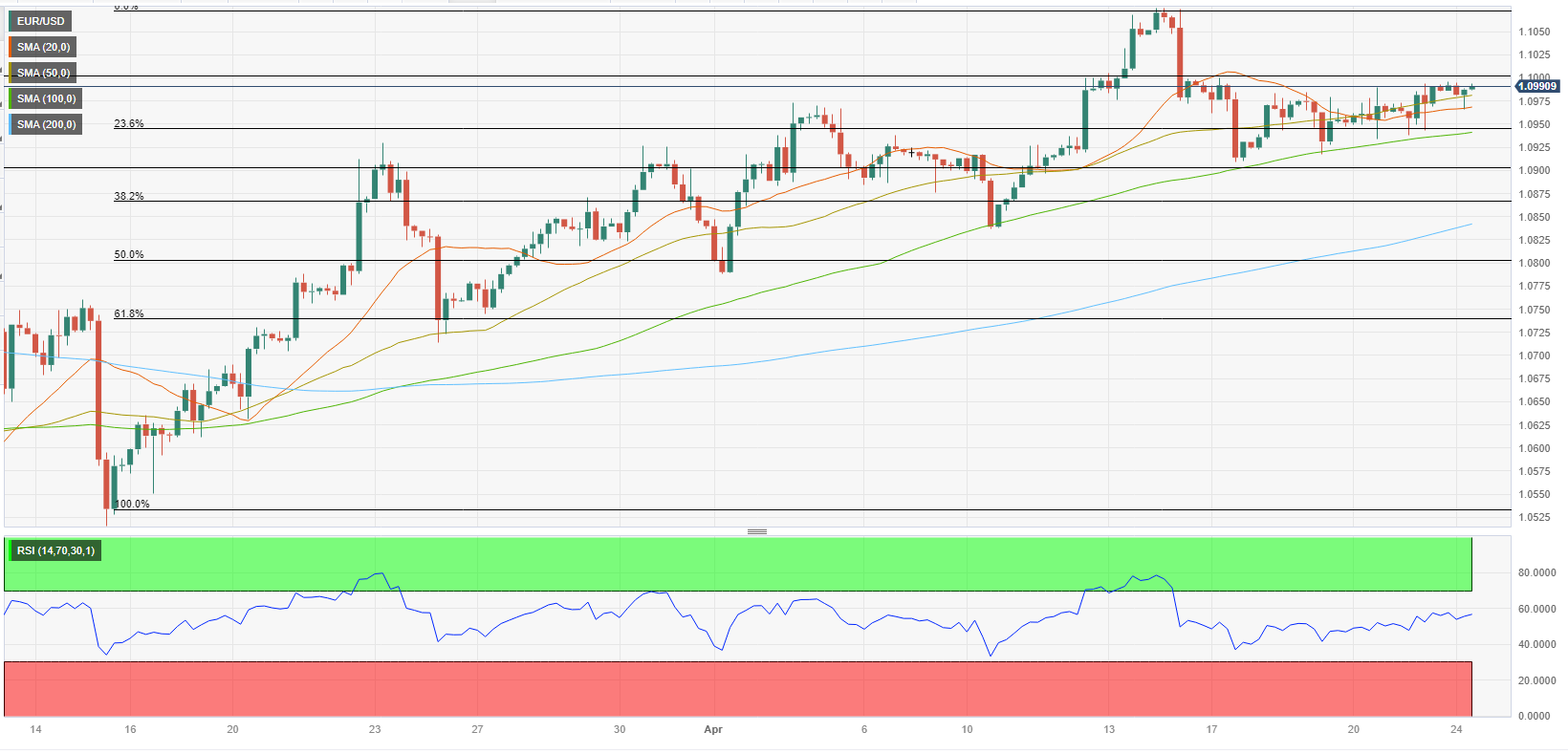
EUR/USD seems to have defined its short-term trading range between 1.1000 (psychological level, static level) and 1.0950 (100-period Simple Moving Average (SMA) on the four-hour chart, Fibonacci 23.6% retracement).
A four-hour close above 1.1000 could attract buyers and open the door for a leg higher toward 1.1050 (static level) and 1.1075 (end-point of the latest uptrend).
On the downside, EUR/USD could extend its slide toward 1.0900 (psychological level) and 1.0870 (Fibonacci 38.2% retracement) in case 1.0950 support fails.
Author

Eren Sengezer
FXStreet
As an economist at heart, Eren Sengezer specializes in the assessment of the short-term and long-term impacts of macroeconomic data, central bank policies and political developments on financial assets.

















