EUR/USD Forecast: Euro benefits from upbeat PMIs
- EUR/USD regained traction and climbed above 1.0900 following a two-day decline.
- Upbeat PMI data from Germany helped the Euro find demand in the European session.
- Stock and bond markets in the US will remain closed in observance of the Thanksgiving Day holiday.

EUR/USD regained its traction and advanced beyond 1.0900 on Thursday after closing the second consecutive day in negative territory on Wednesday. The pair's near-term technical outlook suggests that buyers remain interested following the downward correction.
The US Dollar (USD) gathered strength mid-week after the US Department of Labor reported that the weekly Initial Jobless Claims declined to 209,000 in the week ending November 18 from 233,000. Later in the session, however, the modest rebound seen in Wall Street's main indexes limited the USD's gains and helped EUR/USD find support.
Early Thursday, the data from Germany showed that the pace of contraction in the private sector's business activity softened in early November, with the HCOB Composite PMI improving to 47.1 from 45.9 in October. Commenting on the data, "the November PMI numbers validate our assessment that Germany is currently in a recession, starting from the third quarter," said Dr. Cyrus de la Rubia, Chief Economist at Hamburg Commercial Bank, but noted that the recession may be shallower than expected.
Similarly, HCOB Composite PMI for the Eurozone rose to 47.1 from 46.5 in October.
Stock and bond markets in the US will be closed on Thursday and close early on Friday in observance of the Thanksgiving Day holiday. Hence, EUR/USD could have a hard time finding direction ahead of the weekend.
EUR/USD Technical Analysis
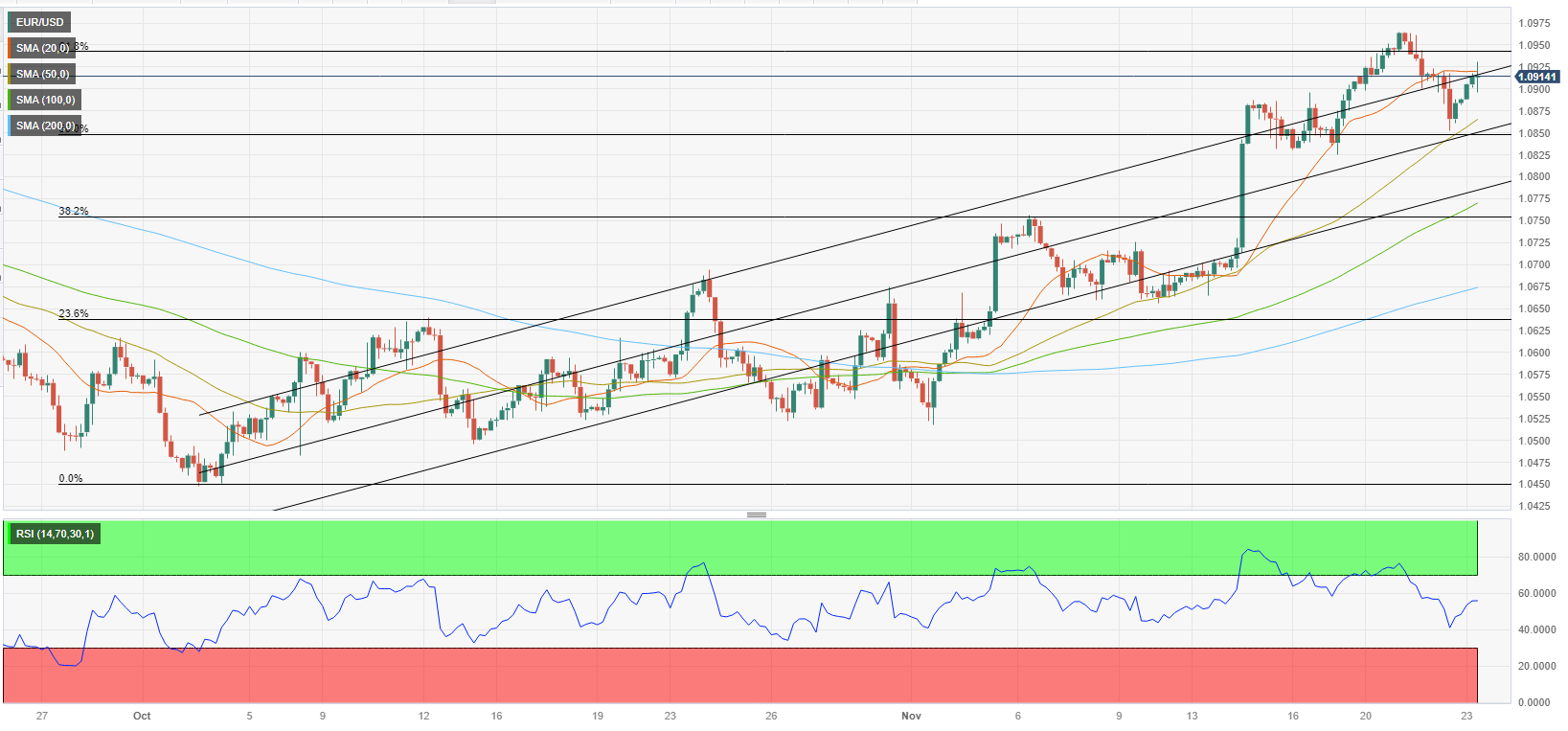
The Relative Strength Index (RSI) indicator on the 4-hour chart rose above 50 and EUR/USD gained traction after correcting toward the mid-point of the ascending regression channel, highlighting the lack of seller interest.
On the upside, 1.0950 (Fibonacci 61.8% retracement of the July-October downtrend) aligns as next resistance for EUR/USD before 1.1000 (psychological level, static level) and 1.1025 (static level from August).
Interim support is located at 1.0900 (psychological level, static level) ahead of 1.0850 (Fibonacci 50% retracement, mid-point of the ascending channel) and 1.0800 (lower limit of the ascending channel).
Author

Eren Sengezer
FXStreet
As an economist at heart, Eren Sengezer specializes in the assessment of the short-term and long-term impacts of macroeconomic data, central bank policies and political developments on financial assets.
















