EUR/USD Forecast: central banks´ updates coming, growth still in the eye of the storm
- EUR/USD's decline set to continue this April but 1.1000 still elusive.
- ECB's Monetary Policy Meeting and FOMC's Minutes to highlight the week.

The EUR/USD pair is poised to finish the week as it started it at around 1.1230, having, however, posted a lower low and a lower high for a third consecutive week. The shared currency was heavily weighed by the Union's data confirming the gloomy economic situation. Not that US data was much better, and there were some soft-figures there too, but the comparison of the overall health favors the world's largest economy.
EU March preliminary inflation was slightly below expected, up by 1.4% YoY in the month vs. 1.5% previously while core CPI printed 0.8%, missing the market's forecast of 0.9% and below the previous 1.0%. More harmful for the EUR, the final versions of the Markit Manufacturing PMI for the same month suffered downward revisions, with the German index down to 44.1, its lowest since mid-2012 and the EU index downwardly revised to 47.5. Activity contracted sharply, and despite the services figures released later in the week were slightly better than initially estimated. Also, European Retail Sales were upbeat, up in February 0.4% MoM and 2.8% YoY, surpassing the market's forecasts. German Factory Orders plunged by 4.2% MoM and by 8.4% YoY in February.
In the US, data was mixed. The official ISM index surged to 55.3 surpassing the expected 54.5 and above the previous 54.2, but the Non-Manufacturing PMI missed the market's forecast, down to 56.1 in March from 59.7 in February. Also, February Durable Goods Orders were slightly better-than-expected, still down by 1.6%. The less volatile ex-transportation measure was up by a measly 0.1% MoM, while on a year-on-year basis growth cooled to 3.3%, while the most-relevant nondefense ex-aircraft figure declined by 0.1% MoM. February Retail Sales were upbeat.
Those mixed readings leaned the scale in favor of the greenback. By the end of the week, the Nonfarm Payroll report failed to bring definitions, as it also resulted mixed. The country added 196K new jobs, surpassing market's expectations, while February reading was upwardly revised t0 33K from 20K. The unemployment rate remained steady at 3.8%, despite the participation rate decreased to 63.0%, anyway beating expectations. Wages' growth disappointed, up by 0.1% MoM, while average hourly earnings rose 3.2% from a year earlier, accelerating at a slightly slower pace than in February. These numbers were welcomed by equities traders, as lessening inflationary pressures indicate the Fed will maintain its on-hold stance for longer but remain far from building the case for a rate cut.
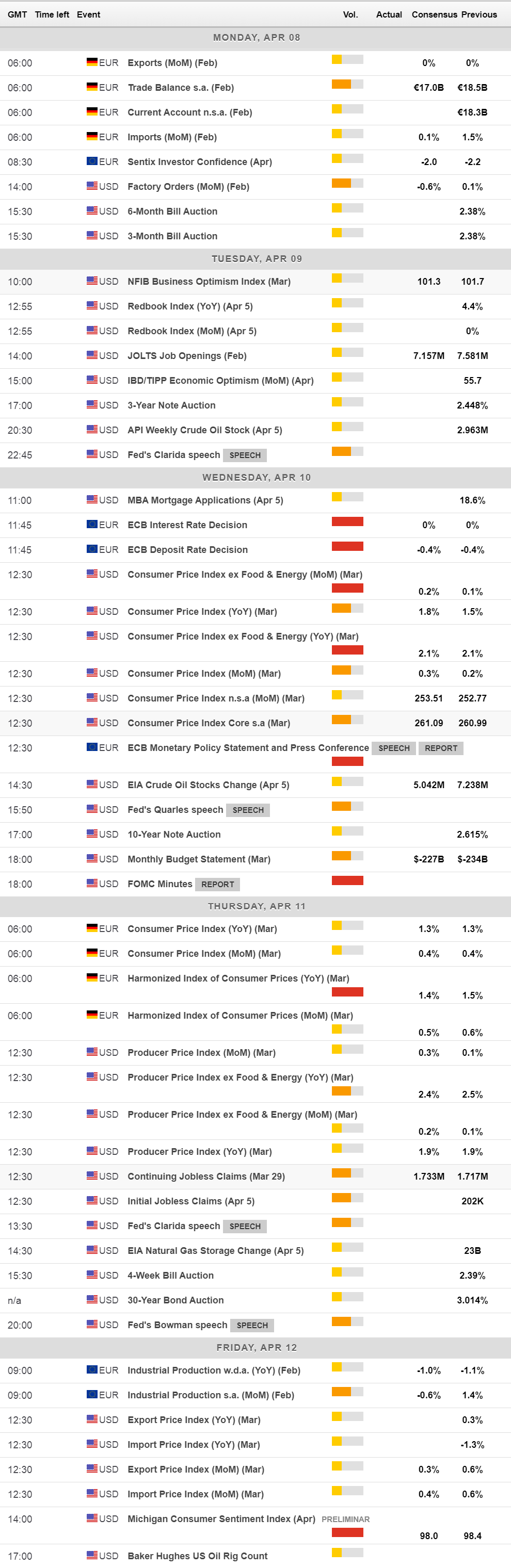
The upcoming week will be a bit more light in terms of macroeconomic releases, with the focus on Wednesday, when the ECB will have its Monetary policy meeting, and the US ill publish an inflation update and the latest FOMC Minutes.
Germany will kick start the week publishing its February Trade Balance data with the surplus seen shrinking to €17.0B. Later in the week, the country will unveil the final readings of March inflation, seen further lower than previously estimated. Germany is the largest European economy, and soft macroeconomic data will keep on weighing the EUR.
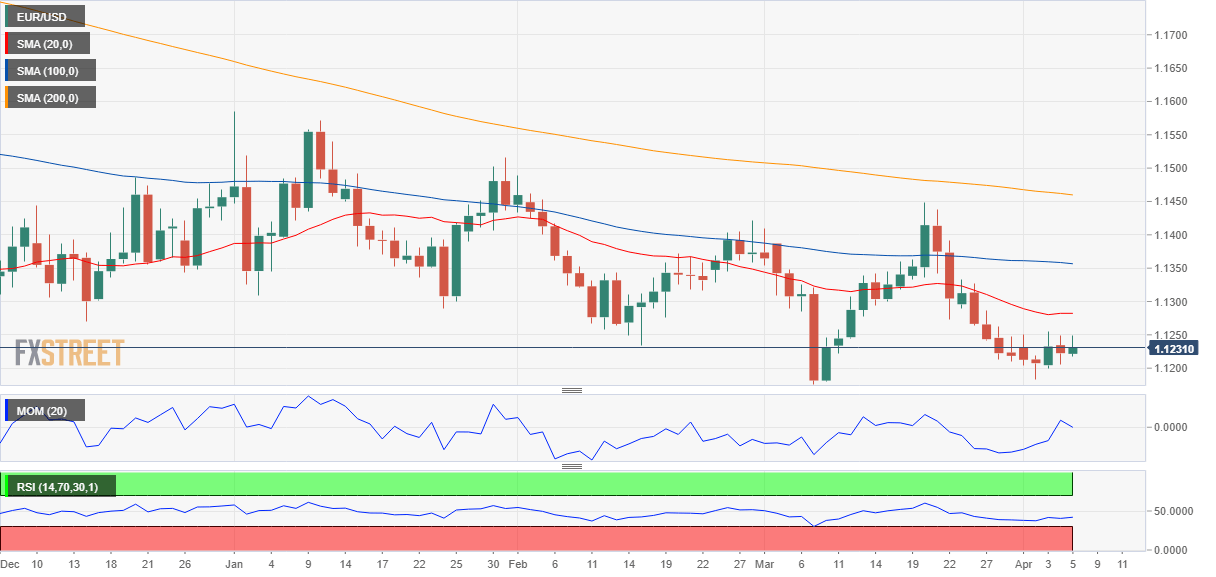
EUR/USD technical outlook
The pair retains its bearish stance in the weekly chart, as not only it posted a lower low and a lower high, but it remains well below all of its moving averages. The 20 SMA maintains its bearish slope, now converging with the 200 SMA at around 1.1330, where the pair also has the 61.8% retracement of its latest daily decline. The Momentum indicator extended its decline below its 100 level, while the RSI continues hovering within negative levels, now at around 40 and without directional strength.
In the daily chart, the pair also developed below all of its moving averages, with the 20 SMA losing downward strength at around 1.1280, but the longer ones heading firmly south above this last. Technical indicators attempted a recovery but failed within negative levels and resumed their declines, keeping the risk skewed to the downside.
The key levels remain the same, with 1.1175 the yearly low being the immediate support, ahead of 1.1120 and 1.1060. To the upside, the mentioned 1.1280 and 1.1330 levels are the ones to watch, with a break above the latest one favoring a corrective movement up to 1.1400.
EUR/USD sentiment poll
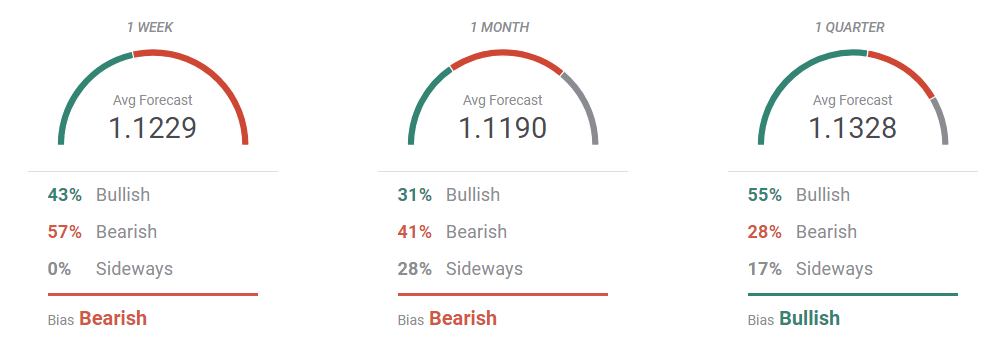
The FXStreet Forecast Poll shows that bears remain a majority in the weekly and monthly perspective, although selling interest decreased when compared to the previous poll, down to 57% from 73% in the shorter view. The average target is 1.1229, in this timeframe, although the Overview chart shows that most possible targets accumulate between 1.1000 and 1.1200.
Bears decrease to 41% in the monthly perspective, but the average target is 1.1190, and the Overview chart shows a strong downward slope in the moving average, suggesting the downward move could extend throughout April.
For the 3-month view, bulls account 55% while bears just 28%, which lifts the average target to 1.1328. However, the spread of possible targets remains quite wide, indicating uncertainty and reluctantly over a break below the 1.1000 level rather than the end of the bearish trend.
Related Forecasts:
USD/JPY Forecast: Can the optimism prevail? A lot depends on the Fed
Author

Valeria Bednarik
FXStreet
Valeria Bednarik was born and lives in Buenos Aires, Argentina. Her passion for math and numbers pushed her into studying economics in her younger years.
















