EUR/USD Forecast: American employment-related data boost the US Dollar by triggering risk-off

EUR/USD Current Price: 1.0868
- The US private sector added 487K new job positions in June, doubling expectations.
- Global equities accelerated their slumps following solid US employment figures.
- EUR/USD bearish potential increases as the pair battles a critical Fibonacci level.
A dismal market mood continued to back the US Dollar during Asian trading hours, resulting in EUR/USD falling to 1.0833, its lowest since mid-June. The pair recovered some ground in the European session, helped by encouraging German data and ahead of United States (US) employment-related figures. Given the resilience of the job market, the Federal Reserve (Fed) is wary of leaving the tightening path, as wage pressures could keep inflation above the central bank’s goal of 2%.
In fact, the Federal Open Market Committee (FOMC) released the Minutes of its last meeting late on Wednesday. The document reaffirmed the Fed’s hawkish stance, as it showed some officials would have preferred to hike rates by 25 basis points (bps), while “almost all participants” judged that additional increases would be appropriate. Market players have already priced in policymakers’ tough stance, and the minutes triggered no immediate price action.
Data-wise, German Factory Orders increased by 6.4% MoM in May, beating expectations. Compared to a year earlier, orders declined by 4.3%. As for the US, the country published Challenger Job Cuts, which showed that US-based employers announced 40,709 cuts in June, down 49% from the 80,089 cuts announced in May. Additionally, the ADP Survey on private jobs creation printed at ,497K more than doubling the market expectations and well above the previous 267K, while Initial Jobless Claims for the week ended June 30 rose by 248K, slightly above the 245K expected. Finally, the Goods and Services Trade Balance posted a deficit of $69 billion in May. The figures spurred risk-aversion and sent global equities down, while providing the US Dollar with an unexpected boost ahead of Wall Street’s opening.
The macroeconomic calendar will later offer the US June S&P Global Services and Composite PMIs, the official ISM Services PMI for the same month and JOLTS Job Openings for May. The latter gained relevance in the past few months, as it shows job openings are quite higher than the number of people looking for a job. Such a scenario allows the Fed to extend its tightening cycle with comfort.
EUR/USD short-term technical outlook
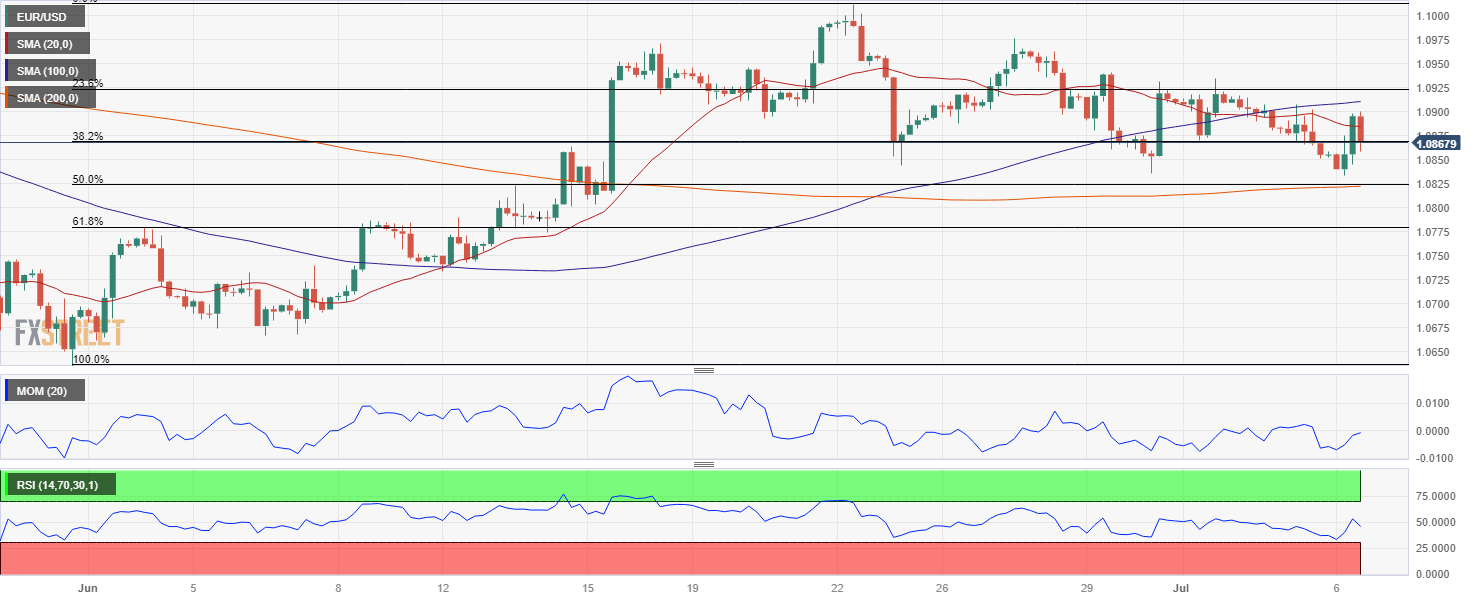
The EUR/USD pair trades around the 38.2% Fibonacci retracement of its latest daily run between 1.0634 and 1.1011 at 1.0866, with the next Fibonacci resistance at 1.0921, retreating from a daily peak at 1.0900. The daily chart shows that the pair met sellers around a still bullish 20 Simple Moving Average (SMA) while a flat 100 SMA converges with the next Fibonacci support, the 50% retracement at 1.0821. At the same time, technical indicators lost their directional strength within negative levels, skewing the risk to the downside.
In the near term, and according to the 4-hour chart, EUR/USD has room to extend its decline. The short-lived peak held below the 100 SMA, while the 20 SMA gains bearish traction below the longer one. Furthermore, technical indicators have lost their upward strength within negative levels, suggesting USD buyers are gaining confidence.
Support levels: 1.0820 1.0770 1.0725
Resistance levels: 1.0920 1.0960 1.1010
Author

Valeria Bednarik
FXStreet
Valeria Bednarik was born and lives in Buenos Aires, Argentina. Her passion for math and numbers pushed her into studying economics in her younger years.

















