EUR/USD analysis: fading momentum at 1.2400 hurts bulls

EUR/USD Current price: 1.2359
- EUR/USD edges lower, helped by divergent macroeconomic outcomes.
- Hopes about strong earnings send Wall Street up for a second consecutive day.
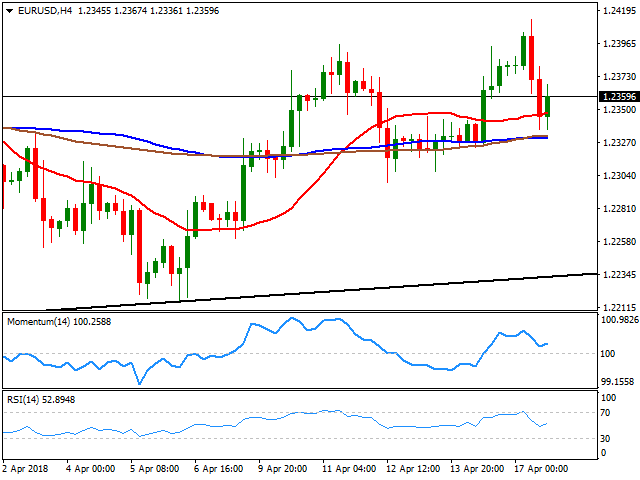
The EUR/USD dollar retreated from a weekly high of 1.2413 to settle around the 1.2360 level in the US afternoon, as the dollar finally found some demand, while European data fell short of market's expectations. While not a market mover, March Italian inflation grew by less-than-expected, supporting ECB's conservative stance regarding QE. Additionally, the monthly German ZEW survey showed that uncertainty coming from the US keeps denting investors confidence worldwide, with the index plummeting to-8.2 in the country for April, and the EU shrinking to 1.9 from the previous 13.4. US data, on the other hand, beat expectations with Housing Starts and Building Permits firmly up in March after falling the previous months, and Industrial Production advancing by more-than-expected, up 0.5% in the same month vs. the expected 0.4% gain. Capacity Utilization was also above forecast, printing 78.0% from the expected 77.9%.
Risk sentiment has improved drastically as investors are now focused on earnings reports, putting aside, at least temporarily, concerns about a trade war or geopolitical tensions in the Middle-East. Wall Street is firmly up for a second consecutive day, boosting demand for the vulnerable greenback. Wednesday will bring fresh EU inflation data, while the US has little to offer that can affect markets. Investors remain quite sensitive, and while concerns are now out of the picture, it doesn't mean they couldn't return out of the bloom.
Technically, failure to sustain gains beyond 1.2400 is quite discouraging for bulls, but the pair continues trading inside a familiar range, and the long-term symmetrical triangle that comes from mid-February. Halfway between the extremes of the figure, the 4 hours chart shows that the price settled around a directionless 20 SMA, while longer moving averages are also flat a few pips below the current level, reflecting the lack of a certain trend. Technical indicators in the mentioned chart have retreated sharply before bouncing modestly around neutral territory, indicating that, while the dollar is getting some attention today, remains far from strong. Below the 1.2300 region, chances turn to the downside for the short term, while a break beyond 1.2430 is now required to consider further gains ahead.
Support levels: 1.2335 1.2295 1.2250
Resistance levels: 1.2390 1.2435 1.2480
Author

Valeria Bednarik
FXStreet
Valeria Bednarik was born and lives in Buenos Aires, Argentina. Her passion for math and numbers pushed her into studying economics in her younger years.
















