|

EUR/USD Analysis: EUR gains as Draghi speaks, US inflation misses

EUR/USD Current price: 1.1672

  • US inflation came in below expected, putting pressure on the greenback.
  • ECB revised growth modestly lower, maintained inflation outlook unchanged.
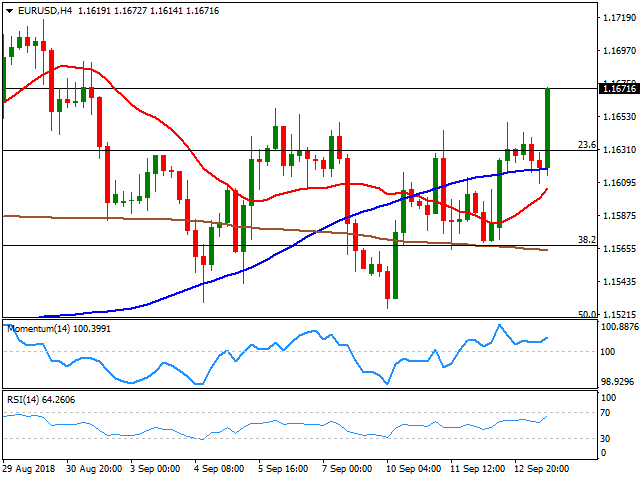
The greenback lost ground Wednesday amid lesser demand on for the perceived safe-haven currency, on the back of decreasing concerns about the trade war between the US and China. The EUR/USD pair peaked at 1.1649 but retreated below a key Fibonacci resistance, entering wait-and-see mode ahead of first tier events. The first one was the ECB that left rates unchanged as expected as largely anticipated, and just now was the turn of US August inflation. According to the official report, core CPI rose 0,1% missing the expected 0.2%, while the annual reading also disappointed, printing 2.2% vs. the expected and previous 2.4%. Weekly unemployment claims for the week to September 7 came in at 204K beating expectations of 210K, while the previous week figure was revised to 205K from 203K, anyway offset by poor inflation figures. The pair peaked on the header, as for ECB's President begins its statement.

The central bank has revised lower its GDP forecast for this year and the next ones, keeping inflation forecast unchanged. In the statement, Draghi expressed concerns about the effects of protectionism measures and repeated that the monetary policy will remain accommodative, even after assets purchases stop.

As the Q&A goes on, the pair trades at fresh weekly highs around 1.1660, finally breaking through the 23.6% retracement of August rally, and with room to extend gains up to that monthly high of 1.1733, particularly if intraday retracements meet buying interest in the 1.1630 region. In the 4 hours chart, the upward momentum is building, with a long candle developing above still directionless moving averages, and technical indicators advancing after a period of consolidation right above their midlines.

Support levels: 1.1635 1.1600 1.1570 1.1530  

Resistance levels: 1.1690 1.1730 1.1770

View Live chart for the EUR/USD

Author

Valeria Bednarik

Valeria Bednarik was born and lives in Buenos Aires, Argentina. Her passion for math and numbers pushed her into studying economics in her younger years.


More from Valeria Bednarik
Share:

Editor's Picks

GBP/USD bounces off lows, back above 1.3200

After bottoming out near 1.3160, GBP/USD manages to regain a bit of shine and reclaim the 1.3200 mark and beyond at the end of the week. Stronger-than-expected UK Retail Sales data seem to be helping the British Pound limit its losses, while the chaotic UK political environment keeps the bulls at bay for now.

EUR/USD looks consolidative around 1.1460

EUR/USD stages a modest rebound after slipping to a three-month low below 1.1420 at the end of the week. That said, the pair now looks to consolidate humble gains just above 1.1460 despite growing uncertainty surrounding the next round of US-Iran negotiations, which keeps the US Dollar’s downside contained.

Gold slips back to six-day lows, targets $4,100

Gold retreats for the third consecutive day on Friday, eroding gains seen in the first half of the week and approaching the key $4,100 mark per troy ounce. Indeed, the precious metal continues to face headwinds from the Fed's hawkish stance and renewed uncertainty surrounding the next round of US-Iran negotiations.

Breaking: Iran closes the Strait of Hormuz amid ceasefire deal violation
Iran says it is closing the Strait of Hormuz after accusing the United States (US) and Israel of violating the ceasefire. According to Iran, the decision came over the continued Israeli strikes in Lebanon. The Iranian Revolutionary Guard Corps Navy issued a warning to all vessels: "Do not approach the Strait of Hormuz; otherwise, your security will be jeopardized."
The Iran war didn't break the US economy, but what happens next?

Nearly four months after the start of the Iran war, the US economy remains remarkably resilient. While the conflict initially triggered a severe disruption to global energy markets and a sharp rise in Oil prices, recent diplomatic progress between Washington and Tehran has eased concerns about a prolonged supply shock.

Regime change: Inside Kevin Warsh's first move to make the Fed unreadable on purpose

The rate did not move. That was the least interesting thing about Kevin Warsh's first meeting in charge of the Fed. The FOMC held its benchmark at 3.50%-3.75% for the fourth straight meeting, exactly as priced, and then the new chair used his first press conference to dismantle the machinery the market has leaned on for a decade.