EUR/USD analysis: EU inflation and political jitters keep the EUR at yearly lows

EUR/USD Current price: 1.1797
- Soft EU inflation and political jitters in Italy undermined the common currency.
- US Treasury yields reached fresh multi-year lows, stabilizing nearby.
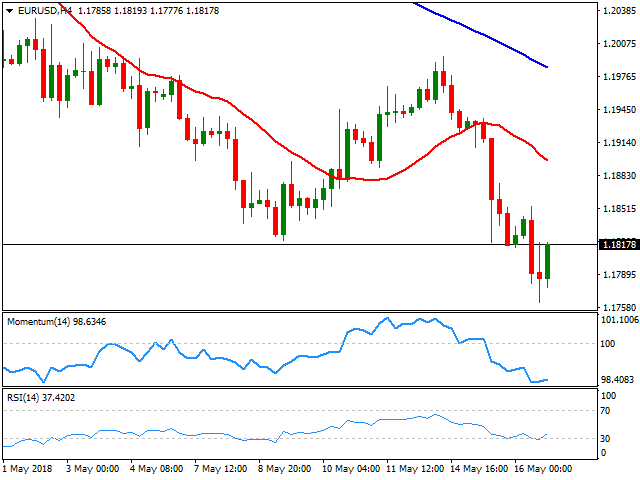
The common currency had quite a bad day, hit by weak core inflation in April and political jitters in Italy, which coupled with persistent dollar's demand to send the EUR/USD pair to a fresh 2018 low of 1.1763. The 5-Star Movement and League, the two Italian parties struggling to form a coalition government, were said to be planning to ask the ECB to forgive €250 billion of Italian debt, although the news was later denied by the League’s economic spokesman. He clarified that they are proposing that debt bought under QE by the ECB does not count in countries’ debt-to-GDP ratios. European inflation came in-line with market's forecast in April, up yearly basis 0.7%, well below ECB's target of close, but below 2.0%. While some analysts believe that this low inflation is due to temporary factors, still indicates a long way ahead before ECB's tightening. US data was mixed, helping the pair correcting higher intraday, although it was unable to advance beyond the 1.1820 level and later resumed its decline. April Housing Starts unexpectedly fell by 3.7%, while Building Permits also shrunk, but by less-than-expected, declining 1.8%. Industrial Production in the same month was 0.7% up although Capacity Utilization grew by less-than-expected, printing 78.0%.
Thursday will be a quieter day in terms of macroeconomic releases, as there are no relevant readings scheduled in Europe, while the US will offer the usual weekly unemployment data and the May Philly Fed Manufacturing Survey. In the meantime, equities shrugged off Tuesday's negative tone, while Treasury yields maintained the bid tone, with the 10-year note yielding 3.10% at one point in the day.
Now trading above the 1.1800 figure, the 4 hours chart indicates that the bearish strength is still strong, as the Momentum barely pared its decline within extreme oversold levels, while the RSI is posting a modest bounce from oversold readings, as the pair is far below all of its moving averages, which present sharp bearish slopes. Still, the short-term candle formation favors an upward correction, that will hardly be enough to revert the dominant bearish trend. Below the daily low, a more relevant support comes at 1.1740, December monthly low, with a break below the level increasing chances of a continued decline toward the 1.1660 region the next relevant support.
Support levels: 1.1765 1.1740 1.1710
Resistance levels: 1.1820 1.1850 1.1880
Author

Valeria Bednarik
FXStreet
Valeria Bednarik was born and lives in Buenos Aires, Argentina. Her passion for math and numbers pushed her into studying economics in her younger years.