|

EUR/USD analysis: ECB´s Nowotny considering reducing QE "significantly"

EUR/USD Current price: 1.2352

  • Hopes about the end of ECB's QE gave the common currency a lift.
  • EUR/USD poised to retest the strong resistance area around 1.2410.
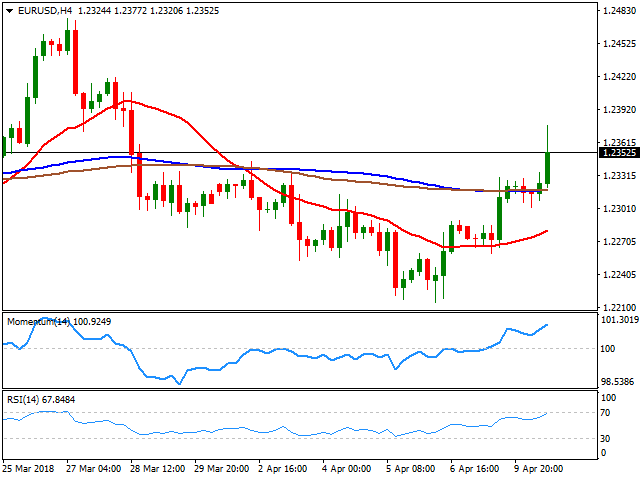
Having traded uneventfully ever since the week started, the EUR/USD pair got a surprise boost this Tuesday from an ECB member, as Nowotny, a member of the Governing Council, said that, while the current bond-purchase program is set to continue until September this year, adding that "we will have to decide in summer what happens next." Furthermore, he said that if the conditions grant it, "we will have the possibility to reduce this programme significantly and head towards an end of the programme.”  The EUR/USD pair jumped to 1.2377, holding now around 1.2350 ahead of the US opening. There were no major news coming from the EU, while the US published its March PPI, up 0.3% MoM and 3.0% YoY, well above market's expectations, yet not enough to trigger dollar's demand. The macroeconomic calendar has nothing more of relevance to offer today.

Technically, the pair's 4 hours chart shows that it has managed to surpass all of its moving averages,  but with the 20 SMA gaining upward traction well below the 100 and 200 SMA, both still directionless and confined to a tight range. Also, technical indicators have accelerated higher, maintaining their bullish slopes at monthly highs and near overbought readings, indicating that the rally could continue, up to the 1.2410 region on a break above the mentioned daily high.

Support levels: 1.2335 1.2300 1.2250

Resistance levels: 1.2380 1.2410 1.2440

View Live Chart for the EUR/USD

Author

Valeria Bednarik

Valeria Bednarik was born and lives in Buenos Aires, Argentina. Her passion for math and numbers pushed her into studying economics in her younger years.


More from Valeria Bednarik
Share:

Editor's Picks

AUD/USD rises to 0.6950 as USD slips on Fed's Warsh

AUD/USD regains traction and extends the bounce toward 0.6950 in the Asian session on Friday. Fed Chair Warsh's comments reinforce the selling pressure on the US Dollar, allowing the pair to stretch higher. Warsh said that he remains committed to delivering price stability without giving away anything on future interest rate path.

USD/JPY falls in symc with USD, gives up 158.00 after Warsh's speech

USD/JPY has come under fresh selling pressure and gives up 158.00 in the Asian session on Friday amid the emergence of fresh US Dollar selling. Fed Chair Warsh's non-committal commentary on the future tightening path, weighs on the US Dollar and the pair.

Gold looks vacillating above $4,150

Gold alternates gains with losses below the key $4,200 mark per troy ounce on Friday. The yellow metal’s irresolute price action comes in response to a modest pullback in the US Dollar and a tepid recovery in US Treasury yields across the board.

Bitcoin steadies at $82,000: The five forces crushing the Uptober rally

Crypto markets have remained under pressure so far in October, with Bitcoin (BTC) sliding below $80,000 earlier this week before recovering to around $82,000 on Friday, as macroeconomic headwinds and cooling demand weigh on the market.

The Fed just got a second hot inflation number. Here's what the diesel signal is really saying
The Federal Reserve (Fed) faces a renewed inflation challenge after two consecutive reports showed price pressure intensifying across the US economy. September's Consumer Price Index (CPI) confirmed accelerating consumer inflation, while the Producer Price Index (PPI) revealed an even sharper rise in business costs. Behind both reports lies a common factor: energy prices.
Everyone's dumping Gold after hot US inflation. Here's why $4,100 could be a floor, not a cliff
Gold (XAU/USD) is recovering from a sharp sell-off triggered by hotter-than-expected United States (US) inflation data released on Wednesday. The precious metal briefly plunged toward $4,073 as investors increased their bets on further Federal Reserve (Fed) interest rate hikes before recovering as US Treasury yields and the US Dollar (USD) reversed their initial gains.














