EUR/USD analysis: bears taking over post-FOMC

EUR/USD Current price: 1.1509
- EU September core annual inflation at 0.9%, weighing on the common currency.
- FOMC's members discussed raising rates above "neutral."
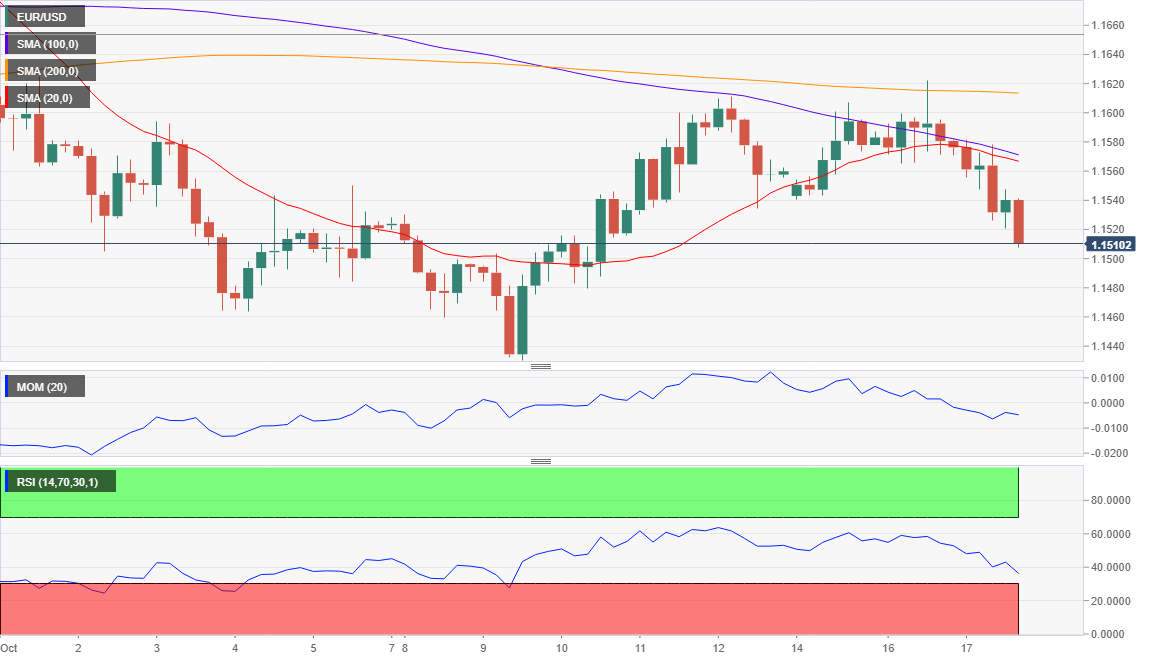
Wednesday was dollar's day, with the American currency strengthening against all of its major rivals since London trading hours. A combination of softer local equities, undermined by political tensions and poor inflation figures in the Old Continent, weighed on European currencies, benefiting the greenback. According to the official release, EU annual CPI was confirmed at 2.1% in September as expected, although the core reading printed 0.9% vs. the expected 1.0%. EU Construction Output was mixed in August, down 0.5% monthly basis, but up 2.5% from a year earlier. The EUR/USD pair fell to 1.1520, during London trading hours, although worse-than-expected US housing data interrupted its run. In September, Housing Starts were down 5.3%, while Building Permits fell by 0.6% against a 3.4% advance expected. Also, MBA Mortgage Applications for the week ended October 12 fell by a whopping 7.1%. The pair extended its decline ahead of the release of US Federal Reserve Minutes of mid-American afternoon, nearing the 1.1500 level as the document showed that some members see the need of raising rates above "neutral," a level currently estimated at 3.0%.
This Thursday, the EU calendar will be quite scarce, with only Germany publishing the Wholesale Price Index for September. The US will release later in the day weekly unemployment data, and the Philly Fed Manufacturing Survey for October, this past seen at 20.0 vs. the previous 22.9.
Bulls have been discouraged after several failed attempts to break above 1.1600, pushing the pair through the lower end of its latest range and a strong support, now resistance, the 23.6% retracement of the 1.1814/1.1431 decline at around 1.1520. In the 4 hours chart, and despite bouncing from such low, the pair is trading below its 20 and 100 SMA, both converging right below the 38.2% retracement of the mentioned decline and with bearish slopes, keeping the risk skewed to the downside. The Momentum indicator in the mentioned chart maintains its bearish slope well below its midline, while the RSI has accelerated his decline, currently at 34 all of which favors a downward extension toward its recent lows in the 1.1430 price zone
Support levels: 1.1490 1.1460 1.1430
Resistance levels: 1.1520 1.1575 1.1620
Author

Valeria Bednarik
FXStreet
Valeria Bednarik was born and lives in Buenos Aires, Argentina. Her passion for math and numbers pushed her into studying economics in her younger years.