EUR/TRY under pressure amidst Euro weakness, tight Turkish policy, and geopolitical risks

Technical overview
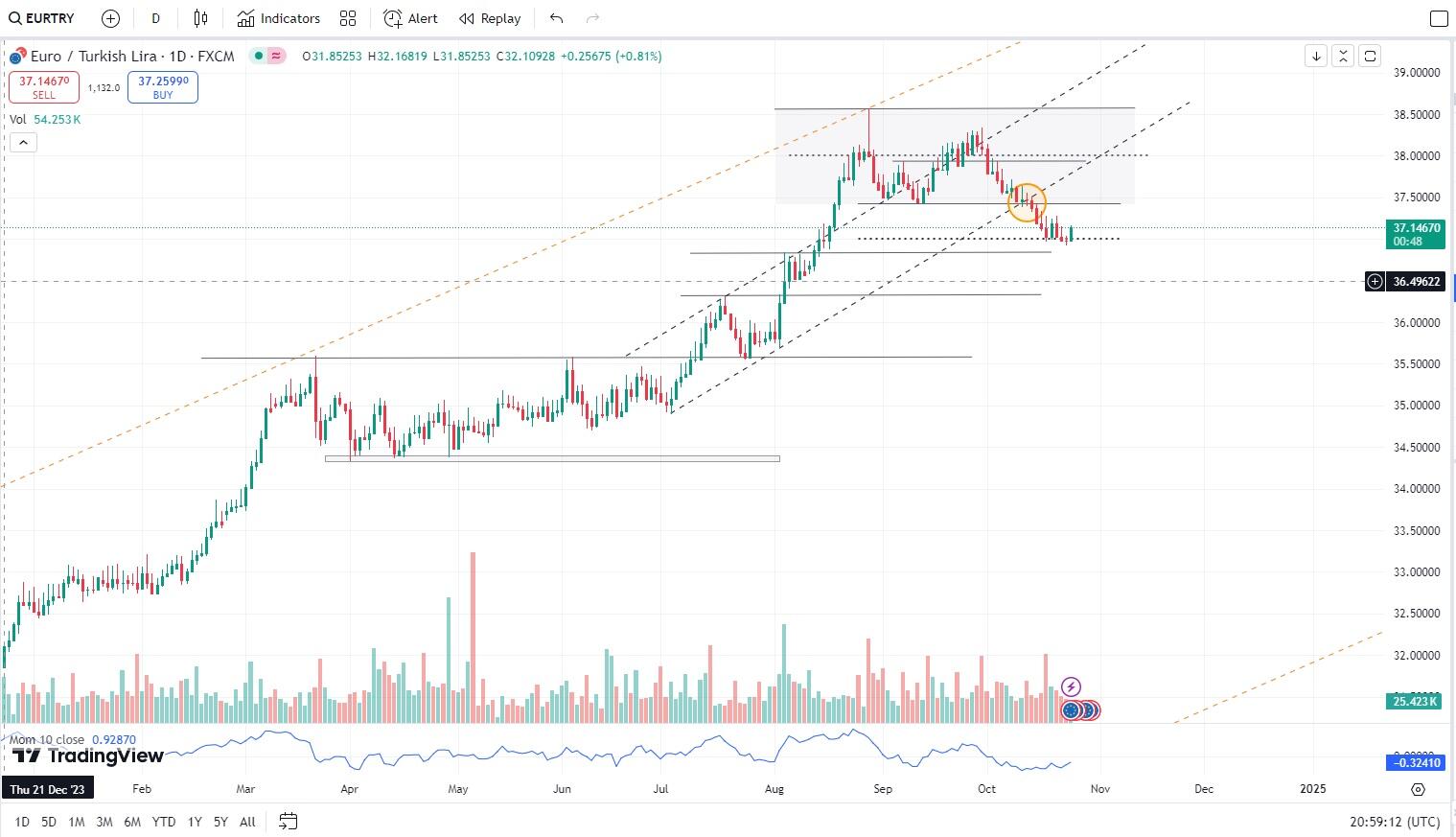
Since the start of October, the EUR/TRY pair has shown weakness, undergoing a slow but steady correction. After surging to an all-time high of 38.567 on August 28, the pair rapidly retraced to the 37.46–37.43 levels, and then hovered around the psychological level of 38. Following a failed attempt to resume the upward trend at the end of September, it finally moved down to the psychological support level of 37.0, retracing more than 4% from its August peak (data from the FXCM trading platform).
If the correction persists, the next significant level is the support around 36.83, followed by 36.30. At the time of writing, EUR/TRY is attempting a reaction and is trading around 37.15. To confirm a reversal, the pair must reclaim the 37.43–37.46 area, which now acts as resistance.
The sideways movement and recent retracement are clearly visible on the daily chart (Image 1), which also shows that the pair has broken the short-term uptrend that began in July. The declining momentum indicator and the sloping RSI confirm the weakness, although the RSI is approaching the oversold threshold.
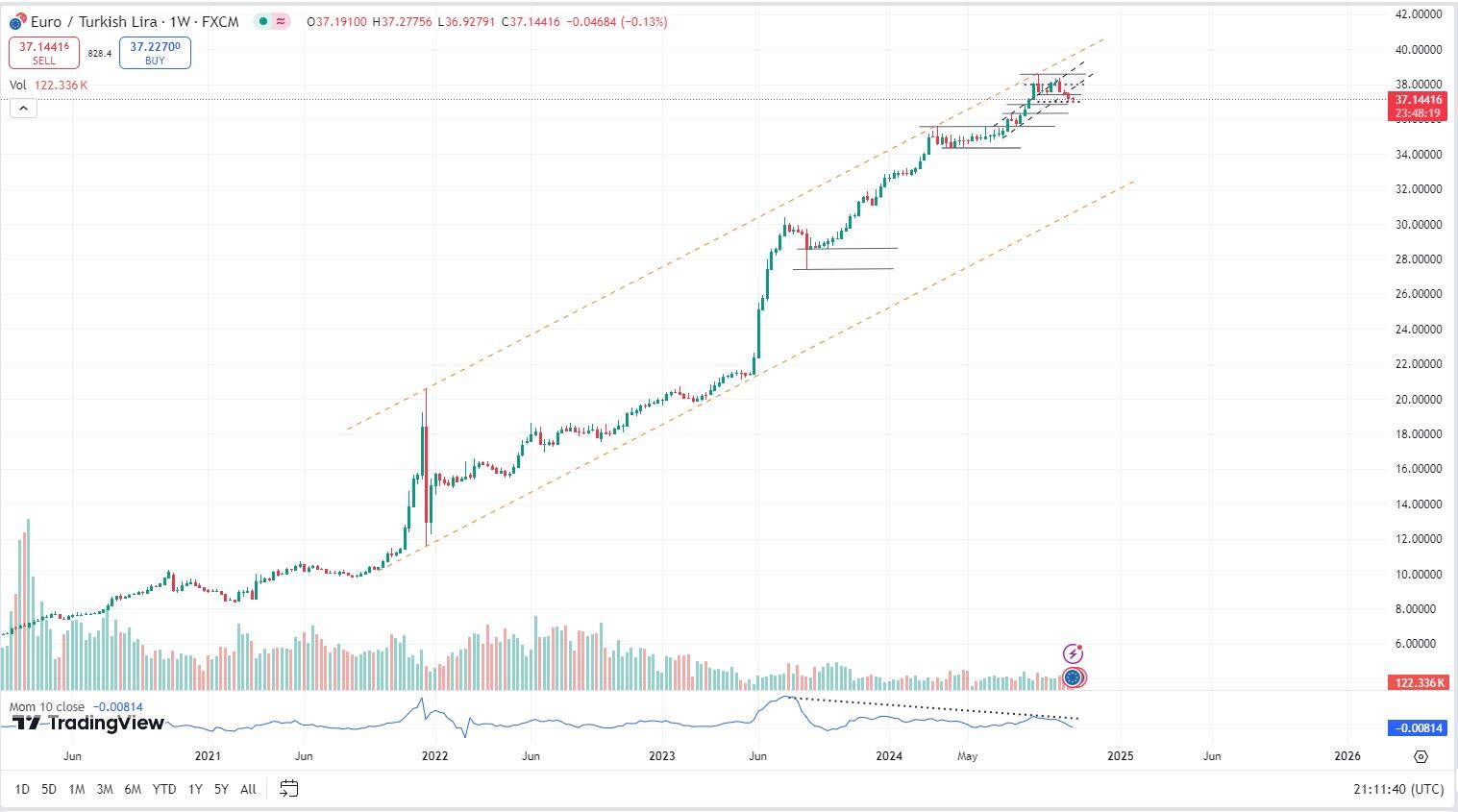
Anyway, the long-term uptrend remains intact, as shown on the weekly chart where the ongoing correction marks the first significant pullback since August 2023. Notably, the weekly momentum chart has been signaling a clear divergence since then.
Fundamental key drivers
The Euro is currently under pressure due to the USD’s strength, which has been supported by several factors: geopolitical tensions in the Middle East, concerns about Taiwan and the Koreas, debates over the scale of upcoming U.S. rate cuts amid a robust economy and strong labor market, and recent fears regarding U.S. inflation resilience. On the EU side, the easing cycle initiated by European authorities coupled with the sluggish economy in the EU countries, is weighing on the Euro.
On the Turkish side, the CBRT kept rates on hold at 50% during the September meeting, maintaining its tight monetary policy to fight hyperinflation and keep the exchange rates under control in order to stabilize the Lira in real terms. The first rate cuts are not expected until January 2025. During an October 3 presentation to the Turkish Parliament, Governor Fatih Karahan highlighted two conditions for rate cuts: a consistent and lasting decline in inflation and inflation expectations converging to the projected range. Despite ongoing improvements, annual inflation remains elevated, with the latest CPI reading at 49.4%, down from 52% the previous month but above the median market expectation of 48.3% (Reuters poll). As to the domestic market expectations, confidence remains weak, with households and corporates still seeing inflation to be around 73% over the next 12 months.
It is also noteworthy that market sentiment toward Turkey has improved significantly over the past year, with domestic and foreign investors increasingly turning to Lira-denominated assets. JPMorgan, for example, remains positive on the Lira and keeps an overweight recommendation on Turkish Lira-denominated bonds.
Conclusions
All these factors are playing a crucial role in moderating the pair’s movements and the recent pullback should be viewed as a short-term correction within a broader uptrend in which sharp accelerations remain unlikely. In the short term, we will monitor whether the pair extends the correction or continues with a sideways consolidation phase. Geopolitical developments remain a significant risk, while the upcoming U.S. presidential election is another factor to watch closely.
Author

Giuseppe Bocci, CTA
Independent Analyst
Giuseppe Bocci is an independent trader primarily active in the U.S. stock market, international bonds, commodities, and forex. He has been trading full-time for about ten years, turning a passion into a profession.

















