|

EUR/GBP Fails to Form a Higher High

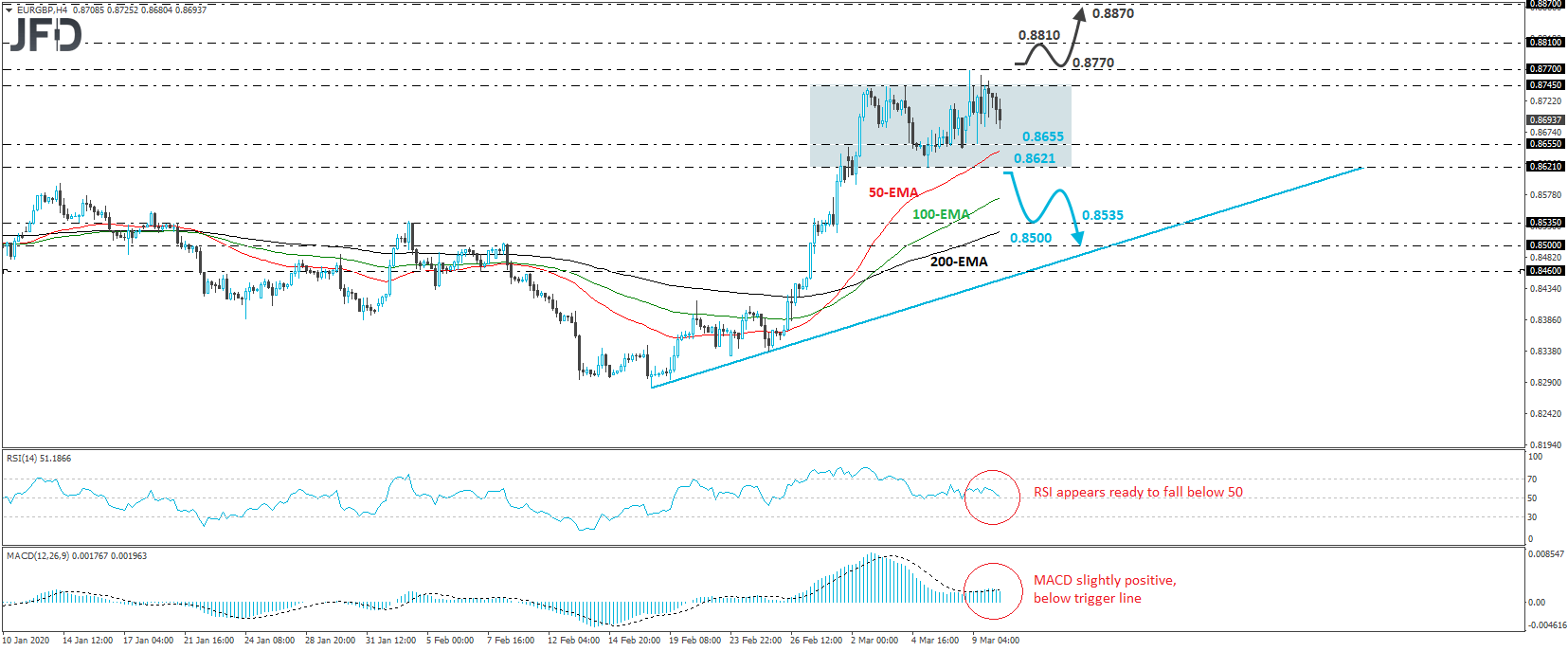
EUR/GBP traded lower on Tuesday, after it failed to clearly overcome the 0.8745 territory, marked by the highs of March 3rd and 4th. The rate traded briefly above that zone yesterday, but the bears were quick to reject the advance and push the pair back below 0.8745. Although EUR/GBP is trading above the short-term upside support line taken from the low of February 18th, due to the failure of the bulls to form a clear higher high, combined with the fact that the rate has distanced itself from the upside line, we will adopt a neutral stance for now.

If the bears are willing to stay in charge for a while more and push the rate below the 0.8621 level, this would signal the completion of a double top formation and may be the start of a deeper correction to the downside. The slide could then get extended towards the 0.8535 zone, the break of which may allow a test near the psychological zone of 0.8500, or the aforementioned upside line.

Shifting attention to our short-term oscillators, we see that the RSI turned down again and looks ready to fall below its 50 line, while the MACD, although slightly positive, lies below its trigger line pointing down. These indicators suggest that the rate may start picking up downside speed soon, which enhances the case for a larger correction in this exchange rate.

In order to start examining whether the prevailing trend is back in force, we would like to see a strong break above 0.8770. Such a move would confirm a forthcoming higher high and may initially pave the way towards the 0.8810 hurdle, marked by the high of October 14th. Another break, above 0.8810, may encourage the bulls to climb towards the peak of October 11th, near the 0.8870 level.
EURGBP

JFDBANK.com - One-stop Multi-asset Experience for Trading and Investment Services


Author

More from JFD Team
Share:

Editor's Picks

GBP/USD softens as Fed rate uncertainty supports US Dollar

GBP/USD edges lower after opening at a bullish gap, remaining within positive territory and trading around 1.3290 during the Asian hours on Tuesday. The currency pair is under pressure as the US Dollar (USD) stabilizes, driven by market caution ahead of the upcoming Federal Reserve policy decision due on Wednesday.

EUR/USD hangs close to monthly lows near 1.1350 on USD strength

EUR/USD is consolidating near the monthly trough, trading near mid-1.1300s in the European morning on Tuesday, undermined by persistent US Dollar demand. Traders seem hesitant and await the outcome of a two-day FOMC policy meeting before placing aggressive directional bets.

Gold sticks to intraday losses below $4,050 as focus remains on FOMC meeting

Gold maintains its offered tone through the Asian session on Tuesday and currently trades just below $4,050, down 0.85% for the day. This follows the previous day's failure to find acceptance above the $4,100 mark and suggests that the path of least resistance for the bullion remains to the downside. 

XRP and XLM extend correction as bearish pressure builds

Ripple and Stellar remain under pressure on Tuesday after losing over 4% and over 5%, respectively, the previous day. In addition, weakening momentum indicators and deteriorating derivatives metrics suggest sellers remain in control, raising the risk of further downside for both altcoins. Derivatives data shows a slight bearish tilt.

Asian stocks including KOSPI slide as AI doubts hit chipmakers
Asian stocks fall sharply on Tuesday as mounting skepticism over the massive financial returns on artificial intelligence spending triggered a widespread sell-off across global semiconductor shares. The tech-driven downturn rippled from Wall Street into Asian markets, while investors shifted toward safety, driving bond prices higher and sending oil lower.
US Dollar mid-year outlook: Exceptional currency, exceptional risks?
The US Dollar enters the second half of 2026 in a markedly different position from a year ago. The King currency has recovered, reflecting persistent US inflation, changing expectations for Fed policy, geopolitical tensions and renewed demand for defensive assets.