ECB Preview: 25bps is not the same as 50bps
- After the RBA and the Fed, it will be the turn of the ECB.
- No doubts about a rate hike, but will it be 25 or 50 basis points?
- EUR/USD: Is a 50 bps rate hike a ticket toward the 200-week SMA?

On Thursday, May 4, the European Central Bank (ECB) will announce its monetary policy decision at 12:15 GMT. Later, at 12:45 GMT, ECB President Christine Lagarde will hold a press conference.
Back in March, the ECB raised interest rates by 50 basis points despite ongoing turmoil in the banking sector. At that moment of uncertainty, the central bank abandoned its forward guidance, not because of falling inflation, but due to uncertainty over how the banking crisis would unfold. The ECB said back then: "The Governing Council is monitoring current market tensions closely and stands ready to respond as necessary to preserve price stability and financial stability in the euro area. The euro area banking sector is resilient, with strong capital and liquidity positions."
The ECB's message was clear: we need to keep raising rates because inflation is too high, and we need to see how the banking shock impacts. We don’t know how financial markets will be in a month.
More than a month later, banking developments are reaching headlines again, but so far, only in the US. Inflation has come down only modestly, and economic growth during the first quarter was minor in the Eurozone. Equity markets have remained resilient; however, many market participants forecast a global recession for the second half of the year, projecting rate cuts from many central banks, including the Federal Reserve (Fed).
Eurozone inflation reaccelerated in April from 6.9% to 7%, giving the hawks at the ECB more arguments for strong action. Core inflation eased from 5.7% to 5.6%, still far from the 2% target. The good news is that food inflation declined for the first time in 18 months. The persistently high inflation warrants more tightening from the ECB, particularly after the Bank Lending Survey showed credit standards continued to tighten during the first quarter, but no faster than in the fourth quarter.
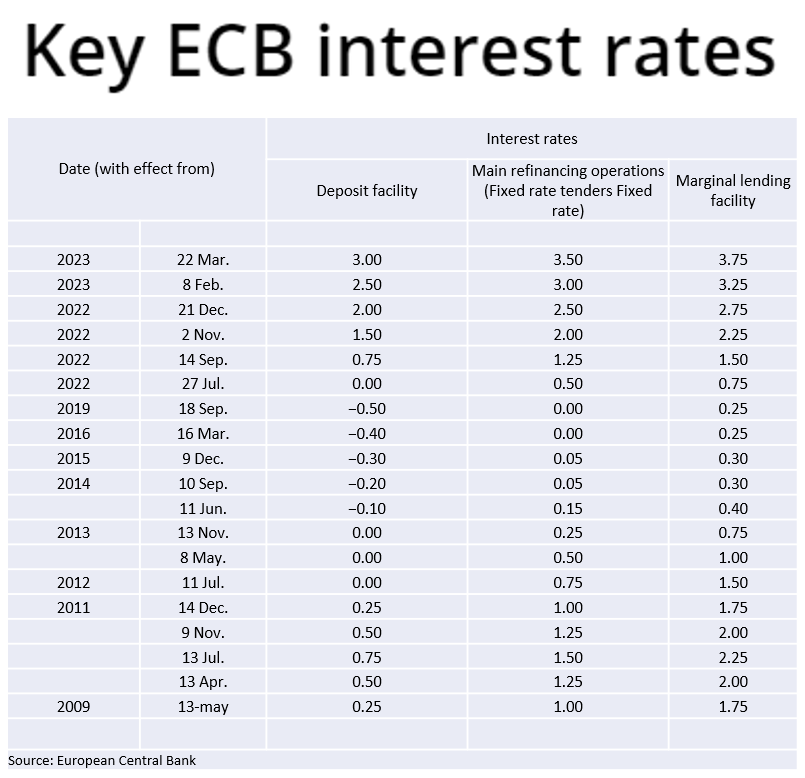
On Thursday, it could be a hawkish 25 bps hike or a dovish 50 bps hike. A new rate hike decision will likely be unanimous, but policymakers will probably differ on the magnitude. The magnitude will be critical for the initial reaction. A 50 bps hike should boost the Euro sharply across the board, while a 25 bps hike could have a mixed impact, depending on what the statement says. The net outcome will depend on the size of the hike and also on what the ECB sees going forward. A cautious hawkish explicit forward guidance seems a likely scenario, which should keep the Euro supported in the short term. A more cautious approach, on the contrary, could weaken the common currency.
EUR/USD: Trend is up
The divergences between a Fed that has stopped raising rates and the ECB that still has work to do on rates have been supporting the EUR/USD. This is partially reflected in the yield spread between US Treasuries and German bunds.
The Euro outperformed this week despite risk aversion. That could continue to be the case, but at some point, the US Dollar could become a safer haven than the euro. However, for Thursday, the risk for Euro bulls is a cautious tone. A hawkish 25 bps or a 50 bps hike could trigger more gains in EUR/USD. However, it is the Federal Open Market Committee (FOMC) on Wednesday and the jobs report (NFP) on Friday, events that would add noise to price action.
A push higher in the EUR/USD could take the pair toward the 200-week Simple Moving Average (SMA), which awaits at the 1.1200 area. The last time the pair traded above this line was back in October 2018. On the contrary, at 1.0900 is the 100-week SMA; a close below would point to a deeper correction, probably to the 20-week SMA at 1.0780.
-638187261416392233.png)
Author

Matías Salord
FXStreet
Matías started in financial markets in 2008, after graduating in Economics. He was trained in chart analysis and then became an educator. He also studied Journalism. He started writing analyses for specialized websites before joining FXStreet.