|

Earnings season begins as Middle East tensions re-escalate

Last week ended with SK Hynix making history with a record debut in US trading for a foreign company. The stock rallied 13% on Friday as investors rushed to buy one of the hottest stocks of the moment on a US exchange, mainly because, even after last year's more than 1’700% rally, SK Hynix remains cheaper than some of its US peers. Its PE ratio stands near 18, versus Micron's, which currently trades at around 22.

Unfortunately, SK Hynix is down by more than 13% in Korea. From a technical perspective, it is now preparing to test a critical Fibonacci support level: the major 38.2% retracement of the April 2025 to June 2026 rally. This level should distinguish between a continuation of the positive trend and a medium-term bearish consolidation phase, which would point to a deeper downside correction.
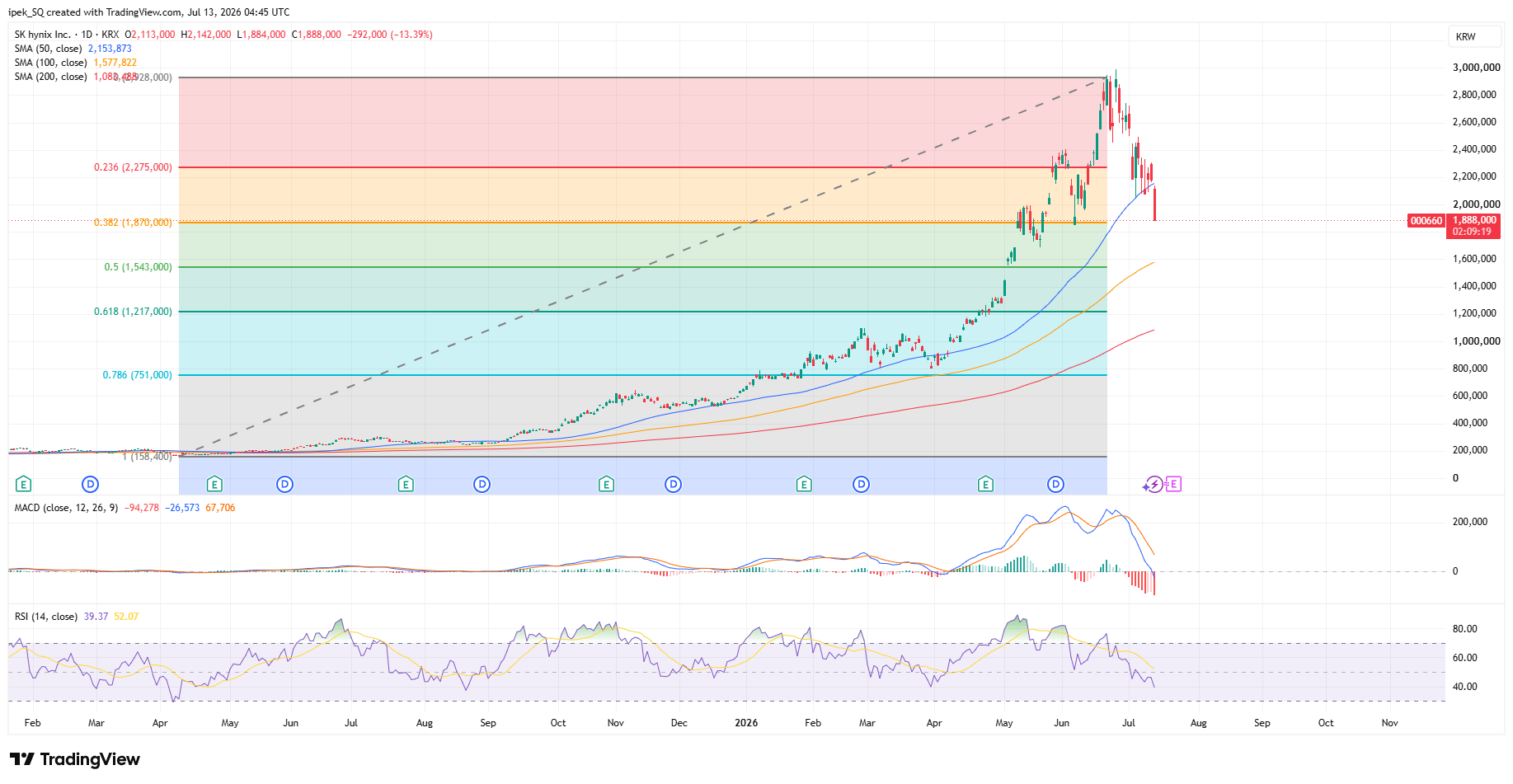
Chart

The reason why this stock, along with other memory chip makers, has gone parabolic is that AI demand has somehow created the perception that a sector historically defined by boom-and-bust cycles could remain permanently in the boom phase. SK Hynix, since we're talking about the company, is planning to double its production capacity over the next five years to keep up with demand. The company's CEO says they would ideally need to increase capacity four- or five-fold, but he also admits that "he doesn't know" what the coming years will bring. Technological breakthroughs, more efficient AI models or simply a slowdown in AI infrastructure investment could quickly turn the market into one of oversupply.


Read the full article here.

Author

Ipek Ozkardeskaya

Ipek Ozkardeskaya began her financial career in 2010 in the structured products desk of the Swiss Banque Cantonale Vaudoise. She worked in HSBC Private Bank in Geneva in relation to high and ultra-high-net-worth clients.


More from Ipek Ozkardeskaya
Share:

Editor's Picks

GBP/USD holds losses below 1.3400 amid escalating US-Iran tensions

GBP/USD finds some support near 1.3370 after a modest gap-down opening, though it lacks bullish conviction and remains below 1.3400. The pair suffers from a return of haven demand for the US Dollar amid renewed US-Iran military attacks and the resultant closure of the Strait of Hormuz. All eyes remain on Mideast updates and central bank talks.


EUR/USD battles 1.1400 amid USD strength, Iran risks

EUR/USD stays defensively close to 1.1400 in European trading on Monday. The pair faces headwinds as the US Dollar starts the week on a strong note on increased safe-haven appeal, following the weekend escalation between the US and Iran. However, hawkish ECB expectations limit the major's downside ahead of speeches from the Fed and ECB policymakers.

Gold seems vulnerable amid Iran risks reviving inflation fears, Fed hike bets

Gold maintains its offered tone through the Asian session, and currently trades just above $4,050, down nearly 1.40% for the day. A further escalation of tensions between the US and Iran, along with the closure of the Strait of Hormuz, lifts crude oil prices and revives inflation fears. This, in turn, bolsters expectations of higher interest rates by the US Federal Reserve, which benefits the safe-haven US Dollar, and drives flows away from the bullion.

Cardano: Ongoing whale accumulation fails to halt downward  correction

Cardano (ADA) extends its losses, trading below $$0.160 after falling over 14% in the previous week. Despite on-chain data showing continued accumulation by whales, the buying activity has failed to lift prices. Meanwhile, bearish derivatives metrics and a weakening technical outlook indicate further downside for ADA.

The US won't default on $39 trillion debt: Why financial repression is coming and Gold is the only hedge
As the US national debt surges past $39 trillion, policymakers face an unsustainable economic trajectory that threatens the global financial system. With a formal default out of the question and fiscal austerity politically unfeasible, the US government is increasingly likely to rely on financial repression, artificially keeping interest rates below inflation to erode the real value of its debt.
Five sessions, one round trip: Why the whipsaw is exactly what Warsh ordered

Markets opened July with a December hike as the base case and spent five trading sessions unlearning and relearning it. A 57K payrolls print bled the tightening bets out of the strip; a re-shut Strait of Hormuz is pushing them back in. Wednesday's minutes from the June FOMC meeting landed mid-round-trip, describing a world that had already stopped existing.














