Durable Goods Orders Preview: Why expectations could be too high, data useful for trading GDP
- Economists expect Durable Goods Orders to have risen in June after advancing in May.
- Misses in most previous core orders releases and downbeat figures in June point to a disappointment.
- The data is useful ahead of Thursday's growth figures.

A high bar makes failure to cross it more likely – also when it comes to economic indicators. That may provide an opportunity to sell the dollar in response to Durable Goods Orders due out on Tuesday, and better still, to prepare for Thursday's Gross Domestic Product figures.
Reasons to lower expectations
Investment has substantially picked up as the pandemic shock faded away. Thanks to robust fiscal and monetary stimulus, it has even exceeded pre-crisis levels, as Durable Goods Orders figures from the past year have shown. However, it seems that economists have been overestimating them in recent months.
Headline orders are skewed by government defense contracts, and both investors and the Federal Reserve focus on Nondefense Ex-Air Orders – aka "core of the core."
After many successful months of beating estimates in 2020, the consensus was above expectations in all but one reads so far in 2021:
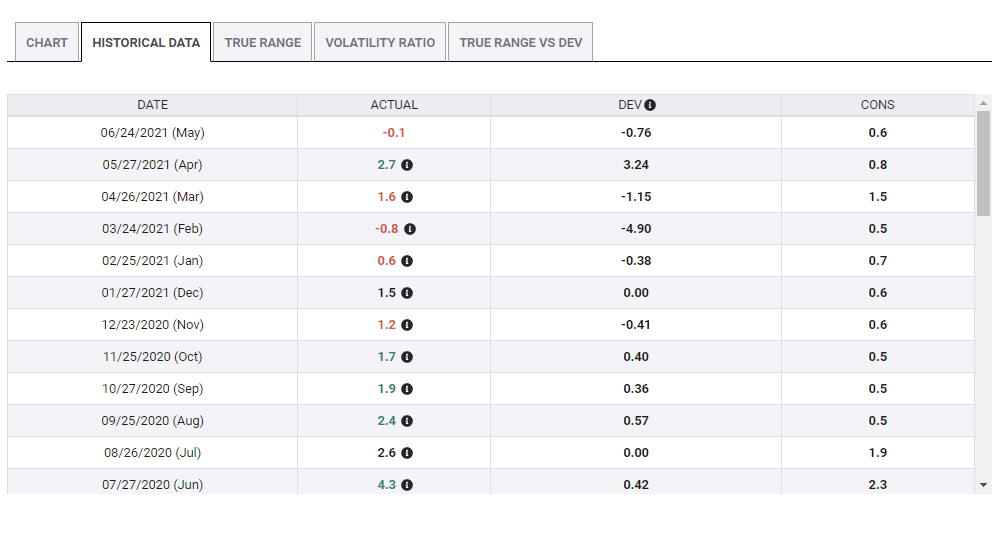
Source: FXStreet
Apart from economists' too rosy record for Durables in 2021, they have missed the slowdown in June. New Home Stales statistics for last month came out at 676,000 vs. 800,000 projected – and were only the latest to miss the mark. Consumer and business surveys such as the Purchasing Managers' Indexes also disappointed.
One of the reasons for these shortfalls was a shortage of both materials and workers. The rapid reopening resulted in robust demand that was hard to match and that is a story that played out over and over again. It is hard to see why Durables would be the exception and beat forecasts – It takes time for the consensus to move.
Market reaction
The economic calendar is pointing to an increase of 2.3% in headline orders and 0.5% in the Nondefense Ex-Air. If the numbers indeed miss expectations, and especially the latter one – the dollar has room to fall. However, as the greenback is a safe-haven currency, its slide would be more pronounced against the yen, another source of calm in times of trouble.
Nevertheless, volatility could be muted as the publication on Tuesday comes just one day before the Federal Reserve's all-important meeting. Markets will likely be on edge ahead of Fed Chair Jerome Powell's hints about the bank's bond-buying scheme. Unless Durables are shockingly high or low, the Fed will probably be unmoved – and so will the dollar.
That means any knee-jerk reaction to Tuesday's publication is set to be limited – and potentially reversed in short order. Beyond the Fed, there is room for a more significant in response to another top-tier event – the first release of GDP data for the second quarter of the year.
If investment figures indeed miss expectations, it would imply somewhat slower growth than estimated. Investors may factor in weaker GDP, while economists are not asked for updated forecasts. In case Durables fall short, real GDP expectations would be revised down, leaving room for a positive surprise. That is a calculation for another day.
Conclusion
Estimates for Durable Goods Orders are likely too high, as past misses on this release and disappointments in other figures for June allude to. The market reaction will likely be muted ahead of the Fed – apart from a minor mean-reversion – but the data would be useful for trading GDP on Thursday.
Analyzing inter-market correlations to see if reflation trade is coming to an end – July 2021
Author

Yohay Elam
FXStreet
Yohay is in Forex since 2008 when he founded Forex Crunch, a blog crafted in his free time that turned into a fully-fledged currency website later sold to Finixio.