Dollar softness, Euro resilience, and Sterling at a crossroads

This week’s FX landscape is being shaped by trade policy shifts, fiscal concerns, geopolitical uncertainty, and key central bank communication. Rather than focusing on a single “chart of the day,” we’re stepping back and highlighting the Charts of the Week—the US dollar, the euro, and sterling—through both macro and technical lenses.
USD: Uncertainty does not help the Dollar
The US dollar has started the week on the softer side. While markets initially reacted positively to the absence of a US military strike on Iran over the weekend, broader uncertainty continues to weigh on sentiment.
Trade policy repricing
The introduction of a 15% Section 122 import surcharge has shifted the global trade landscape. Unlike the previous IEEPA regime with varying tariff levels, this flat surcharge changes the calculus for major trading partners:
- China and Brazil could see relatively lower tariff burdens.
- The UK and Australia lose the edge from previously negotiated 10% arrangements.
- The EU remains a central focus as trade terms are reassessed.
US equity futures are down around 0.6–0.7% overnight, reflecting investor caution. While equities initially bounced, businesses face limited immediate relief from tariff pressures.
Fiscal concerns and treasury risk
One of the cleaner market reactions discussed last week was the potential for US Treasuries to weaken on fiscal concerns. With Asia holidays limiting overnight Treasury price action, FX markets may take direction from bond moves later today.
There is a non-negligible risk of a synchronized sell-off in:
- Treasuries.
- Equities.
- The dollar.
Should investors conclude that a core pillar of Washington’s economic framework is weakening, dollar softness could accelerate.
Data and event risk
After a soft 4Q25 US GDP print, the calendar this week includes:
- Consumer Confidence (Tuesday).
- PPI (Friday).
- President Trump’s State of the Union.
- Nvidia 4Q25 earnings.
- Fed Governor Christopher Waller speech (2:00pm CET).
Waller voted for a 25bp cut in January. If he reiterates a dovish, precautionary stance due to labor market risks, it reinforces dollar softness. However, any less-dovish tone could spark a short-covering bounce.
For now, DXY appears biased lower within a 97.00–98.00 range, though geopolitical risk around Iran may limit aggressive USD selling.
EUR: Defensive gains with technical structure in focus
The euro is quietly edging higher. Even though Friday’s risk rally faded, EUR/USD has shown resilience. The narrative appears to be shifting toward stabilization rather than deterioration in EU trade conditions.
Macro backdrop
- The EU may not receive a worse trade deal than currently priced.
- European exporters have largely adapted to existing tariff conditions.
- Eurozone business sentiment continues to improve.
- The German Ifo survey is expected to show a modest uptick in expectations.
However, a strong upside surprise—toward 91.5 in the expectations component—would likely be required to drive a more decisive EUR breakout.
If US assets soften further, capital may rotate into the euro as the most liquid alternative to the dollar.
EUR/USD – Technical overview
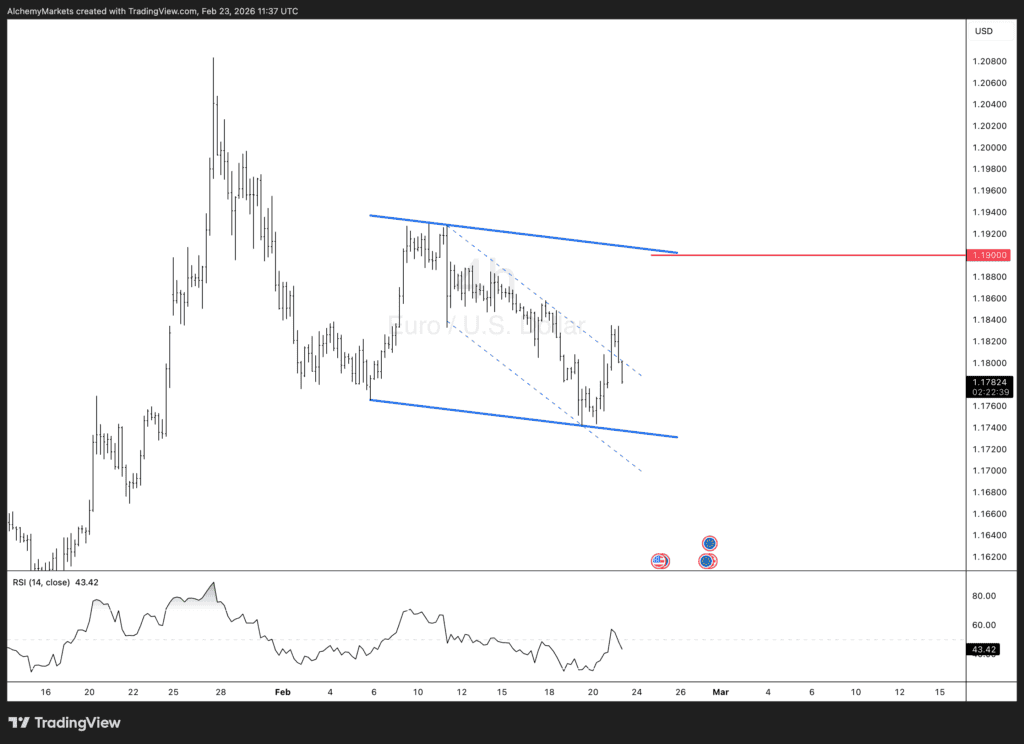
From a technical perspective:
- Price action has been contained within a descending wedge.
- The pair recently bounced from the lower boundary.
- RSI (14) sits near the mid-40s, suggesting neutral momentum with room to recover.
- Immediate resistance sits near 1.1850–1.1880.
- A move toward 1.1900 is possible, but a sustained break looks premature given geopolitical risks.
The broader structure still shows lower highs, meaning bulls must clear 1.1900 convincingly to shift medium-term momentum.
For now, EUR/USD looks like it can grind higher—but without strong acceleration.
GBP: Sterling faces political and policy crosscurrents
Sterling’s outlook this week is shaped by both monetary and political developments.
BoE communication risk
Two key figures—Governor Andrew Bailey and Megan Greene—testify before the Treasury committee.
Markets currently price roughly a 20bp move for March. Any signal that they are leaning toward a 25bp cut could:
- Firm expectations of easing.
- Apply fresh pressure to sterling.
- Push EUR/GBP higher.
Political event risk
Thursday’s UK by-election in Gorton and Denton adds another layer of uncertainty. A heavy defeat for the ruling Labour Party could:
- Reignite leadership speculation.
- Increase political risk premium.
- Weigh on GBP.
EUR/GBP – Technical overview
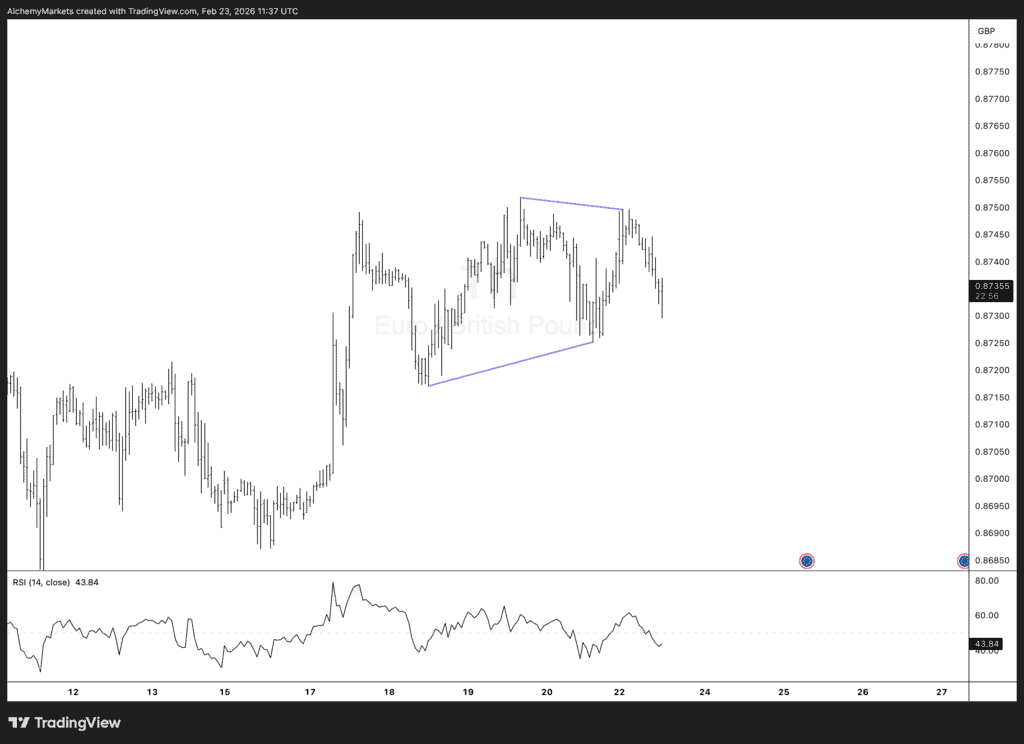
Technically, EUR/GBP has been forming a tight consolidation triangle:
- A narrowing wedge-like pattern has developed.
- Price recently broke lower from the upper boundary.
- RSI hovers near 43–44, indicating mild bearish momentum but not oversold.
Key levels:
- Resistance: 0.8750
- Support: 0.8720
- Broader target: 0.8800 if sterling weakens on event risk
While the recent move shows some short-term EUR pullback, the macro backdrop suggests upside risk toward 0.88 into week’s end, especially if BoE commentary leans dovish or political risk intensifies.
Final thoughts: Positioning for the week ahead
This week’s charts highlight a common theme—uncertainty favors relative over absolute moves.
- The dollar is vulnerable to fiscal and trade concerns but supported by geopolitical caution.
- The euro is benefiting defensively from improving sentiment and dollar softness.
- The pound faces a delicate balance between dovish BoE signals and political developments.
Rather than explosive breakouts, markets appear set for tactical moves within defined ranges:
- DXY: 97–98.
- EUR/USD: 1.1850–1.1900 cap.
- EUR/GBP: bias toward 0.88.
In short, this isn’t just a chart of the day. It’s a week defined by crosscurrents—where macro themes and technical structures are tightly intertwined.
Author

Zorrays Junaid
Alchemy Markets
Zorrays Junaid has extensive combined experience in the financial markets as a portfolio manager and trading coach. More recently, he is an Analyst with Alchemy Markets, and has contributed to DailyFX and Elliott Wave Forecast in the past.
















